
Highlights
- China's MIIT Minister met Saudi Arabia's communications minister in Beijing to discuss AI, cloud computing, and subsea cable cooperation under Vision 2030.
- No commercial agreements were signed, but the meeting signals strategic intent to expand Chinese investment in Saudi digital infrastructure.
- Subsea cable networks are emerging as critical geopolitical assets, with the US scrutinizing Chinese involvement in global telecommunications projects.
- Saudi Arabia is pursuing a multi-aligned tech strategy, courting both American semiconductors and Chinese digital infrastructure partnerships.
- The meeting reflects the broader Great Powers Era 2.0 dynamic where control of enabling digital infrastructure rivals traditional resource competition.
Are Beijing and Riyadh elevating digital cooperation? China's Minister of Industry and Information Technology Li Lecheng met with Saudi Arabia's Minister of Communications and Information Technology Abdullah Alswaha in Beijing on July 14, signaling both governments' intent to deepen cooperation in artificial intelligence, digital infrastructure, cloud computing, and subsea communications cables.
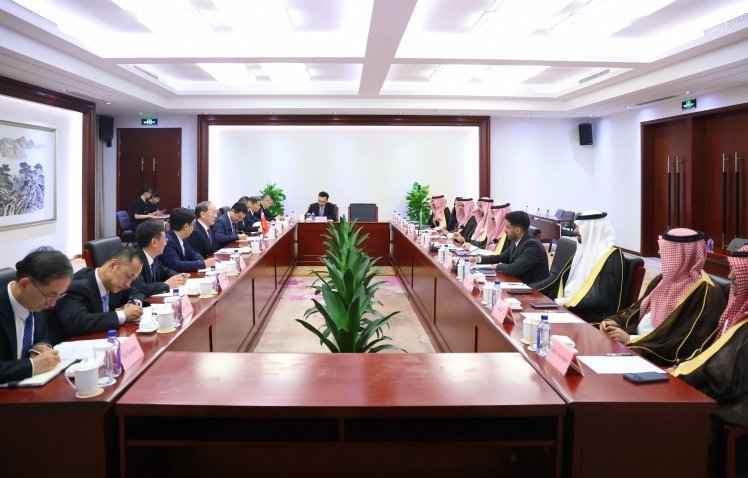
Li said China's Ministry of Industry and Information Technology (MIIT) is prepared to expand policy dialogue with Saudi Arabia, leverage the complementary strengths of both countries' technology sectors, and encourage practical commercial cooperation between Chinese and Saudi enterprises. Alswaha welcomed additional Chinese investment and specifically highlighted submarine cable infrastructure, cloud computing, talent development, and digital capacity building as priority areas for future collaboration.
Officials from MIIT, affiliated institutions, Saudi government agencies, and the Saudi Embassy in Beijing participated in the meeting.
No Commercial Agreement—But a Strategic Signal
The announcement includes no signed agreements, investment commitments, named corporate participants, or implementation timeline. It is therefore better viewed as a strategic policy signal than a commercial breakthrough.
Nevertheless, the sectors emphasized are significant. Saudi Arabia continues pursuing its Vision 2030 strategy to become a regional hub for AI, cloud computing, hyperscale data centers, and digital services. China, meanwhile, has developed globally competitive telecommunications equipment manufacturers, cloud providers, AI developers, and digital infrastructure companies seeking overseas growth.
Should policy discussions translate into commercial agreements, Chinese firms could expand their role across Saudi data centers, sovereign cloud infrastructure, digital workforce development, and next-generation connectivity.
Subsea cable cooperation is particularly noteworthy. These networks have become increasingly strategic infrastructure as geopolitical tensions, maritime security concerns, and cyber risks reshape global communications. For Saudi Arabia, resilient international connectivity is becoming as important as energy infrastructure itself.
Great Powers Era 2.0 Extends Beneath the Waves
Under the REEx Great Powers Era 2.0 framework, strategic competition increasingly revolves around control of enabling infrastructure—not simply commodities, factories, or shipping routes.
Artificial intelligence requires computing infrastructure. Computing requires cloud platforms, data centers, semiconductor supply chains, and secure international fiber connectivity. Undersea cables have therefore become strategic assets that influence economic resilience, digital sovereignty, and geopolitical influence.
The United States has increasingly viewed Chinese participation in global telecommunications and subsea cable projects through a national security lens, while Beijing argues such restrictions politicize commercial infrastructure.
For investors and policymakers, the broader message is clear: Saudi Arabia continues pursuing a multi-aligned technology strategy, seeking to attract American capital and advanced semiconductors while simultaneously expanding cooperation with China across selected areas of digital infrastructure.
The key question is no longer whether Beijing and Riyadh intend to cooperate—it is how far that cooperation ultimately extends into critical digital infrastructure.
Disclaimer: This report is based primarily on information released by China's Ministry of Industry and Information Technology and affiliated state media. The announcement reflects the Chinese government's account of the meeting. No commercial agreements were announced, and readers should seek independent confirmation of any future projects or investment commitments.


0 Comments
No replies yet
Loading new replies...
Moderator
Join the full discussion at the Rare Earth Exchanges Forum →