
Highlights
- Barium isotope analysis of the Shitouping deposit in Jiangxi Province shows magma crystallization is the primary driver of heavy rare earth enrichment.
- Deep magmatic fluids play a secondary role, redistributing rare earths into easily weathered minerals that form economically viable ion-adsorption deposits.
- Findings suggest exploration should prioritize identifying highly evolved granitic systems over simply locating hydrothermal fluid evidence.
- The study is limited to a single deposit, and authors caution that broader applicability across other ion-adsorption systems requires further research.
A new study led by Yong-Wen Zhang (opens in a new tab) of the Jiangxi Mineral Resources Guarantee and Service Center, Nanchang, China; Geological Survey and Exploration of Jiangxi Province, Nanchang, China; and East China University of Technology, Nanchang, China, working with researchers from several Chinese academic institutions, offers new evidence explaining how some of the world's richest heavy rare earth (HREE) deposits formed in southern China. Using barium isotope analysis, mineralogy, and whole-rock geochemistry, the team concludes that mineral fractional crystallization—not fluid alteration alone—is the primary process that pre-enriches heavy rare earth elements before weathering creates economically valuable ion-adsorption deposits. The researchers found that deep magmatic fluids remain important, but principally by redistributing rare earth elements into minerals that weather more easily rather than generating the original HREE enrichment. If these findings are confirmed by additional studies, they could influence future exploration strategies for heavy rare earth deposits worldwide.
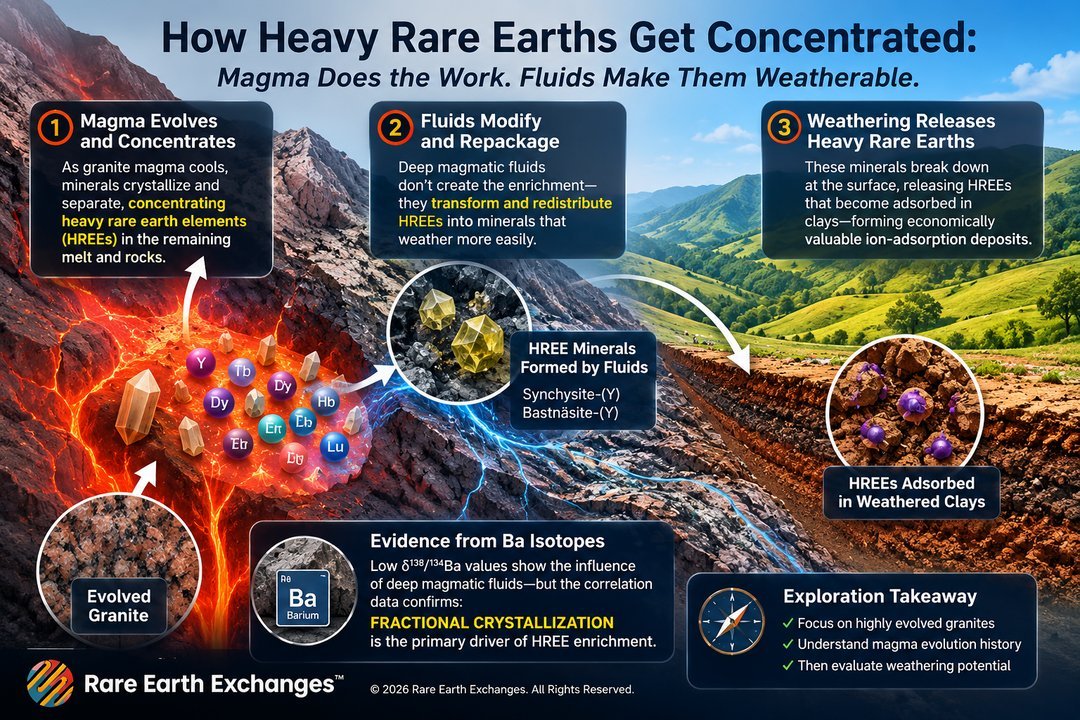
How the Scientists Solved the Puzzle
The researchers investigated the Shitouping heavy rare earth deposit in Jiangxi Province by analyzing three related granite types. They combined mineralogical observations, major and trace element geochemistry, and high-precision barium isotope measurements to determine whether HREE enrichment resulted primarily from magma evolution or from later fluid activity moving through the rocks.
The Key Discovery
The study concludes that fractional crystallization—the natural separation of minerals as magma cools—is the dominant mechanism responsible for concentrating heavy rare earth elements in the original granite. Deep magmatic fluids subsequently altered the rocks, producing minerals such as synchysite-(Y) and bastnäsite-(Y) that weather more readily and ultimately release heavy rare earths into today's ion-adsorption deposits. In short, the magma concentrated the heavy rare earths, while the fluids helped make them economically recoverable.
Why It Matters
For explorers and investors, the findings suggest that identifying highly evolved granitic systems may prove more important than simply identifying evidence of hydrothermal fluids. If confirmed in other deposits, exploration models could increasingly focus on reconstructing a granite's crystallization history before evaluating its weathering potential. Such an approach could improve exploration targeting both within and outside China.
Limitations and What's Next
The study examined a single deposit in southern Jiangxi, so its conclusions may not apply to every ion-adsorption rare earth system. The authors emphasize that fluid processes remain essential for redistributing rare earth elements and forming weathering-prone minerals. They also acknowledge that the broader debate over the origin of heavy rare earth enrichment is not settled and that additional studies across other deposits will be needed to determine whether this model applies more generally.
| Author | Institution(s) |
|---|---|
| Yong-Wen Zhang | Jiangxi Mineral Resources Guarantee and Service Center, Nanchang, China; Geological Survey and Exploration of Jiangxi Province, Nanchang, China; East China University of Technology, Nanchang, China |
| Xian-Guang Wang | Jiangxi Mineral Resources Guarantee and Service Center, Nanchang, China; East China University of Technology, Nanchang, China |
| Hong-Rui Fan | Institute of Geology and Geophysics, Chinese Academy of Sciences, Beijing, China; College of Earth and Planetary Science, University of Chinese Academy of Sciences, Beijing, China |
| Fang Huang | School of Earth and Space Sciences, University of Science and Technology of China, Hefei, Anhui, China |
| Fa-Sheng Lou | Geological Survey and Exploration of Jiangxi Province, Nanchang, China |
| Ming-Xuan Cao | Geological Survey and Exploration of Jiangxi Province, Nanchang, China |
| De-Fu Zhang | East China University of Technology, Nanchang, China |
| Geng-Xin Deng | School of Earth and Space Sciences, University of Science and Technology of China, Hefei, Anhui, China |
| Liang-Xin Gong | Geological Survey and Exploration of Jiangxi Province, Nanchang, China |
| Xin Li | School of Earth and Space Sciences, University of Science and Technology of China, Hefei, Anhui, China |
Citation: Zhang, Y.-W., Wang, X.-G., Fan, H.-R., et al. (2026). Key factors controlling the pre-enrichment of heavy rare earth elements in the Shitouping ion-adsorption type deposit, southern Jiangxi: Evidence from Ba isotopes. Ore
Geology Reviews, 194, 107333. https://doi.org/10.1016/j.oregeorev.2026.107333 (opens in a new tab)


0 Comments
No replies yet
Loading new replies...
Moderator
Join the full discussion at the Rare Earth Exchanges Forum →