
Highlights
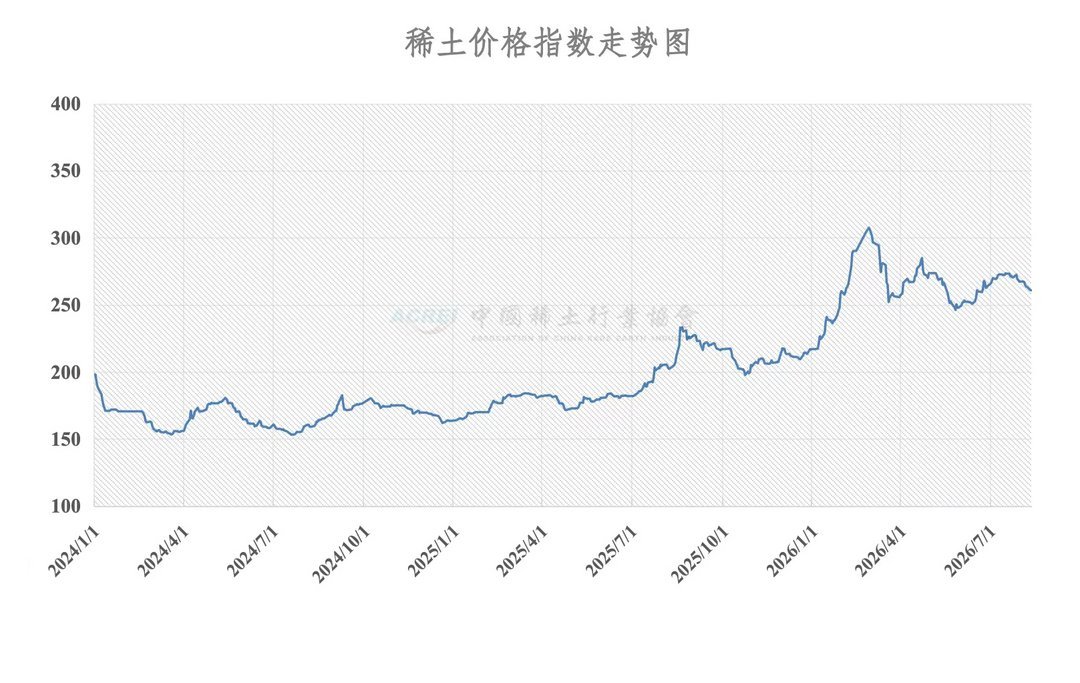
- China's August 11 Rare Earth Price Index hit 260.8, with terbium oxide at ~$990–999/kg domestically versus $3,625–4,500/kg reported outside China.
- Ex-China heavy rare earth prices for dysprosium and terbium have risen roughly four- to five-fold since China's April 2025 export controls, with yttrium surging ~140-fold.
- Pentagon-backed contracts with MP Materials and Serra Verde establish price floors—$110/kg for NdPr, $575/kg for dysprosium, $2,050/kg for terbium—signaling governments are pricing supply-chain security.
- Chinese domestic quotations, third-party assessments, and government contract floors represent distinct classes of pricing information and should not be treated as interchangeable market prices.
China’s Rare Earth Industry Association reported its Rare Earth Price Index at 260.8 on August 11, 2026, based on transaction data supplied by domestic rare-earth enterprises. Its accompanying reference sheet put NdPr oxide at RMB714.9–734.9/kg, dysprosium oxide at RMB1,365–1,405/kg and terbium oxide at RMB6,600–6,660/kg. Those are legitimate Chinese domestic reference prices. They increasingly tell Western buyers much less about what qualified material outside China actually costs, however—or whether it can be obtained at all. The association itself describes the index as a reference calculated from domestic transaction data, not an investment benchmark. An entire separate and apart pricing index forms for outside of China.
REEx Insight | There Is No Single Rare-Earth “Market Price”
Rare earths increasingly inhabit two pricing universes. China’s domestic market is shaped by production controls, export licensing, industrial consolidation, state-owned enterprises and national-security policy. Those forces do not make Chinese prices fictitious, but they mean the quotations should not be confused with the continuous, transparent global price discovery associated with commodities such as copper or gold.
Outside China, the problem is almost the reverse: too little liquidity and transparency. Transactions are commonly bilateral, confidential and specification-dependent. Numerous so-called pricing agencies have begun publishing dedicated European and North American rare-earth oxide assessments, describing heavy-rare-earth spot activity as sporadic.
The Two-Price Rare-Earth Market
USD conversions use REEx’s requested working rate of RMB1 = US$0.15, not the prevailing foreign-exchange rate.
| Strategic product | China Aug. 11 reference | China US$/kg | Indicative ex-China evidence | REEx scarcity read |
|---|---|---|---|---|
| NdPr oxide | ¥714.9–734.9/kg | $107–110 | ~$110–125+ | Most mature of these ex-China markets. The Pentagon’s $110/kg MP Materials floor is contract-specific, not an industry price. Chinese NdPr reached about $123/kg earlier in 2026. |
| NdPr alloy | ¥872–892/kg | $131–134 | Bespoke / thin | Alloy composition, provenance and customer qualification make standardized comparisons difficult. |
| Dysprosium oxide | ¥1,365–1,405/kg | $205–211 | $575 floor; ~$800–1,450 reported/assessed stress levels | Serra Verde’s $575 is a contractual floor, not spot. Europe at $800/kg; other 2026 market reporting cited about $1,450/kg under scarcity. |
| Dysprosium metal | ¥1,730–1,750/kg | $260–263 | Highly bespoke | Metal cannot be priced mechanically from oxide; conversion, purity and qualification matter. |
| Terbium oxide | ¥6,600–6,660/kg | $990–999 | $2,050 floor; ~$3,625–4,500+ assessed/reported | $3,625/kg; 2026 market reports reached about $4,500/kg. See Serra Verde price floor below. |
| Terbium metal | ¥8,185–8,285/kg | $1,228–1,243 | Highly bespoke | Physical availability and qualification can outweigh published quotations. |
| Yttrium oxide | ¥58.7–62.7/kg | $8.81–9.41 | ~$1,100–1,575 at severe 2026 scarcity points | CIF North America at $1,575/kg by April 30, versus roughly $10/kg average in China. |
Important: the ex-China column is not a spot-price curve. It combines documented price floors, formal assessments and reported scarcity quotations to demonstrate what buyers have encountered. Geography, purity, product form, volume, qualification, delivery obligations and timing can produce enormous differences.
Washington Is Manufacturing a Market
The Pentagon’s MP Materials agreement establishes a 10-year $110/kg floor for MP’s NdPr products. It does not establish a universal American NdPr price. Serra Verde provides an even more revealing heavy-rare-earth precedent. Its U.S.-backed arrangement includes floors of $575/kg for dysprosium and $2,050/kg for terbium. Again, these are negotiated contractual protections—not market-clearing benchmarks. What they reveal is more important: Western governments are explicitly assigning monetary value to supply-chain security.
Heavies | When Possession Matters More Than Price
The bifurcation is extraordinary. Rare Earth Exchanges® has looked across multiple data points assessing dysprosium oxide CIF Europe at $800/kg and terbium oxide north of $4000/kg in some cases, multiples of Chinese domestic prices. Ex-China dysprosium and terbium prices have risen roughly four- to five-fold after China’s April 2025 controls, while yttrium rose about 140-fold. That is not an ordinary commodity spread. It is increasingly an access premium. A U.S. procurement executive gains little comfort from seeing Dy oxide quoted near $210/kg in China if compliant, qualified material cannot actually be delivered.
REEx Bottom Line | Buyer Beware
For NdPr, policy-backed price floors are beginning to create some Western economic visibility. For Dy, Tb and Y, scarcity can overwhelm conventional pricing altogether. REEx therefore treats Chinese domestic quotations, pricing-agency assessments and government-backed contract floors as different classes of information—not interchangeable definitions of “the price.” In rare earths, provenance, qualification, delivery certainty and geopolitical accessibility can matter as much as the number printed on the screen.
Source qualification: The August 11 index and product quotations originate from the China Rare Earth Industry Association. It is an industry association, not state-owned media. Its own disclaimer says the prices are collected from industry companies for reference. Because the data originate inside China’s heavily state-directed rare-earth ecosystem, REEx believes they should be independently corroborated before major procurement or investment decisions.


0 Comments
No replies yet
Loading new replies...
Moderator
Join the full discussion at the Rare Earth Exchanges Forum →