
Highlights
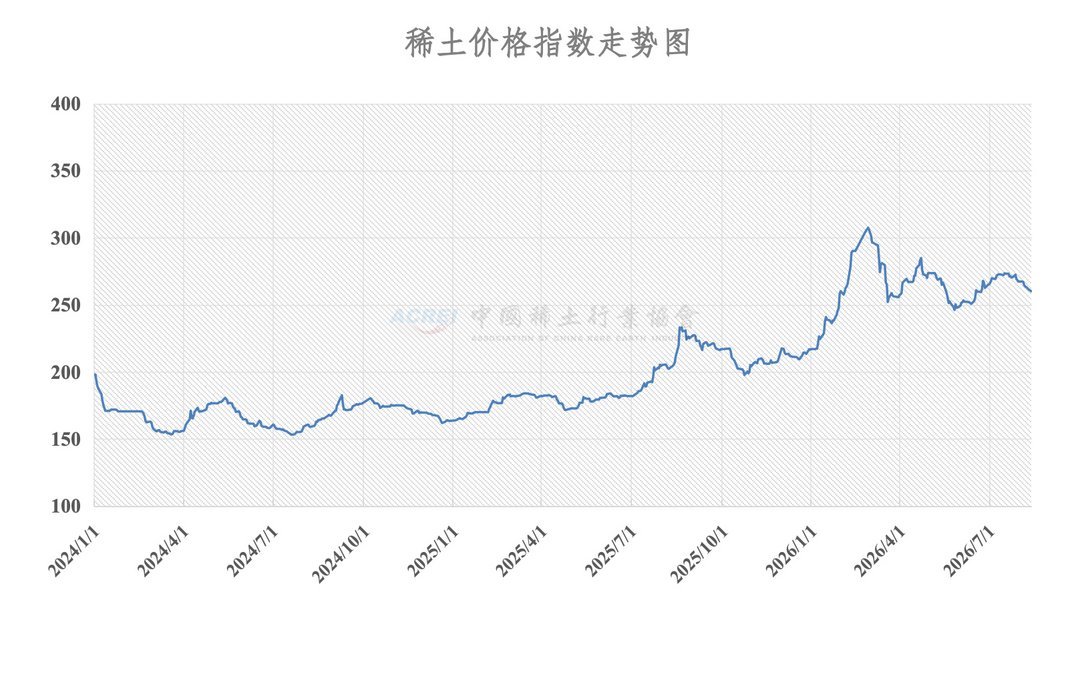
- China's rare earth price index dropped to 260.1 on August 12, 2026, retreating from an early-2026 peak above 300 but remaining well above 2024 levels.
- Dysprosium oxide trades at $204–210/kg inside China but commands $575–$2,500+/kg in ex-China transactions, reflecting extreme supply scarcity and information asymmetry.
- Policy-backed floors like the Pentagon's MP Materials deal at $110/kg NdPr and Serra Verde's offtake agreements are project-specific contracts, not universal Western market benchmarks.
- With no centralized exchange and confidential bilateral contracts dominating trade, sophisticated traders exploit information advantages to extract substantial markups from anxious Western buyers.
- REEx aims to reduce information asymmetry by providing transaction visibility and comparable pricing intelligence in a market where opacity itself has become a profitable business model.
China’s rare earth price index fell to 260.1 on August 12, continuing its retreat from an early-2026 peak above 300 but remaining sharply above 2024 levels. The Association of China Rare Earth Industry (ACREI) reported domestic reference prices of ¥712.5–732.5/kg (US$106.88–109.88) for NdPr mixed oxide, ¥1,365–1,405/kg ($204.75–210.75) for dysprosium oxide, and ¥6,595–6,655/kg ($989.25–998.25) for terbium oxide, using the requested ¥1=$0.15 conversion.
Chinese Price Points as of August 12, 2026
REEx Insight | The Number Is Real. The “Market Price” Is More Complicated.
Rare earths increasingly expose the weakness of the term spot price. China’s quotations represent domestic reference prices, but not Western-style open price discovery. China’s rare earth system operates amid state ownership of resources, production controls, industrial policy, and export licensing. Outside China, transparency is hardly better: China supplied 91% of global refined magnet rare earths in 2024, according to the IEA, leaving a thin ex-China market dominated by confidential bilateral contracts rather than exchange trading.
Pricing-agency assessments can therefore be useful indicators, but small transaction samples and dependence on trader reporting can produce snapshots rather than universally executable prices. REEx has previously documented extraordinary spreads when material is scarce.
NdPr Is Expensive. Heavies Can Be Unobtainable.
The critical light rare earths are neodymium and praseodymium, the foundation of high-performance NdFeB magnets. The strategic heavies are dysprosium and terbium, which help magnets retain performance at elevated temperatures. Yttrium and holmium are also increasingly important supply-risk indicators.
China Price vs. the Emerging Ex-China Market
| Strategic product | China Aug. 12 reference | China USD* | Indicative ex-China range | Approx. premium vs. China | REEx interpretation |
|---|---|---|---|---|---|
| NdPr mixed oxide | ¥712.5–732.5/kg | $106.88–109.88/kg | ~$110–140/kg | ~0–31% | Most developed Western benchmark; $110 floor exists in specific strategic contracts |
| Dysprosium oxide | ¥1,365–1,405/kg | $204.75–210.75/kg | ~$575–2,500+/kg | ~2.7–12× | Extremely thin ex-China supply; transaction circumstances dominate price |
| Terbium oxide | ¥6,595–6,655/kg | $989.25–998.25/kg | ~$2,050–5,000+/kg | ~2–5+× | One of the most strategically constrained magnet materials |
| Yttrium oxide | ¥58.7–62.7/kg | $8.81–9.41/kg | No reliable universal spot range | Potentially multiples | Availability can overwhelm quoted price; specification and provenance critical |
| Holmium oxide | ¥584.6–604.6/kg | $87.69–90.69/kg | No sufficiently robust transparent benchmark | N/M | Thin, specialized market; avoid implying precision unsupported by observable transactions |
*China USD conversion uses the requested ¥1 = US$0.15, rather than representing a live FX conversion.
Important pricing qualifier: The ex-China figures above should be labeled indicative transaction/assessment ranges—not executable spot prices. There is no deep, liquid exchange for these products. REEx's own work puts NdPr oxide around $120–140/kg, Dy oxide around $575–2,500+/kg and as high as over $4,500+/kg, and Tb oxide around $2,050–5,000+/kg (and higher), while emphasizing that purity, origin, qualification, delivery point, volume, urgency, and contract structure can radically alter an actual transaction. With tightening supply, accessibility becomes an ever-growing concern. This applies to select critical minerals as well.
I would also explicitly distinguish the bottom of the heavy-REE ranges from spot pricing. The $575/kg Dy and $2,050/kg Tb figures are the floors in the Serra Verde arrangement cited by REEx; they are not market-wide price floors or current spot quotes. Likewise, MP Materials' $110/kg NdPr protection is contractual and should not be presented as the U.S. market price.
For Western buyers, however, availability can matter more than the quoted number. China’s 2025 controls demonstrated this brutally: IEA reports that export disruptions forced some manufacturers to reduce utilization or temporarily halt production.
$110 Is Not America's Universal NdPr Price
Another distortion is emerging: policy-created floors. The Pentagon's landmark MP Materials agreement guarantees MP's NdPr products a $110/kg floor for 10 years. It does not establish $110/kg as a statutory or universal U.S. rare earth price. Likewise, Serra Verde's 15-year U.S.-backed offtake establishes project-specific floors of $110/kg NdPr, $575/kg dysprosium, and $2,050/kg terbium. Those figures are powerful evidence of what governments may pay to secure non-China supply—but they are not universal heavy-rare-earth benchmarks.
That leaves Western buyers navigating something between a commodity market and strategic procurement. Buyer beware: in rare earths, the quoted price and the price of actually obtaining qualified material can be very different things.
Rare Earth Exchanges: Ex-China Rare Earth Pricing—The Market Behind the Market — REEx analysis of the widening gap between Chinese reference prices, ex-China assessments, and actual procurement costs.
Opacity Has Become a Business Model
The absence of any real transparent price discovery also creates opportunity for sophisticated traders. Rare earth markets are characterized by asymmetric information: one party may know far more than another about available inventory, recent transactions, replacement cost, and a buyer’s urgency. REEx is aware of situations in which larger traders have purchased material from smaller suppliers and subsequently offered essentially the same product to major corporate buyers at substantial markups. That is not necessarily improper—traders provide liquidity, logistics, financing, and assume risk—but in an opaque market, the spread can reflect information advantage as much as value added.
Traders can also test bids and offers to gauge what increasingly anxious buyers are willing to pay, further complicating published price assessments derived partly from trader conversations.
With no centralized exchange, limited transaction reporting, and highly confidential bilateral contracts, buyers may have little ability to determine whether a quotation reflects scarcity, service, and risk—or simply what the seller believes the buyer will tolerate.
One of REEx's objectives is to reduce that information asymmetry by bringing more transaction visibility, comparable pricing intelligence, and transparency to a market where opacity itself has become valuable.
Source disclaimer: This article is based principally on data published by the Association of China Rare Earth Industry. ACREI is not accurately characterized as a state-owned media organization; it is a Chinese industry association established with government approval and operating under government and Party oversight. Its published prices are industry reference data, not independently verified global market-clearing prices. Commercial users should independently verify quotations, specifications, availability, provenance, and transaction terms before relying upon them.


0 Comments
No replies yet
Loading new replies...
Moderator
Join the full discussion at the Rare Earth Exchanges Forum →