
Highlights
- ANSTO bench testing raised combined magnet rare earth extraction from 83% to 92% using calcite pre-treatment at Finland's Korsnäs project.
- Calcite removal via HCl pre-leaching upgraded TREY grade from 2.3% to 3.9%, with terbium extraction jumping from 49% to 69% and dysprosium from 43% to 66%.
- Results are from 50-gram bench-scale tests on historical concentrate, not plant-scale recoveries or a proven economic flowsheet.
- High uranium and thorium co-extraction above 96–97% creates a downstream impurity-separation challenge requiring further optimization.
- Next steps include physical calcite rejection and production of a bench-scale mixed rare earth carbonate to test commercial viability.
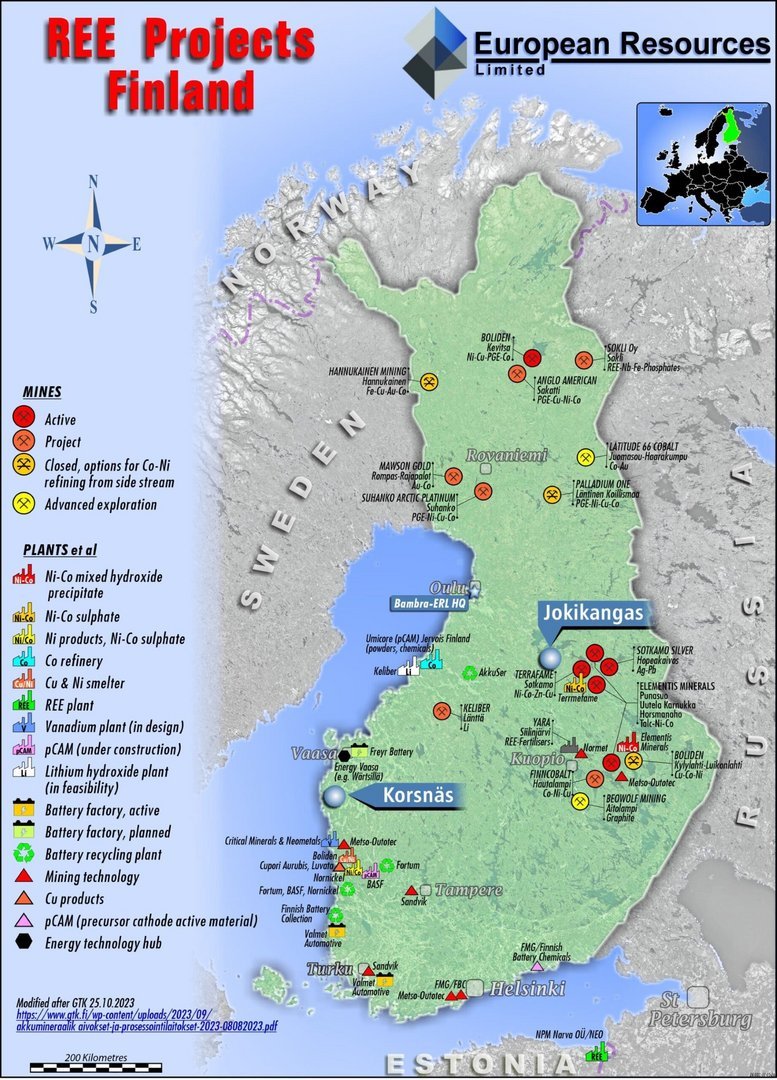
European Resources Limited (opens in a new tab) (ASX: ERE) has delivered a meaningful metallurgical advance at Finland’s Korsnäs rare earth project (opens in a new tab). Australian Nuclear Science and Technology Organisation (opens in a new tab) (ANSTO) bench testing lifted combined magnet rare earth extraction from 83% to 92% after calcite pre-treatment. Neodymium reached 92%, praseodymium 94%, while dysprosium and terbium improved sharply. The chemistry is encouraging. The critical caveat: these are 50-gram bench-scale tests on historical concentrate—not plant recoveries or proof of an economic flowsheet.
REEx Insight: The Gangue Was Stealing the Acid
Sometimes the breakthrough is not finding more rare earths. It is getting the unwanted minerals out of their way.
Hydrochloric-acid pre-leaching achieved 69% calcium extraction, interpreted by ANSTO as close to complete calcite removal. That upgraded total rare earths plus yttrium (TREY) from 2.3% to 3.9%, with generally 0–2% rare earth losses. Subsequent acid baking lifted terbium extraction from 49% to 69%, dysprosium from 43% to 66%, and yttrium from 43% to 75%.
For Europe, Dy and Tb matter disproportionately because these high-value magnet inputs sit among the rare earth supply chain’s deepest China dependencies.
Good Chemistry Meets the Scale-Up Wall
Korsnäs carries an Inferred Mineral Resource of 15.4 Mt at 1.00% TREO, but the ANSTO material came from a separate historical concentrate produced by Outokumpu between 1965 and 1972. Now comes economics. Acid consumption requires optimization, while uranium and thorium extraction exceeded 97% and 96%, creating a downstream impurity-separation challenge. The company appropriately stresses these are not plant-scale recoveries.
Next: test physical calcite rejection, remove impurities, and produce a bench-scale mixed rare earth carbonate (MREC). That is when promising chemistry starts confronting commercial reality.


0 Comments
No replies yet
Loading new replies...
Moderator
Join the full discussion at the Rare Earth Exchanges Forum →