
Highlights
- China's robot industry generated RMB165.5 billion in H1 2026, a 24.5% year-over-year increase, with 2025 full-year revenue exceeding RMB300 billion.
- Beijing's strategy links R&D, commercialization, and deployment into one industrialization ecosystem, while China already accounts for 54% of global industrial robot installations.
- High-performance robots rely on NdFeB permanent magnets using neodymium, praseodymium, dysprosium, and terbium—materials where China holds dominant supply chain control.
- Morgan Stanley projects the humanoid robot market could reach $5 trillion by 2050, with rare earth permanent magnets identified as a key materials exposure.
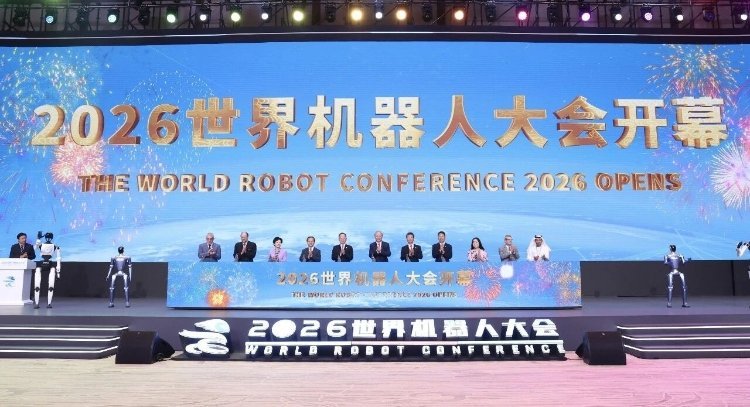
China's robot industry is accelerating. At the 2026 World Robot Conference in Beijing, the Ministry of Industry and Information Technology reported first-half industry revenue of RMB165.5 billion ($23 billion), up 24.5% year over year, after 2025 revenue exceeded RMB300 billion. Beijing now wants intelligent robots deployed across manufacturing, agriculture, healthcare, eldercare, and emergency response. For rare earth investors, robots represent another potentially enormous demand engine for permanent magnets.
REEx Insight: Millions of Machines Need Muscles
Robotics is where artificial intelligence acquires a body—and that body needs motors, actuators, and increasingly sophisticated materials.
Morgan Stanley estimates the humanoid robot population could reach roughly 1 billion by 2050, creating a potential $5 trillion market. Its research specifically identifies rare earth permanent magnets among the materials exposed to this extraordinary growth curve.
As Rare Earth Exchanges® has examined, that creates a strategic collision: one of tomorrow's largest potential technologies depends upon a permanent-magnet supply chain overwhelmingly concentrated in China.
Beijing Builds the Robot Factory
China's numbers already demonstrate considerable momentum. Robot-sector companies above the government's reporting threshold generated more than RMB300 billion in 2025, with revenue growing more than 20% annually on average over the preceding five years.
Now growth is accelerating: 24.5% in the first half of 2026.
Beijing's strategy goes beyond selling robots. MIIT outlined coordinated R&D, commercialization, real-world testing, and deployment—effectively connecting laboratories, manufacturers, and customers into one industrialization system. That ecosystem matters because China already dominates industrial robot installations. International Federation of Robotics data show China accounted for 54% of global industrial robot deployments in 2024, installing 295,000 units. (ifr.org (opens in a new tab))
AI Meets China's Magnet Advantage
For Washington, the uncomfortable question is upstream. High-performance robots commonly employ compact permanent-magnet motors, making NdFeB magnets and elements such as neodymium and praseodymium—and, in some designs, dysprosium and terbium—strategically relevant. China's advantage could therefore compound: dominate rare earth separation, metals, and magnets while simultaneously becoming the world's largest robot manufacturing and deployment ecosystem.
In Great Powers Era 2.0, robots may become another battlefield where control of materials influences control of machines.
REEx Disclosure: The underlying report comes from China's Ministry of Industry and Information Technology, a state institution. Chinese government industry statistics and policy claims should be independently verified. Morgan Stanley's long-range robotics projections are forecasts, not assured outcomes.


0 Comments
No replies yet
Loading new replies...
Moderator
Join the full discussion at the Rare Earth Exchanges Forum →