
Highlights
- Researchers achieved 99.9% radionuclide purity and over 90% single-pass Pb-212 recovery using silica-supported anion-exchange resin from monazite processing residue.
- A kilogram-scale batch yielded 158 microcuries; projections suggest 50 tonnes of residue could produce 365 curies annually, enough for roughly 24,000 cancer treatments.
- Thorium-228's 1.9-year half-life enables transport and on-site Pb-212 generation near treatment centers, adding strategic logistics value.
- Six patents have been filed with two granted; bulk production is targeted within two to three years at over one curie daily.
- China's rare-earth processing legacy is being repositioned from environmental liability into a potential medical-isotope supply chain advantage over Western competitors.
China may have found a valuable second life for one of rare-earth processing’s most troublesome legacies: radioactive waste. Professor Yuezhou Wei’s (opens in a new tab) University of South China (opens in a new tab) team reports recovering high-purity lead-212 (Pb-212)/bismuth-212 (Bi-212) and precursor thorium-228 (Th-228) from radium-rich residue left by monazite processing. The results are potentially important for targeted alpha cancer therapy—but remain at pre-commercial scale.
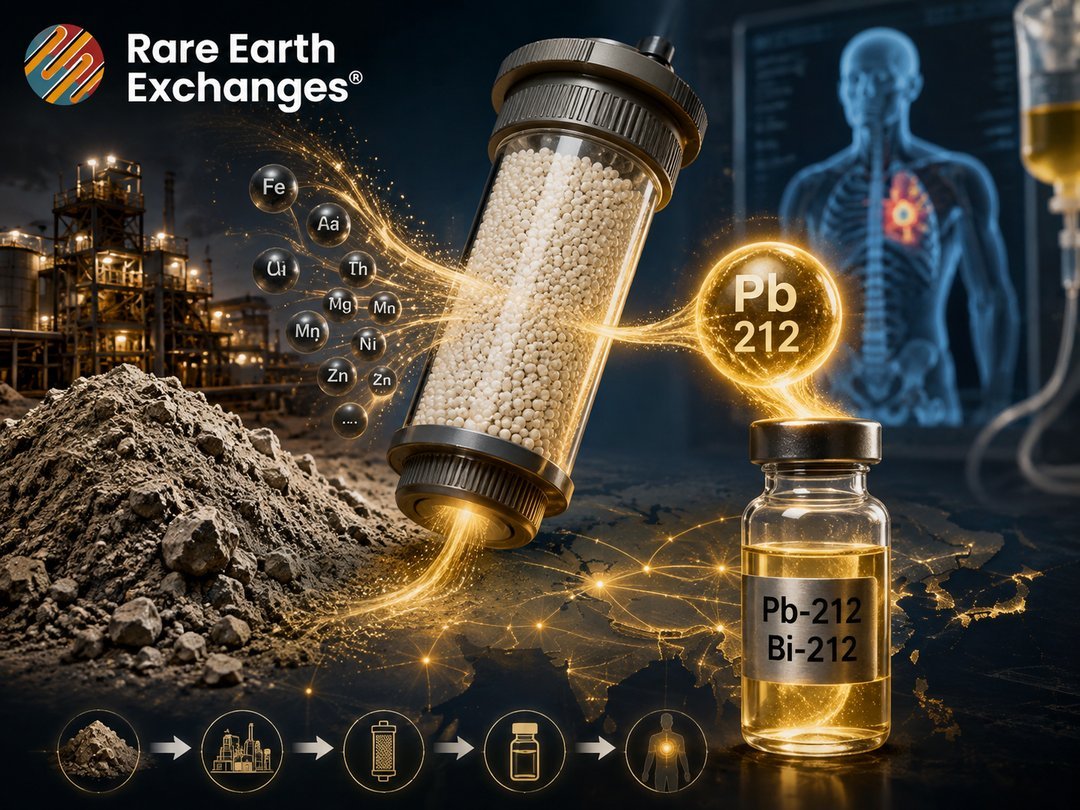
REEx Insight: The Waste Pile Becomes a Strategic Asset
This is more consequential than another recycling story. Monazite processing concentrates radioactive decay-chain materials that historically create costly waste-management liabilities. China accumulated such residues while building the world's dominant rare-earth processing industry. The researchers are now asking whether yesterday's environmental burden can become tomorrow's medical-isotope feedstock.
Their silica-supported anion-exchange resin reportedly separated Pb-212/Bi-212 from a solution containing more than 20 major metal impurities, achieving 99.9% radionuclide purity, >90% single-pass Pb-212 recovery, and ≥85% Th-228 recovery. A kilogram-scale batch yielded 158 microcuries. (gmw.cn (opens in a new tab))
Rare Earths Meet Nuclear Medicine
One technical distinction matters: Pb-212 is primarily a beta emitter; its therapeutic value comes from its decay chain, particularly alpha-emitting Bi-212/Po-212. The IAEA lists Pb-212's half-life at 10.64 hours. (iaea.org (opens in a new tab))
The team calculates that repeatedly processing 50 tonnes of residue could theoretically produce 365 curies annually—equivalent to about 24,000 treatments. Those are projections, not demonstrated clinical output.
More strategically interesting is Th-228. Its roughly 1.9-year half-life allows transportation and subsequent generation of Pb-212 closer to treatment centers.
Six patents have been filed, two granted, and pilot development is underway. Researchers target bulk production within two to three years and eventually more than one curie daily. (gmw.cn (opens in a new tab)) For the West, the lesson is uncomfortable: China's decades of rare-earth processing created not only industrial expertise, but secondary resource inventories the country is now learning to monetize. China mined the ore. Then it mastered the processing. Now it may begin mining the waste.
Source disclaimer: The originating report comes from China’s state-affiliated Guangming Daily/Guangming Online. Yield, purity, scalability, cost, and patient-treatment claims require independent validation before being considered commercially established.


0 Comments
No replies yet
Loading new replies...
Moderator
Join the full discussion at the Rare Earth Exchanges Forum →