
Highlights
- Bunting CEO Robert Bunting Jr. told Penn State's Critical Minerals Workshop that U.S. policy funds mines and factories but neglects the specialized last-mile steps needed to turn sintered blocks into finished magnets.
- China produced roughly 90% of refined magnet rare earths and 90%+ of sintered permanent magnets in 2025, while U.S. domestic finishing capacity remains minimal.
- Engineering labor, qualification time, and accumulated manufacturing experience are identified as the hardest constraints—harder to rebuild than physical infrastructure.
- Bunting reports customers are stockpiling two to three years of magnet inventory through its MagVault program, signaling a dramatic break from just-in-time supply chains.
- DOE's proposed PROSPECT program would invest up to $100 million in critical-minerals education and workforce development to address the human-capital gap.
America can finance a mine or factory faster than it can recreate generations of industrial know-how. That was Bunting (opens in a new tab) CEO Robert Bunting Jr.’s (opens in a new tab) message at Penn State’s August Critical Minerals & Materials Workshop (opens in a new tab): U.S. policy increasingly addresses mining and processing, yet the overlooked “last mile”—cutting, grinding, grain-boundary diffusion, magnetizing, coating, and qualification—requires specialized equipment, people, and accumulated manufacturing experience. Penn State confirms the three-day workshop took place August 11–13.
REEx Insight — A Block Is Not a Magnet
Bunting’s argument reinforces a central REEx warning: announced capacity is not industrial capability.
On the podcast, Bunting described mine-to-magnet as deceptively simple: separation is extremely difficult, Rare Earth Exchanges® (opens in a new tab) metallization “is not easy,” and manufacturers still face slicing, grinding, diffusion, and magnetization before reaching a finished component.
REEx continues to validate the broader bottleneck. China produced about 90% of refined magnet rare earths and 90%+ of sintered permanent magnets in 2025, while diversified metals, alloys, and finished-magnet capacity continues to lag upstream mining.
Robert Bunting, CEO Bunting
Source: LinkedIn
The Bottleneck Has a Human Face
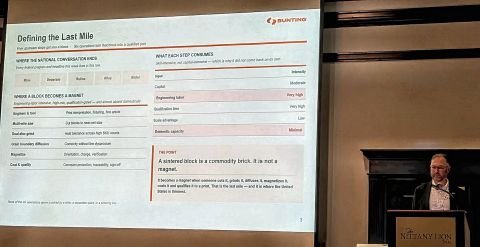
Bunting’s Penn State slide makes the problem memorable: “A sintered block is a commodity brick. It is not a magnet.” His presentation identifies engineering labor and qualification time as “very high” intensity requirements while describing domestic last-mile capacity as minimal.
Bunting’s REEx interview goes further. Bunting argues that engineering knowledge may become one of the hardest constraints and urges students toward metallurgy, mining, and magnet engineering (opens in a new tab). He also says Bunting is expanding bonded-neodymium capacity and sees customers stockpiling two to three years of inventory through its MagVault (opens in a new tab) program—an extraordinary reversal of just-in-time manufacturing.
Washington is beginning to recognize the people problem: DOE's proposed PROSPECT program (opens in a new tab) anticipates up to $100 million to expand critical-minerals education and workforce capacity.
The lesson for investors is stark: America does not merely need mines and magnet plants. It needs the industrial memory to make them work.


0 Comments
No replies yet
Loading new replies...
Moderator
Join the full discussion at the Rare Earth Exchanges Forum →