
Highlights
- Inner Mongolia Shengquan Keliyuan launched phased trial production at a RMB500 million, 100,000-tonne-per-year rare earth alloy facility in Baotou's Guyang County.
- The project produces 40,000 tonnes of rare-earth magnesium alloys and 60,000 tonnes of rare-earth calcium-barium alloys used in advanced casting and metallurgy.
- Full commissioning is targeted for October, with projected annual output of RMB1 billion and approximately 200 permanent jobs.
- Shengquan Keliyuan co-drafted China's national standards for rare-earth magnesium ferrosilicon alloys, signaling deep technical integration into China's rare earth industrial system.
- The project exemplifies China's strategy of converting mineral dominance into localized metallurgical manufacturing, extending well beyond mining and separation.
China is adding another substantial layer of downstream rare-earth processing capacity. Inner Mongolia Shengquan Keliyuan New Materials Technology Co., Ltd (opens in a new tab). has begun phased trial production at a 100,000-metric-ton-per-year multi-component rare-earth alloy complex in Guyang County, Baotou, according to an August 26 report from the Guyang County Party Committee Publicity Department.
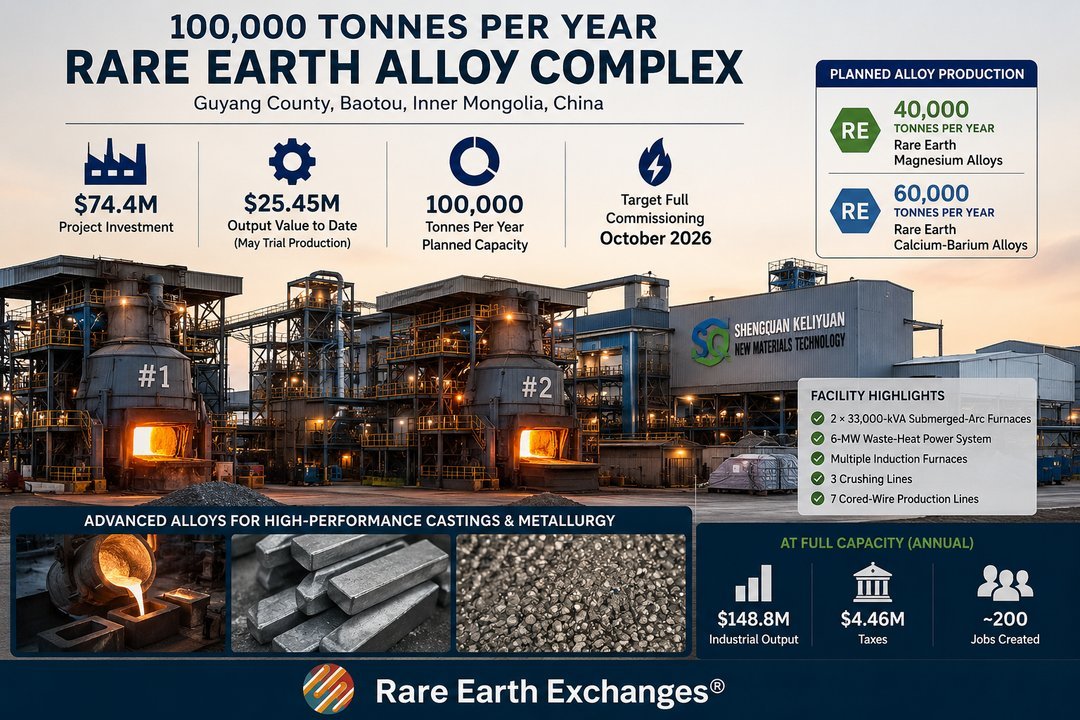
The RMB500 million (US$74.4 million) project began trial production in May and has already generated RMB171 million (US$25.45 million) in output value. Some induction furnaces are operating steadily, with the entire production line targeted for commissioning in October. Guyang government records independently confirm the planned 100,000-ton capacity, including 40,000 tonnes of rare-earth magnesium alloys and 60,000 tonnes of rare-earth calcium-barium alloys.
REEx Insight: China Keeps Moving Rare Earths Down the Value Chain
The important number is not simply 100,000 tonnes. This is another example of China converting mineral-resource dominance into localized metallurgical manufacturing. These are not primarily NdFeB magnet alloys. Shengquan Keliyuan (opens in a new tab) is producing rare-earth/magnesium/calcium-based specialty alloys and modifiers used in advanced casting and metallurgy. Such materials can control graphite formation and improve the mechanical properties of high-performance castings. China therefore continues building capacity beyond mining and separation into the less-publicized metallurgical products embedded throughout industrial supply chains.
That matters for the West. U.S. and European critical-mineral strategies frequently emphasize mines, separated oxides, and permanent magnets, while China's industrial ecosystem extends across metals, master alloys, additives, casting materials, and downstream manufacturing.
There is another signal: Shengquan Keliyuan is not an obscure entrant. The company participated in drafting China's current national standards for rare-earth magnesium ferrosilicon and rare-earth ferrosilicon alloys. This suggests technical capability and integration into China's established rare-earth industrial system.
From Ore Province to Metallurgical Cluster
The plant includes two 33,000-kVA submerged-arc furnaces, a 6-MW waste-heat power system, dedicated electrical infrastructure, multiple induction furnaces, three crushing lines, and seven cored-wire production lines.
At full capacity, authorities project RMB1 billion in annual industrial output, RMB30 million in taxes, and approximately 200 permanent jobs.
Guyang's strategy is explicit: reduce dependence on shipping relatively low-value rare-earth raw materials elsewhere and attract additional downstream processors around the new capacity. That is industrial clustering in action—and precisely the ecosystem Western governments are attempting to recreate.
REEx Connect
| Organization | Role / Relevance |
|---|---|
| Inner Mongolia Shengquan Keliyuan New Materials Technology Co., Ltd. | Rare-earth alloy producer and project operator |
| Shengquan Group | Listed corporate group associated with Shengquan Keliyuan; filings identify the Inner Mongolia company as a subsidiary |
| Guyang County Government | Local government supporting infrastructure, permitting and industrial development |
| Guyang County Party Committee Publicity Department | Original source of the August 26 project report |
| Baotou Rare Earth Research Institute | Rare-earth research institution; co-participant with Shengquan Keliyuan in Chinese alloy standards |
Source Disclaimer: This news item originates from the Guyang County Party Committee Publicity Department, a Chinese Communist Party local-government publicity organ, and was distributed through Chinese rare-earth industry media. It should therefore be treated as an official Chinese source rather than independent reporting. Production, investment, capacity and economic projections should be independently verified. Government records separately corroborate the project's RMB500 million investment and planned 100,000-ton annual capacity.


0 Comments
No replies yet
Loading new replies...
Moderator
Join the full discussion at the Rare Earth Exchanges Forum →