
Highlights
- China controls ~90% of rare earth refining and sintered magnet production, giving it leverage over $6.5 trillion in global downstream manufacturing.
- German automakers BMW, Volkswagen, Porsche, and Mercedes-Benz posted China sales declines of 20–32% in H1 2026 as Chinese brands surge in Europe.
- Canada opened a 49,000-vehicle annual quota for Chinese EVs at 6.1% tariff, giving Chinese automakers their first major North American proving ground.
- U.S. tariffs block Chinese cars from showrooms but cannot eliminate American dependence on Chinese-controlled rare earth and battery supply chains.
- China's industrial strategy spans mining, refining, metallization, magnets, batteries, motors, and finished EVs—a vertically integrated system the West is still trying to replicate.
The West spent decades looking at China as a low-cost manufacturing base. Beijing was building something far more consequential: an industrial system extending from critical minerals and chemical processing through metals, magnets, batteries, motors, electronics—and ultimately the finished products that capture the highest economic value. The consequences are now visible in automobiles. BMW, Mercedes-Benz, Volkswagen and Porsche are losing substantial volume in China while Chinese manufacturers including BYD, Chery, SAIC and Leapmotor expand rapidly across Europe. Canada has meanwhile opened an initial 49,000-vehicle annual quota for China-origin EVs at a 6.1% tariff, giving Chinese manufacturers their first significant opening into a major North American market.
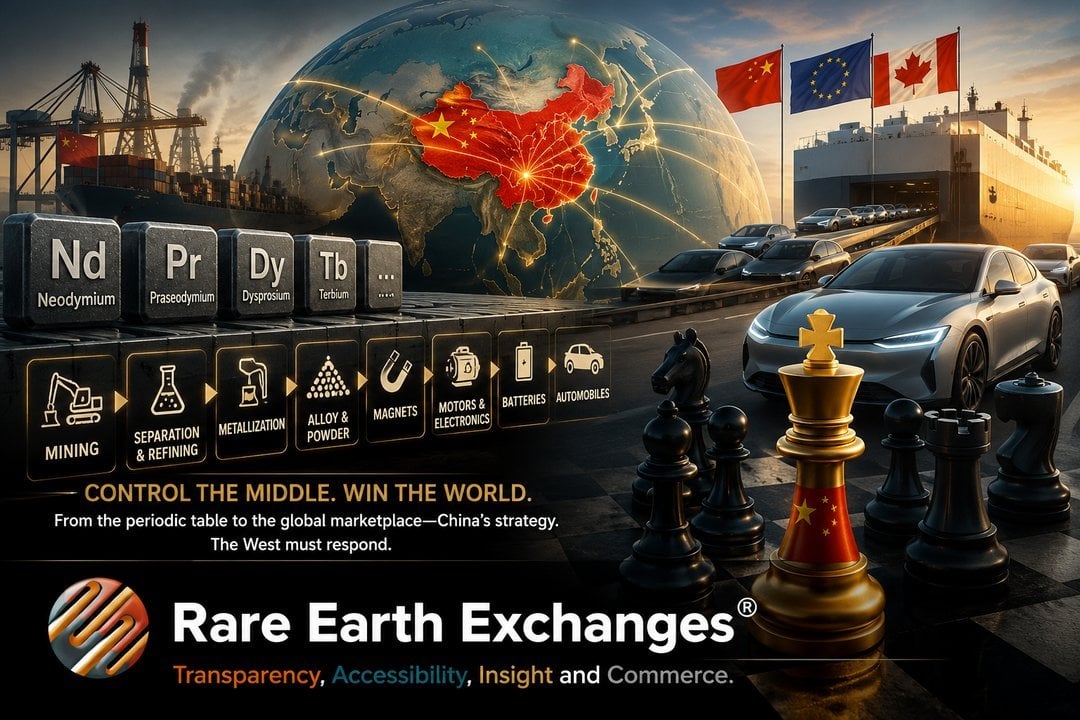
Rare Earth Exchanges® has warned investors and policymakers that controlling the middle of the periodic table can ultimately determine who wins at the end of the manufacturing line in Great Powers Era 2.0. Automobiles may now be the clearest demonstration yet.
REEx Insight: China Didn't Build an EV Industry. It Built the System Beneath It.
The mistake is to view China's rise in automobiles as a conventional competition between car companies.
China started much further upstream. For decades, Beijing pursued industrial policy across the periodic table: rare earths, lithium, graphite, nickel, cobalt, manganese and other strategic materials. It then pushed beyond mining into the less glamorous—but vastly more strategically important—stages of separation, refining, metallization, alloying, cathodes, anodes, magnets and batteries.
Only after creating scale in those layers does the full power of the strategy become apparent downstream.
In magnet rare earths, China accounted in 2025 for approximately 60% of global mining, 90% of refining and 90%+ of sintered permanent-magnet production, according to the IEA. Critically, the IEA identifies metallization—the conversion of oxides into metals, alloys and powders—as one of the most acute remaining diversification bottlenecks.
Batteries tell the same story. In 2025, China produced more than 80% of global battery cells, about 85% of cathode active material and more than 90% of anode active material. Chinese manufacturers supplied almost three-quarters of batteries deployed in electric cars worldwide.
That creates a powerful industrial flywheel: materials → processing → metals → components → batteries/magnets → motors/electronics → automobiles → global market share. This is the deeper REEx thesis. China's critical-mineral/rare earth element dominance should not be valued by the price of the materials. It should be valued by the downstream economic activity that control of that mineral can enable—or disrupt.
The International Energy Agency (IEA) now estimates that full implementation of China's expanded 2025 rare-earth controls could put $6.5 trillion of annual downstream production outside China at risk across automobiles, high technology, defense and energy. That is extraordinary leverage generated from comparatively tiny volumes of material.
And automobiles may be only the beginning. The same industrial architecture extends into robotics, drones, energy storage, wind turbines, industrial automation, data centers and defense systems. China is no longer simply exporting manufactured products. It is harvesting the downstream returns on an upstream and midstream industrial strategy built over decades.
The Great Automotive Reversal
For years, German automakers went to China because that was where the customers were.
Now the traffic is reversing. BMW Group sold 261,773 vehicles in China during H1 2026, down 20.4%. Porsche delivered just 14,501, down 32%. Volkswagen Group's first-half China deliveries fell roughly 26%, while Mercedes-Benz's disclosed quarterly figures imply a first-half contraction of approximately 28%. Reuters reported second-quarter declines exceeding 30% for major German manufacturers as Chinese competitors continued taking share.
This is more than a weak economic cycle.
Chinese consumers increasingly expect advanced software, connectivity, rapid model cycles, electrification and aggressive pricing. German engineering prestige remains valuable, but it no longer guarantees dominance.
Volkswagen CEO Oliver Blume warned this month that the company needs deep cost reductions to remain competitive, citing aggressive Chinese competition in Europe and deteriorating profitability in China.
The incumbent is now fighting on both fronts. Europe: China's Second Automotive Battlefield
Chinese manufacturers are simultaneously moving outward.
Across the EU, UK and EFTA in H1 2026, BYD registrations reached 174,144, up 145.5%; Chery reached 155,800, up 305.8%; and Leapmotor reached 56,005, up 558.3%. SAIC Motor, including MG, registered 180,659 vehicles.
Those ACEA manufacturer figures include multiple powertrains and therefore should not be described as BEV-only sales. But the EV trend is unmistakable: reported Dataforce figures put Chinese brands at 14.2% of Western European BEV sales during the first five months of 2026.
Tariffs have slowed the advance, not stopped it. Chinese manufacturers are using battery EVs, plug-in hybrids, localized manufacturing and increasingly sophisticated European distribution strategies. Their structural advantage is not simply cheaper labor. It is proximity to an enormous integrated supplier ecosystem that Western manufacturers are simultaneously spending billions trying to recreate.
Canada Opens a North American Door
Canada has now changed the strategic map. Beginning March 1, Ottawa replaced its 100% surtax on Chinese EVs with an initial 49,000-vehicle annual quota subject to Canada's normal 6.1% most-favored-nation tariff. The quota increases 6.5% annually, with an increasing portion eventually reserved for vehicles priced at C$35,000 or less.
Canada says the arrangement could also encourage Chinese joint-venture investment in domestic auto manufacturing and the EV supply chain.
Forty-nine thousand vehicles will not transform North American automotive economics overnight. But strategically, Canada offers something more valuable: a proving ground. Chinese manufacturers can learn North American certification, winter performance, consumer financing, insurance, servicing, residual values, distribution and customer behavior.
The question is no longer whether China's automotive industry can compete outside China.
It already is. The question is how far that industrial system ultimately travels.
America's Tariff Wall Has a Hole Beneath It
The United States remains substantially more protected. China-origin EVs face roughly 100% Section 301 tariffs, while Commerce Department connected-vehicle restrictions create another formidable barrier.
But Washington has a different vulnerability. America can prevent a Chinese EV from entering the showroom while remaining dependent on Chinese-controlled supply chains to manufacture the American vehicle sitting beside it.
That vulnerability became real in 2025.
After China imposed export licensing on seven heavy rare earths and related magnets, shipments plunged. Some Western automotive factories reduced utilization or temporarily stopped production. European prices for certain controlled rare earths rose to multiples of Chinese domestic prices.
Washington is finally responding through investments in domestic mining, separation and magnets, including the extraordinary public-private support being directed toward MP Materials and other emerging Western suppliers.
But rebuilding a mine is not enough.
A mine without separation is concentrate. Separation without metallization is oxide. Metal without alloy and powder is not a finished magnet. And a magnet that has not been qualified into a motor is not an automobile. That is the supply-chain reality REEx believes investors must understand.
November 10 Is a Warning Light, Not an Export Cutoff
One important distinction matters. November 10, 2026 is not an announced termination date for Chinese rare-earth exports. It is the scheduled expiration of China's suspension of the broader rare-earth controls announced October 9, 2025. Those measures are separate from the April 2025 controls covering seven medium and heavy rare-earth categories. And the distinction is important because the investment thesis does not require predicting that Beijing will shut off exports.
China already demonstrated in 2025 that licensing friction alone can disrupt factories thousands of miles downstream. That is certainly a form of leverage.
The Periodic Table Comes Due
The West's industrial debate is still too frequently organized around individual commodities: Do we have enough neodymium? Enough lithium? Enough graphite? China's strategy suggests a better question:
What industries become possible when one country controls multiple strategic materials, the technologies that process them, the components made from them and the manufacturing ecosystem consuming them?
The answer is increasingly visible on European roads.
China built mining capacity. Then refining. Then metallization. Then magnets, cathodes, anodes and batteries. Then motors, other components and assemblies, and electronics. Now Chinese companies are competing for the global markets in EVs, energy storage, robotics, drones and advanced manufacturing that sit above those foundations.
This is the warning Rare Earth Exchanges has been making to Western investors and policymakers: critical-mineral security is not ultimately about owning rocks. It is about preserving the industrial capacity—and the trillions of dollars of downstream economic value—that those rocks make possible.
Tariffs can keep a Chinese automobile off an American dealer lot. They cannot manufacture a dysprosium atom, separate neodymium, metallize an oxide, sinter a magnet, build a battery or qualify a traction motor.
China spent decades building those capabilities. The West is now discovering what they are worth.
Citations
- IEA — Rare Earth Elements 2026 (opens in a new tab) — China rare-earth mining, refining and permanent-magnet concentration; metallization and downstream diversification bottlenecks.
- IEA — Critical-Mineral Export Controls and Supply Concentration (opens in a new tab) — 2025 rare-earth controls, automotive disruptions and supply-chain concentration.
- IEA — Global EV Outlook 2026: Manufacturing and Trade (opens in a new tab) — Chinese EV, battery, cathode and anode manufacturing shares.
- IEA — Global EV Outlook 2026: Electric Vehicle Batteries (opens in a new tab) — battery manufacturing capacity and Chinese producer market share.
- IEA — Global Critical Minerals Outlook 2026 (opens in a new tab) — estimated $6.5 trillion of downstream production potentially exposed to expanded rare-earth controls.
- Reuters — German Automakers Hit by Sharp China Sales Drop (opens in a new tab) — BMW, Mercedes-Benz and Volkswagen China-market deterioration.
- Reuters — Volkswagen Says Deep Cuts Needed to Remain Competitive (opens in a new tab) — Volkswagen restructuring and Chinese competitive pressure.
- BMW Group, H1 2026 sales release — China volumes and year-over-year performance.
- Porsche, H1 2026 deliveries — China and global deliveries.
- Volkswagen Group, H1 2026 deliveries — China and global performance.
- Mercedes-Benz Group, Q2 2026 interim report — quarterly China performance.
- ACEA, June/H1 2026 registrations — European manufacturer registrations and powertrain data.
- Government of Canada — Chinese EV Quota Consultation (opens in a new tab) — 49,000-vehicle quota, annual growth and affordable-vehicle provisions.
- Government of Canada — Spring Economic Update 2026 (opens in a new tab) — removal of the 100% surtax and application of the 6.1% MFN tariff.
- Government of Canada — Canada-China Trade Framework (opens in a new tab) — potential Chinese joint ventures and Canadian EV-supply-chain investment.
- European Commission — definitive countervailing duties on China-origin battery electric vehicles.
- China Ministry of Commerce, April 9, 2026 briefing — suspension through November 10, 2026 of the October 9, 2025 expanded rare-earth measures.
- U.S. Bureau of Industry and Security — Connected Vehicles Rule.
- MP Materials — U.S. public-private rare-earth partnership, NdPr price support, magnet offtake and capacity expansion.


0 Comments
No replies yet
Loading new replies...
Moderator
Join the full discussion at the Rare Earth Exchanges Forum →