
Highlights
- Open University of Cyprus researchers reviewed 638 publications to build an integrated framework linking critical-mineral demand with lunar in-situ resource utilization and asteroid mining.
- Asteroid rare earth valuations are exploration hypotheses, not reserve bases—most elements in meteorites are far less concentrated than viable Earth-based ores.
- The first major customer for space mining may be space itself, with water, iron, and aluminum used in orbit rather than returned to Earth.
- Building an independent rare-earth supply chain on Earth—covering separation, refining, and magnet manufacturing—may prove harder than escaping Earth's gravity.
- Trillion-dollar asteroid valuations ignore market-moving effects, recovery costs, and lack JORC or NI 43-101 reserve classification standards.
Could the next great mining frontier be above our heads? If so, the road to an asteroid mine will probably start on the Moon. Antonis A. Zorpas of the Open University of Cyprus and Vincenzo Naddeo of the University of Salerno examine (opens in a new tab) how lunar and asteroid resources could eventually support an industrial economy beyond Earth. Their perspective considers rare earth elements (REEs), platinum-group metals (PGMs), iron, nickel, cobalt, water and other resources—but is considerably more cautious than visions of trillion-dollar asteroids suggest. The Moon offers the more realistic proving ground for learning to excavate, process and use extraterrestrial materials. Commercial asteroid mining remains conceptual, constrained by uncertain mineral grades, microgravity, formidable transportation costs, immature processing technologies and unresolved international rules. And yes, lunar and asteroid mining would require overcoming Earth’s gravity. Yet REEx notes an irony closer to home: building an independent rare-earth supply chain requires overcoming several decades of industrial dependency. Judging by the pace of progress, that may prove the harder engineering problem.
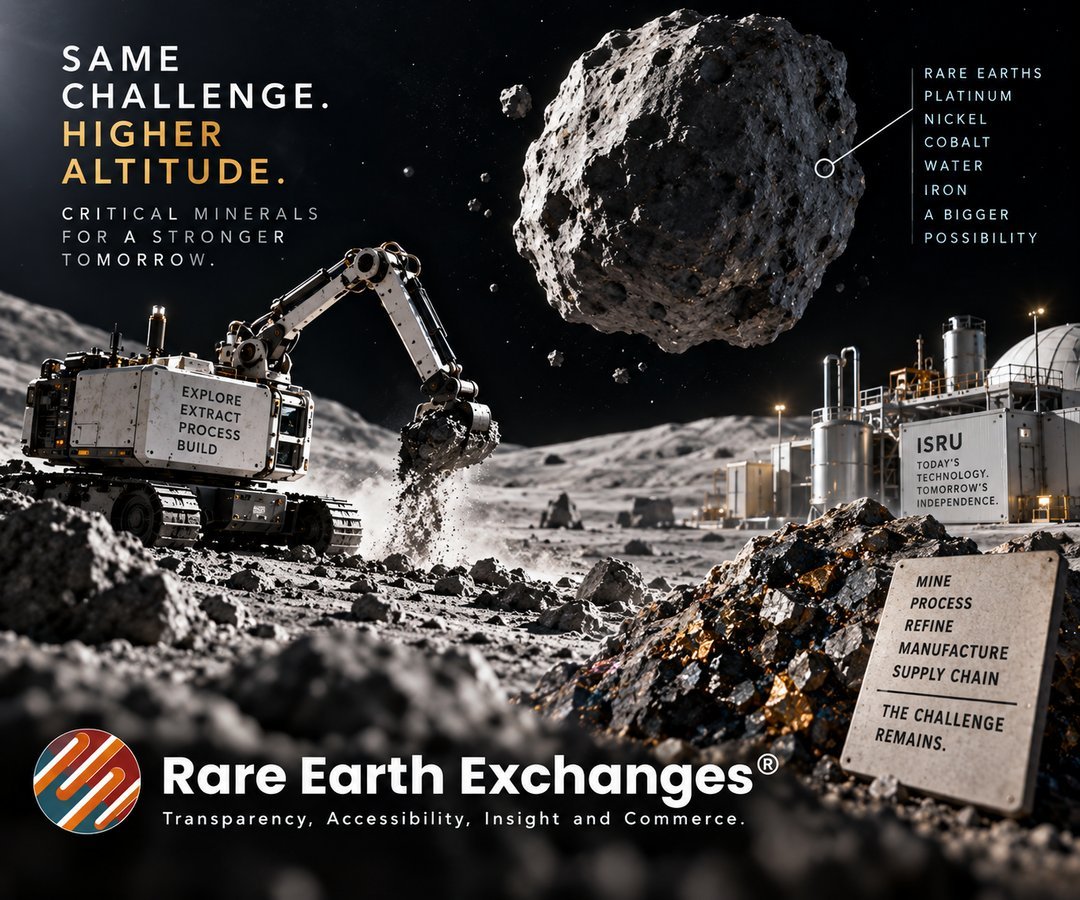
REEx Insight: Space Mining Has Its Own Mine-to-Magnet Problem
The biggest lesson for critical-mineral markets is simple: geology does not equal supply.
Finding neodymium, dysprosium, platinum or nickel in an asteroid does not make it ready to use. The material must still be mined, concentrated, separated, refined and turned into useful products. A space-based industry would need much of the same supply chain we struggle to build on Earth—from mining and processing to refining, recycling, energy and manufacturing.
Rare earths make the point even clearer. Finding neodymium in an asteroid is a long way from making a powerful NdFeB magnet. The rare earths must first be separated and purified, then made into metals, alloys and finally magnets.
The real value is not just in owning the resource. It is in mastering the entire supply chain.
That leads to an interesting possibility: the first big customer for space mining may be space itself, not Earth. Water could support astronauts or be split into hydrogen and oxygen for rocket fuel. Iron, aluminum and silicon could help build equipment and structures. Making these materials in space could avoid the enormous cost and difficulty of launching every kilogram from Earth.
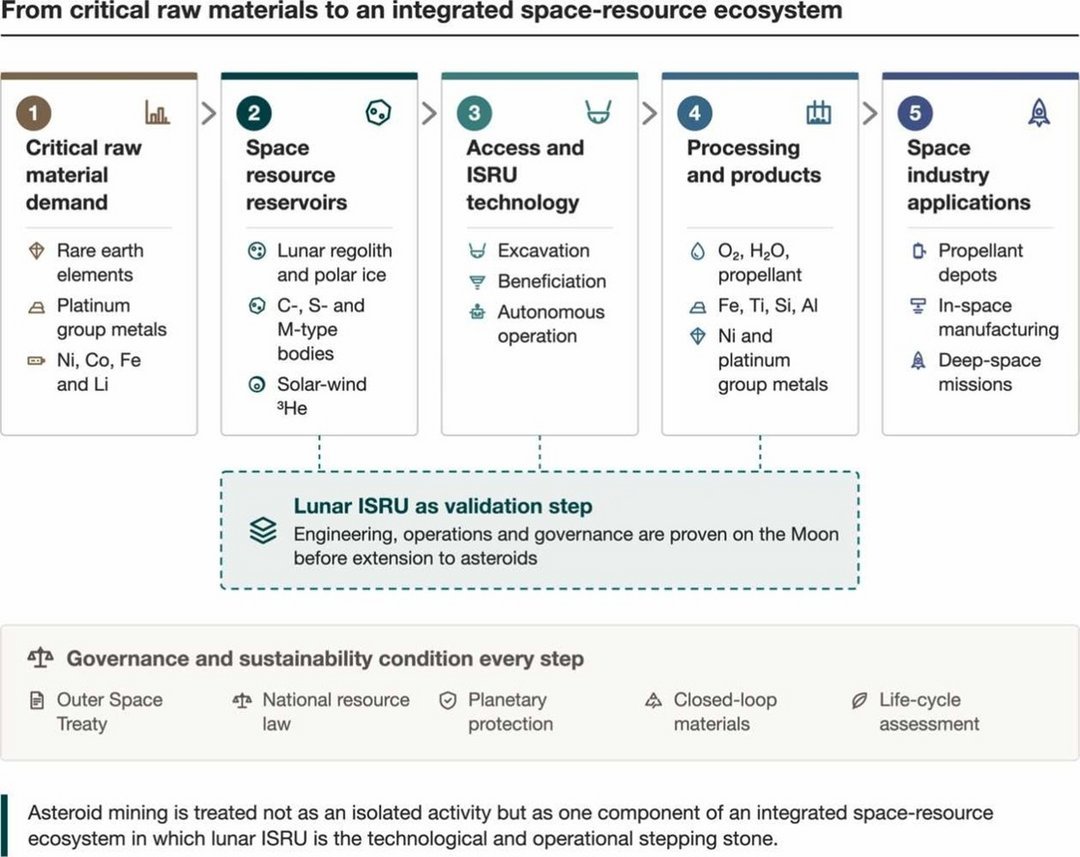
What Did the Researchers Actually Do?
This was not a mining experiment, mineral discovery or feasibility study. It was a multidisciplinary perspective supported by literature review and bibliometric analysis. The researchers searched Scopus for peer-reviewed English-language literature from 2016 through March 2026. Their search produced 638 records, with 57 publications ultimately included for bibliometric mapping. NASA, ESA and market databases supplied additional technical and economic information.
Their central contribution is an integrated framework connecting critical-mineral demand with lunar in-situ resource utilization (ISRU).
Are Asteroids Really Rare-Earth Treasure Chests?
Here the evidence becomes more nuanced. The Zorpas-Naddeo paper presents asteroids as potential sources of REEs and other critical materials. But that should not be interpreted as proof of economically mineable rare-earth deposits. A broader analysis by Cannon and colleagues comparing 83 elements in meteorites against terrestrial ore grades found most elements much less concentrated than good Earth-based ores, with light rare earths particularly depleted.
Yet the science is evolving. A 2026 Monthly Notices of the Royal Astronomical Society study analyzing carbonaceous chondrites found that some groups—particularly CV and CM meteorite analogues—show comparatively higher REE abundances, suggesting certain undifferentiated asteroids deserve further investigation. The researchers nevertheless emphasized the need for sample-return and in-situ missions before extrapolating meteorite measurements to entire asteroids.
For REEx, the conclusion is simple: asteroid REEs are an exploration hypothesis, not a reserve base.
Beware the “Trillion-Dollar Asteroid”
The paper also cites spectacular theoretical asteroid valuations. Those numbers require substantial caution.
They are generally calculated using assumptions about an asteroid's estimated composition and today's commodity prices. They are not equivalent to JORC-, NI 43-101- or CRIRSCO-style mineral resources or reserves. The authors themselves flag some valuations as non-peer-reviewed estimates dependent on composition, accessibility, recovery and price assumptions.
There is another problem: markets move. Returning huge quantities of platinum or another scarce commodity could depress its price. Multiplying hypothetical asteroid tonnage by today's spot price therefore says little about what the material would actually be worth after extraction.
Limitations and What Comes Next
The paper has important limitations. Its bibliometric review excluded non-English research and several academic disciplines, while its open-access filter created acknowledged selection bias. More fundamentally, there is still no commercial asteroid mine, large-scale extraterrestrial refinery or demonstrated system capable of economically returning industrial quantities of asteroid material to Earth. The authors call for autonomous robotic mining, lunar ISRU demonstrations, asteroid transportation and controlled re-entry technologies, life-cycle sustainability studies, realistic techno-economic modeling and clearer international governance.
The larger idea is nevertheless profound. Humanity may eventually create a second industrial geography beyond Earth. If that happens, the winners will probably not be determined by who discovers the asteroid with the biggest theoretical price tag. Just as with rare earths on Earth, strategic power will belong to those who master the entire chain—from resource characterization and extraction through separation, refining and manufacturing.
The Harder Mission May Be Here on Earth
For the West, there is a mildly uncomfortable punchline. We are contemplating how to mine and refine metals on the Moon while still struggling to build complete critical-mineral supply chains on Earth. As REEx continues to remind, ex-China independence requires far more than opening mines: it means beneficiation, chemical separation, refining, metallization, alloy production, magnet manufacturing, qualified customers, skilled workers, reliable energy and enough patient capital to survive Chinese pricing. The technology exists for much of this; the industrial ecosystem often does not.
Asteroid mining may require escaping Earth's gravity. Building an independent rare-earth supply chain merely requires escaping several decades of industrial dependency—which, judging by the pace of progress, may prove the more difficult engineering problem.
The authors reported no funding and no competing financial interests.
Citation: Zorpas, A.A., & Naddeo, V. (2026). Asteroid and Lunar Space Resources for Future Space Industry: Critical Materials, In-Situ Resource Utilization and Governance Challenges. Chemical Engineering Research and Design. Available online August 28, 2026. DOI: 10.1016/j.cherd.2026.08.047.


0 Comments
No replies yet
Loading new replies...
Moderator
Join the full discussion at the Rare Earth Exchanges Forum →