
Highlights
- Europe has strong research and patents but lacks industrial scale, capital deployment, and midstream processing capacity to compete with China.
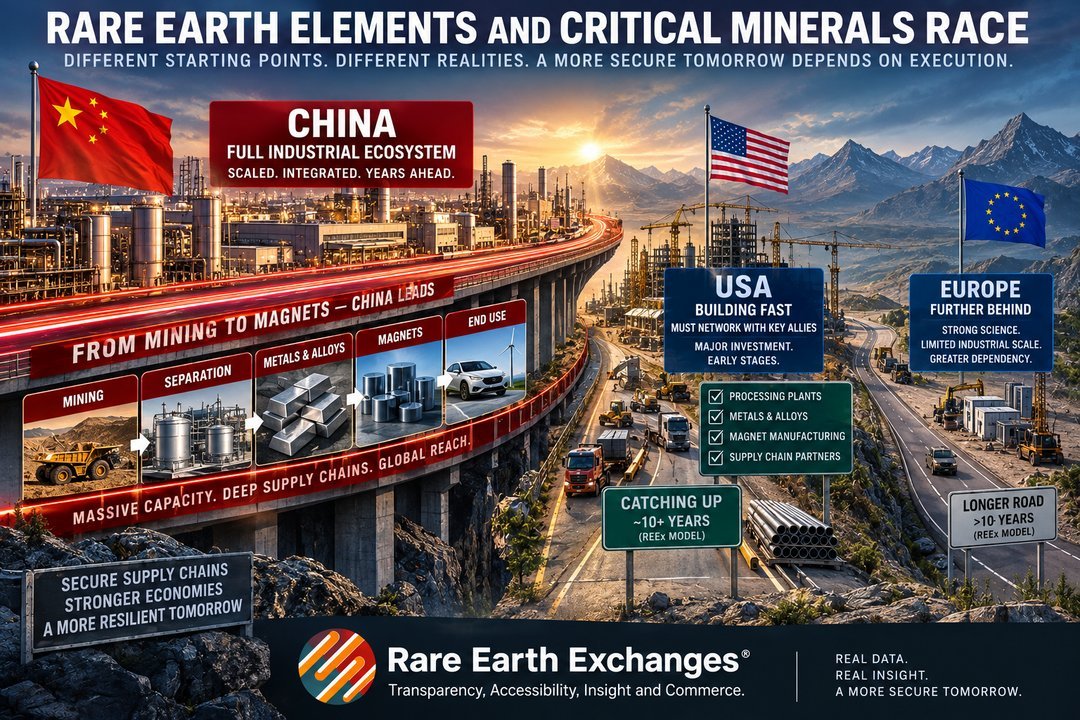
- China holds a two-decade lead in processing plants, engineers, supplier networks, and downstream customers across critical material chains.
- The US is ahead of Europe in commercialization but still rebuilding midstream infrastructure and should not be seen as a mature China alternative.
- Rare earths illustrate the gap: Europe can plan magnet plants but depends on China for separated NdPr, Dy, and Tb inputs.
- Scientific capability is not industrial sovereignty—Europe must move from policy architecture to factories producing qualified tonnes.
Europe has formidable scientists, patents, and research infrastructure—but China has something more immediately strategic: industrial scale and about a two decades’ lead. A new report (opens in a new tab) by Dr. Alberto Claudio Tremolada (opens in a new tab), Vice President CT060 UNI Italian Standards Authority European Commission Workgroups Member, maps 100 advanced materials and 2,943 European research and technology infrastructures while acknowledging serious weaknesses in commercialization, capital deployment, critical-material supply, and midstream processing. The report is directionally right, but investors should recognize the hierarchy: China remains far ahead; the United States is building rapidly from a comparatively early ex-China base; Europe risks falling further behind both.
REEx Insight | Patents Don't Process Tonnes
The report identifies Europe's Technology Readiness Level (TRL 4–6) “Valley of Death,” fragmented industrial scale-up, and dependence on non-EU strategic raw materials and midstream refining. But Great Powers Era 2.0 requires looking beyond laboratories and patent statistics. China's advantage lies in decades of accumulated processing plants, equipment, engineers, operating knowledge, supplier networks, and downstream customers. The United States is ahead of Europe in mobilizing capital and commercialization, as the report itself recognizes. Yet America should not be mistaken for a mature alternative to China. Across several critical-mineral chains, it remains in the early stages of reconstructing midstream infrastructure.
Rare Earths Reveal the Real Battlefield
Rare earths make the hierarchy unmistakable. Europe can build NdFeB magnet plants, but magnets require separated NdPr—and high-performance grades may require Dy and Tb—followed by metallization, alloying, and qualified magnet production. The report itself flags rare-earth supply and magnet-chain dependence.
That is the lesson investors should carry across advanced materials: scientific capability is not industrial sovereignty.
China already built much of the machine. America is trying to build another. Europe still needs to prove it can move from policy architecture to factories producing qualified tonnes.


0 Comments
No replies yet
Loading new replies...
Moderator
Join the full discussion at the Rare Earth Exchanges Forum →