
Highlights
- Xi Jinping called for advanced manufacturing to become 'bigger and stronger' at the September 2024 National Advanced Manufacturing Conference in Beijing.
- The key Chinese policy phrase 自主可控 (zìzhǔ kěkòng) signals autonomous, controllable industrial chains—far stronger than the official English translation 'self-supporting and risk-resilient.'
- Premier Li Qiang directed officials toward AI-enabled factories, domestic high-end technologies, and advanced manufacturing clusters as the core operating model.
- Rare earths are not explicitly named in Xi's directive, but the policy framework maps directly onto their role feeding magnets, motors, EVs, robotics, and defense systems.
- Western analysts face a stark warning: a mine alone is not a supply-chain strategy without integrated downstream manufacturing ecosystems.
China's leadership has elevated advanced manufacturing as a national strategic priority, explicitly connecting industrial development with security, technological autonomy, and greater control over supply chains. At the September 16–17 National Advanced Manufacturing Conference in Beijing, Xi Jinping called for advanced manufacturing to become "bigger and stronger," while Premier Li Qiang directed officials toward next-generation intelligent manufacturing, "AI + manufacturing," high-end domestic technologies, and industrial clusters. For rare earths, the significance is the architecture surrounding the materials: Beijing continues building an integrated system connecting strategic inputs with advanced downstream manufacturing.
REEx Insight — Three Words the West Should Study
The critical phrase is 自主可控 (zìzhǔ kěkòng)—literally carrying the sense of being autonomous and controllable. China's official English translation renders it more gently as making industrial chains "self-supporting and risk-resilient." That distinction matters. Xi explicitly paired high-quality development with high-level security. Li supplied the operating model: domestic high-end technologies, AI-enabled factories, smart hardware and software, commercialization of research, advanced-manufacturing clusters, and future industries. Vice Premier Zhang Guoqing (opens in a new tab) called for deeper implementation of programs targeting key industrial chains.
For REEx, this is Great Powers Era 2.0™ in policy form: ecosystem competes against ecosystem. Rare earths are not mentioned specifically in Xi's directive. That distinction is important. But the policy framework maps directly onto their strategic role: rare earths feed magnets; magnets feed motors; motors feed EVs, robotics, industrial equipment, aerospace, and defense. The Western takeaway is stark: a mine is not a supply-chain strategy. Separation without metals, metals without magnets, or magnets without qualified downstream customers creates individual assets—not an industrial ecosystem.
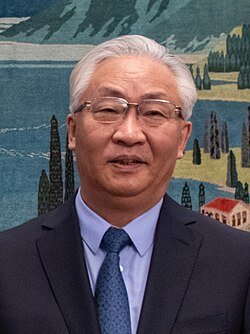
Vice Premier Zhang Guoqing
AI Moves Onto the Factory Floor
Li identified next-generation intelligent manufacturing as the main direction and ordered deeper implementation of the "AI + manufacturing" initiative. Beijing also wants stronger basic research, breakthroughs in critical core technologies, and faster commercialization. This is a strategic directive, not a project announcement. That may make it more consequential, not less. It tells ministries, state enterprises, financial institutions, provincial governments, and manufacturers where Beijing wants the system moving.
REEx Connect
| Organization / Leader | Strategic Role |
|---|---|
| Communist Party of China / Xi Jinping | National industrial and supply-chain strategy |
| State Council of the People's Republic of China / Premier Li Qiang | Advanced-manufacturing implementation |
| State Council / Vice Premier Zhang Guoqing | Key industrial-chain programs |
| Ministry of Industry and Information Technology | Manufacturing and industrial technology policy |
| National Development and Reform Commission | Economic planning, industrial policy, and investment |
| State-owned Assets Supervision and Administration Commission of the State Council | Oversight of centrally administered state-owned enterprises |
Source caution: The underlying report originated with Xinhua News Agency, China's state news agency, and was republished by the China Rare Earth Industry Association. It communicates official Chinese policy and should be read as such; claims concerning implementation or outcomes require independent verification. Reuters independently confirmed the central policy directives.


0 Comments
No replies yet
Loading new replies...
Moderator
Join the full discussion at the Rare Earth Exchanges Forum →