
Highlights
- Tesla teams conducted supplier audits in Ningbo on September 17, examining Tuopu Group, Sanhua Intelligent Controls, and Joyson Electronics for Optimus production readiness.
- An unconfirmed 50,000-unit 2026 Optimus production target has emerged from Chinese sources, while Tesla publicly states only that Gen3 is its first mass-production-ready design.
- Humanoid robots represent a high-growth demand channel for NdFeB magnets, yet Tesla's robotics scale-up deepens reliance on China's rare-earth refining and magnet manufacturing dominance.
- Tesla audits reportedly assess manufacturing capability itself, with some production functions potentially shifting toward Chinese suppliers rather than U.S. operations.
- Investors are cautioned that translating Optimus targets into NdPr, Dy, or Tb demand requires disclosure of robots shipped, magnet content, magnet chemistry, and country of origin.
Tesla is again turning to China's manufacturing ecosystem as it tries to move Optimus from prototype to mass production. Rare Earth Exchanges® sources in China suggest Tesla teams began a new round of supplier audits in Ningbo on September 17, examining production consistency, equipment, and suppliers including Tuopu Group, Sanhua Intelligent Controls, and Joyson Electronics. According to our sources, a roughly 50,000-unit 2026 Optimus plan now emerges, yet Tesla has not publicly confirmed that production figure. Tesla itself says Gen3 is its first Optimus design intended for mass production, with production planned before year-end.
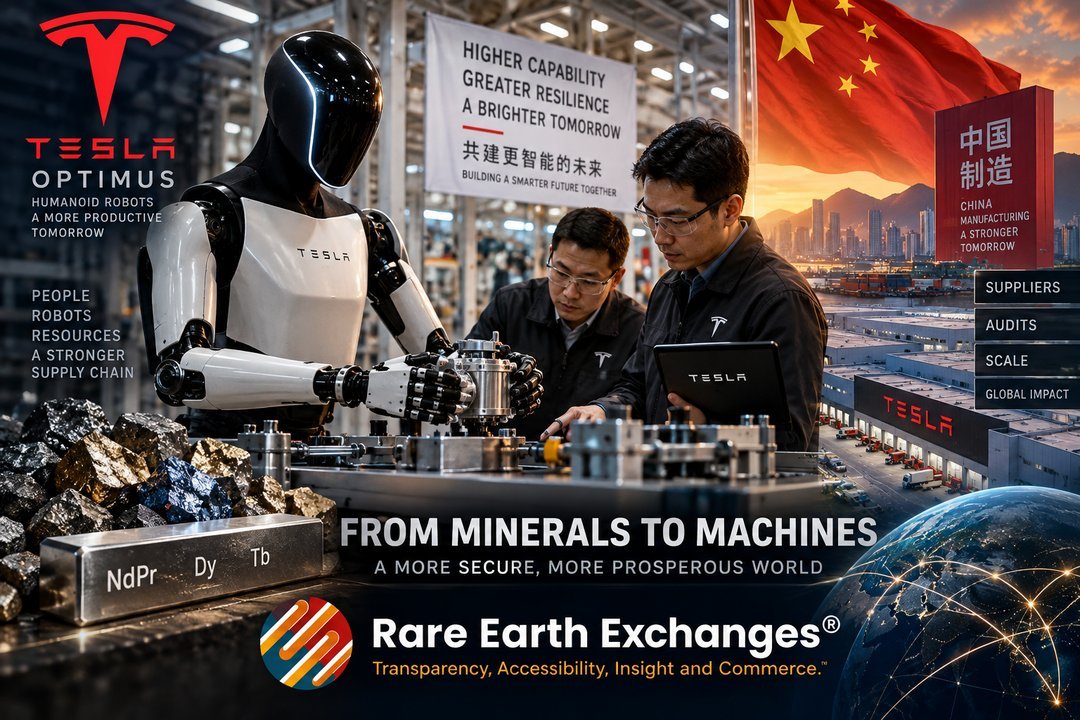
REEx Insight — The Robot Revolution Has a Magnet Problem
For rare-earth investors, the important story is not whether Optimus can dance. It is what sits inside the joints. Humanoid robots potentially create another high-growth demand channel for compact, high-torque motors—and therefore NdFeB magnets. Yet Tesla is trying to industrialize Optimus while China still dominates rare-earth refining and magnet manufacturing. That creates a strategic paradox: Tesla's robotics ambition may increase its exposure to the same Chinese manufacturing ecosystem Western industrial policy is trying to diversify away from.
The audits reportedly extend beyond components to manufacturing capability itself. Chinese and our sources suggest Tesla is examining production consistency and helping move some manufacturing capabilities from U.S. operations toward Chinese suppliers. For REEx, the investor metric is therefore not robots announced but robots shipped × magnet content × magnet chemistry × country of origin. Until Tesla discloses those variables, translating Optimus targets directly into NdPr/Dy/Tb demand would be speculation.
From Prototype Theater to Factory Math
Tesla's official January disclosure is more conservative than some Chinese headlines: Gen3 was designed for mass production, its first production line was under construction, and eventual planned capacity is one million robots annually—not current output. That distinction matters. Optimus has already experienced redesigns and shifting production targets. The current audits are credible evidence of manufacturing preparation, not proof that 50,000 robots will ship this year.
Still, something important is happening: China's automotive supply chain is positioning itself to become a humanoid-robot supply chain. For rare earths, that could create another downstream demand engine hiding inside the AI boom.


0 Comments
No replies yet
Loading new replies...
Moderator
Join the full discussion at the Rare Earth Exchanges Forum →