
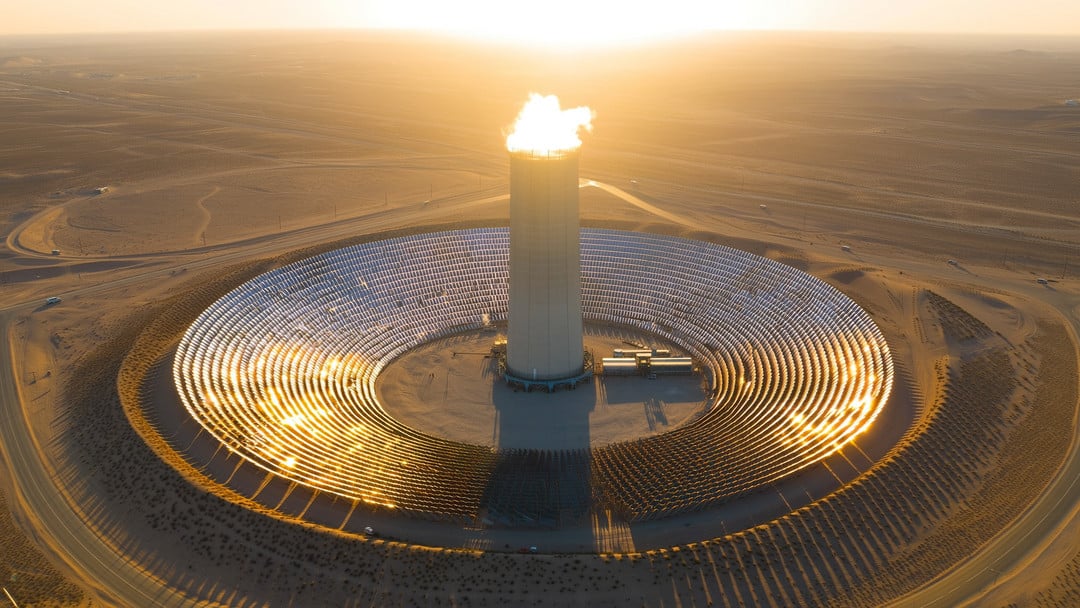
Before solar thermal towers, many large solar plants were either instant-only, producing power only when the sun shines, or required separate fuel-fired systems to remain dispatchable. Power towers changed this by pairing concentrated sunlight with high-temperature heat and thermal storage, better aligning output with evening demand peaks and grid reliability needs. Solar thermal towers use fields of sun-tracking mirrors called heliostats to focus light onto a receiver atop a tower, producing high-grade heat that can be stored for hours and converted to electricity on demand. This capability changes how utilities plan firm capacity and ramping. Rare earth elements matter because several key subsystems rely on REE-enabled magnets, optical materials, sensors, and specialized alloys that improve precision, temperature stability, and durability in harsh desert conditions. This article explains how the system works end-to-end from sunlight to heat to storage to steam cycle, where rare earths show up in real components, what current 2025 to 2026 deployment and cost drivers look like, and where supply-chain risks and material substitutions could shape future viability.
Table of Contents
How Did Solar Thermal Towers Change Utility-Scale Solar Power—and Why Do Rare Earths Matter?
Before solar thermal towers arrived on the scene, most large solar plants had a fundamental limitation: they could only generate electricity while the sun was shining. If a utility needed power during the evening peak—when families come home, turn on lights, and crank up the air conditioning—those solar plants had nothing to offer. Grid operators had to fire up natural gas turbines or other fossil-fueled systems to fill the gap.
Solar thermal towers changed that equation. Instead of converting sunlight directly into electricity like photovoltaic (PV) panels, these plants use thousands of sun-tracking mirrors to concentrate light onto a receiver mounted high on a tower. That concentrated light creates intense heat, which gets stored in tanks of molten salt (opens in a new tab) for hours. When the grid needs power—even after sunset—the stored heat raises steam to spin a turbine.
This ability to store energy as heat and dispatch electricity on demand made solar thermal towers genuinely different. Utilities could plan around them the way they plan around fuel-burning plants, but without the emissions.
So where do rare earth elements fit in? Several critical subsystems inside these plants—heliostat tracking motors, high-temperature sensors, precision actuators, and even the mirrors themselves—depend on materials enabled by rare earth elements. These elements improve the precision, temperature tolerance, and long-term durability that desert-operating power towers demand.
This article walks through the full process: sunlight to heat to storage to electricity. It explains exactly where rare earths show up, what the 2025–2026 deployment picture looks like, and how supply-chain risks could shape the future of this technology.
Rare Earth Role in Solar Thermal Towers
Which Elements Are Used and Why
A solar thermal tower plant is a precision machine operating in brutal conditions—extreme heat, high winds, abrasive dust, and relentless UV exposure. The rare earth elements used in these plants address those specific challenges.
Neodymium and praseodymium are the most prominent. They form the basis of NdFeB (neodymium-iron-boron) permanent magnets, which are among the strongest commercially available. These magnets appear in the servo motors and stepper motors that drive heliostat tracking systems, as well as in some pump motors and actuators throughout the plant. According to the U.S. Department of Energy and Argonne National Laboratory, NdFeB magnets enable compact, high-torque motor designs that would be significantly larger and heavier using conventional ferrite magnets.
Dysprosium and terbium are sometimes added to NdFeB magnets in small quantities. These "heavy" rare earths improve a property called coercivity—the magnet's ability to resist demagnetization at high temperatures. In a desert plant where ambient temperatures regularly exceed 40°C and equipment near the receiver runs even hotter, this thermal stability matters.
Samarium appears in SmCo (samarium-cobalt) magnets, which tolerate even higher temperatures than standard NdFeB. According to technical literature from magnet manufacturers such as Arnold Magnetic Technologies, SmCo magnets are sometimes selected for sensors, encoders, or actuators positioned near hot equipment where NdFeB magnets might degrade.
Cerium and lanthanum play a less obvious but still important role. They show up in polishing compounds and specialty glass formulations used during mirror and receiver manufacturing. The USGS rare earth end-use reporting consistently lists polishing as one of the largest end uses for cerium oxide.
Yttrium and europium can appear in phosphors used for indicator lights, inspection lighting, and certain optical sensing components in industrial control equipment, as described in International Energy Agency and USGS supply-chain summaries.
How It Works
The connection between rare earths and plant performance follows a clear chain of cause and effect through each subsystem.
In the heliostat tracking system, NdFeB magnets containing neodymium and praseodymium sit inside the servo or stepper motors that tilt and rotate each mirror. These magnets produce strong magnetic flux in a small package, which translates into precise, responsive pointing. Tighter pointing accuracy means more reflected sunlight hits the receiver where it should, raising the overall thermal efficiency of the plant.
At the receiver and thermal instrumentation level, SmCo magnets or dysprosium-enhanced NdFeB magnets work inside sensors and valve actuators. These components must function reliably at elevated temperatures without drifting out of calibration. When a valve actuator loses precision during hot, windy conditions, the result can be thermal transients that stress the receiver and steam-cycle equipment.
During mirror and receiver manufacturing, cerium and lanthanum polishing compounds help achieve the extremely smooth surface finishes that high-performance mirrors require. Lower surface scatter means higher optical efficiency, which reduces the number of heliostats needed to hit a target output level.
The thermal constraints are worth emphasizing. Tower plants combine intense concentrated solar flux with desert heat, creating an environment where standard components degrade faster. Heavy rare earths like dysprosium and terbium, or the use of SmCo magnets, represent a deliberate engineering trade: higher material cost in exchange for stability and reliability over a 25-to-30-year plant life.
Journey from Mine to Product
Supply Chain Steps
Rare earth elements travel a long and complex path before they end up inside a heliostat motor or a polishing slurry.
It starts at the mine. The most common ore minerals are bastnäsite, monazite, and ion-adsorption clays. After extraction, the ore is processed into a mixed rare earth concentrate—a blend of many different elements that must then be chemically separated.
Separation is where the real complexity begins. Individual rare earth oxides are isolated through solvent-extraction circuits, which involve dozens of mixer-settler stages and strict process control. These oxides are the primary tradable intermediates tracked by the USGS in its Mineral Commodity Summaries.
From oxides, the path splits. For magnets, oxides are reduced to metals, alloyed (for example, combining neodymium, iron, and boron), milled into fine powders, pressed into shapes, sintered at high temperature, heat-treated, and coated to resist corrosion. The finished magnets then ship to motor and encoder manufacturers, who integrate them into the tracking drives and actuators used across the heliostat field.
In a parallel path, cerium and lanthanum oxides go into polishing powders, glass additives, and coatings. These feed mirror manufacturers and sensor module assemblers. Everything converges at the EPC (engineering, procurement, and construction) stage, where the full plant is assembled, commissioned, and tested.
Typical Chokepoints
Three bottlenecks consistently stand out in rare earth supply chains.
Separation capacity is the most frequently cited constraint. The solvent-extraction process is capital-intensive, technically demanding, and environmentally sensitive. As emphasized in IEA critical minerals analysis and U.S. DOE supply-chain reviews, limited separation capacity directly constrains the availability of individual rare earth oxides, even when ore supply is adequate.
Heavy rare earth availability is a tighter problem than light rare earth supply. Dysprosium and terbium come predominantly from ion-adsorption clay deposits concentrated in southern China and Myanmar. Their supply dynamics are more volatile, which complicates long-term procurement for the high-temperature magnet grades that tower plants may need.
Specialized manufacturing creates a third chokepoint. Magnet sintering, grain engineering, precision coating, and motor assembly are performed by a limited number of qualified suppliers worldwide. Qualifying a new supplier can take years—far longer than sourcing a commodity metal. For project developers working on tight construction schedules, this qualification lead time can be a genuine risk.
Statistics and Societal Impact
Quantitative Snapshot
According to the IEA and SolarPACES annual reporting, global concentrating solar power capacity using power tower (central receiver) technology reached roughly 3 to 4 gigawatts of cumulative installed and under-construction capacity by 2025–2026, with projects concentrated in China, the Middle East and North Africa region, Chile, and to a smaller extent the United States and Spain. Tower technology represents a growing share of the CSP pipeline relative to older parabolic trough designs.
Modern tower plants typically range from about 50 MW to 150 MW net capacity, with thermal energy storage durations of 8 to 17 hours. The Noor Energy 1 project in Dubai, for example, includes a 100 MW tower with molten salt (opens in a new tab) storage, according to project technical disclosures.
Capacity factors for towers with storage in high-DNI regions have been reported in the range of 40 to 70 percent, depending on DNI quality, storage hours, and cooling method. NREL performance benchmarking and operator data filed with public utility commissions provide the basis for these ranges.
Estimating rare earth intensity per plant requires care. Using magnet mass estimates from motor engineering references and the number of heliostat drives in a typical field (often 8,000 to 20,000 heliostats), along with auxiliary motors and actuators, a mid-scale tower plant likely contains on the order of several hundred kilograms to a few tonnes of NdFeB magnet material across all subsystems. This is modest compared to the steel and concrete in the plant, but the magnets are concentrated in precision components where failure has outsized consequences.
Downstream Effects
The most important societal contribution of solar thermal towers is dispatchability. By shifting solar-generated energy into evening hours, these plants reduce the need for fast-ramping natural gas units during the period when grid demand peaks and PV output drops to zero. In high-DNI regions with proper storage sizing, this directly supports peak adequacy and grid reliability.
Reliability and safety also improve when control systems maintain precise heliostat pointing and responsive valve and pump operation during extreme heat and dust storms. Fewer tracking errors mean fewer thermal hot spots on the receiver, which reduces forced outages and lowers the risk of equipment damage.
Over a multi-decade plant life, higher optical efficiency and tracking accuracy can meaningfully reduce the required heliostat field area for a given output target. Fewer mirrors mean lower capital cost, less land, and reduced operations and maintenance labor. Stable, long-lived components enabled by appropriate rare earth material choices reduce spare-part consumption and unplanned maintenance trips.
Innovators and History
Key Breakthroughs
The central receiver concept dates back to experimental programs in the late 1970s and 1980s. The U.S. Department of Energy's Solar One project in California's Mojave Desert demonstrated that a tower with a heliostat field could generate electricity at utility scale. Its successor, Solar Two (opens in a new tab), proved that molten salt could serve as both the heat-transfer fluid and the storage medium—a pivotal advance documented in DOE CSP program retrospectives and SolarPACES historical overviews.
Molten salt storage was the commercial unlock. By decoupling solar energy collection from electricity generation, it allowed plant operators to store heat during the day and produce power during the evening peak. NREL technology assessments credit this capability as the feature that differentiates tower CSP from PV in grid planning.
On the materials side, the commercialization of NdFeB permanent magnets in the 1980s—originally developed by teams at General Motors and Sumitomo Special Metals—enabled a new generation of compact, high-torque motors. Later development of high-temperature magnet grades using dysprosium and terbium additions, as documented in IEEE publications and magnet industry technical notes, extended reliable operation into hotter environments.
Grid integration milestones followed. In Spain, the Gemasolar plant demonstrated round-the-clock solar generation. In the United States, the Crescent Dunes and Ivanpah projects provided operational data—including hard lessons about construction risk, receiver reliability, and ramp-rate performance—that informed subsequent designs.
From Lab to Product
The path from pilot plants to bankable commercial projects required solving several practical problems at once. Pilot towers validated receiver heat-flux management, molten salt handling, and heliostat calibration methods. These lessons were then translated into standardized EPC packages with modular heliostat designs and scalable storage blocks.
Specialized suppliers scaled up production of heliostat drives, encoders, and mirror coatings. Project developers packaged performance guarantees that lenders and utilities could underwrite. According to BloombergNEF market commentary and public project financing summaries, this standardization was essential for bringing construction costs within a range that attracted project finance, particularly in markets like the Middle East where sovereign support further de-risked the investment.
Why It Matters Now
Current Drivers
In 2025–2026, the primary technical driver for solar thermal towers is the growing need for firm, low-carbon capacity that can deliver power during evening peaks. This need is most acute in regions where high DNI coincides with constrained transmission or heavy midday curtailment of PV generation. The IEA's power-sector outlook and NREL grid studies both highlight the value of dispatchable solar in these specific contexts.
Policy drivers reinforce the technical case. Clean capacity procurement mandates, long-duration storage incentives, and industrial policies that value dispatchable clean heat and power all create demand signals. U.S. DOE program updates, EU energy strategy documents, and Middle Eastern national energy plans reference CSP towers as part of their dispatchable clean energy portfolios.
Market demand from large energy users and utilities that must meet reliability targets while reducing emissions adds another layer. Grid operators designing resource adequacy frameworks increasingly distinguish between energy-only resources (like standalone PV) and firm capacity resources (like towers with storage), giving dispatchable solar a structural advantage in certain procurement processes.
Security and Policy Context
The supply chain concentration risk for rare earths remains real. According to IEA critical minerals reporting and U.S. government supply-chain assessments, much of the world's rare earth separation and permanent magnet manufacturing capacity is still located in China as of 2025–2026. This concentration creates a vulnerability for any technology that relies on precision REE-enabled components.
Policy responses are accelerating. Onshoring and "friend-shoring" initiatives for REE separation, metalmaking, and magnet production are underway in the United States, Canada, Australia, and the European Union. Recycling pilot programs aim to recover rare earths from end-of-life electronics and industrial equipment. The European Commission's Critical Raw Materials Act and U.S. DOE and Department of Defense program announcements in 2025 both address traceability standards and ESG reporting for critical mineral supply chains.
For solar thermal tower projects, these supply-chain dynamics can affect component lead times and project bankability. Even though the total mass of rare earths in a single plant is modest, the components that contain them—heliostat drives, encoders, sensors—are precision items with long qualification cycles. A disruption in magnet supply does not just delay delivery; it can stall an entire construction schedule.
Future Outlook
Materials and Design Trends
Magnet engineering is evolving to reduce dependence on heavy rare earths. Grain-boundary diffusion techniques allow manufacturers to concentrate dysprosium at the boundaries between magnet grains rather than distributing it throughout the entire magnet body, achieving similar high-temperature performance with significantly less material. The U.S. DOE's materials roadmaps and peer-reviewed IEEE materials reviews document these advances.
Substitution pathways offer additional flexibility. Where size and efficiency tradeoffs are acceptable, ferrite magnets or induction motor designs can replace NdFeB in some heliostat drives. SmCo magnets may be selectively used in the hottest zones to avoid heavy-REE dependence entirely, though at higher per-magnet cost.
On the optical side, anti-soiling coatings, improved reflector materials, and more robust camera-based calibration systems are reducing the rate at which mirrors lose performance between cleaning cycles. NREL CSP research summaries and SolarPACES technical working group themes highlight lower water use and sustained optical efficiency as active development priorities.
Thermal media may also evolve. While molten nitrate salts remain the standard, some advanced designs are exploring higher-temperature media such as ceramic particles, chloride salts, or air-based receivers. These could raise power-cycle efficiency, but they also increase demands on high-temperature materials and control systems—potentially shifting, rather than eliminating, the need for thermally stable rare earth components.
Five-to-Ten-Year Scenario
Demand for solar thermal towers over the next decade will likely remain regionally concentrated. High-DNI markets with strong clean-capacity needs—parts of the Middle East, North Africa, Chile, China, and the southwestern United States—offer the strongest fit. In other regions, PV combined with battery storage will likely dominate on cost and modularity grounds. IEA regional outlooks and BloombergNEF market analysis frame this as a "horses for courses" outcome rather than a winner-take-all competition.
Key bottlenecks to watch include:
- Project finance risk tied to construction complexity and schedule overruns
- Supply availability of qualified heliostat components with stable lead times
- REE magnet market volatility, particularly for high-temperature grades
Mitigation pathways are available. Diversified magnet supply chains, standardized heliostat platforms that reduce EPC risk, continued storage media innovation, and clearer market signals for dispatchable clean capacity can all improve project viability. Policy mechanisms documented by national energy agencies and grid planners—such as capacity markets that properly value dispatchability—will play a significant role in determining whether solar thermal towers expand or remain a niche technology.
Glossary
Direct Normal Irradiance (DNI): The amount of sunlight arriving in a direct beam from the sun, measured in watts per square meter. Only direct-beam sunlight can be effectively concentrated by mirrors, which is why tower plants perform best in clear-sky desert climates.
Heliostat: A sun-tracking mirror assembly that reflects sunlight toward a fixed focal point on a tower-mounted receiver. Each heliostat continuously adjusts its angle throughout the day to maintain accurate aim.
Central Receiver: The component mounted atop the tower that absorbs concentrated sunlight and converts it to high-temperature heat. It is the thermal "target" for the entire heliostat field.
Molten Salt Thermal Energy Storage: A system that stores heat energy in tanks of molten nitrate salts (typically a sodium nitrate and potassium nitrate mixture). The salts can hold heat for hours, allowing electricity generation after sunset.
NdFeB: Neodymium-iron-boron, the composition of the strongest class of commercially available permanent magnets. Used in heliostat tracking motors, actuators, and some sensors in solar thermal towers.
Coercivity: A measure of a magnet's resistance to being demagnetized by heat, opposing magnetic fields, or mechanical stress. Higher coercivity means the magnet holds its strength under harsher conditions.
Grain-Boundary Diffusion: A manufacturing technique that concentrates heavy rare earth elements like dysprosium at the boundaries between crystal grains in a magnet, achieving high-temperature performance with less total rare earth material than uniform distribution would require.
FAQs
What are solar thermal towers and how are they different from solar towers for ventilation?
Solar thermal towers are concentrating solar power plants that use heliostats to focus sunlight onto a receiver to produce heat for electricity generation and storage. Solar updraft towers are different systems that use warm air buoyancy to drive turbines and do not use heliostat fields or high-temperature receivers.
What is a heliostat and why does tracking accuracy matter?
A heliostat is a sun-tracking mirror that reflects sunlight toward a fixed point on a tower-mounted receiver. Small pointing errors spread the reflected beam, lowering receiver temperature and increasing losses, which can reduce output and stress equipment through uneven heating.
How hot do receivers get and what does that enable?
Modern receivers typically operate at several hundred degrees Celsius, and advanced concepts aim higher to improve steam-cycle efficiency. Higher temperatures can increase conversion efficiency and reduce storage volume for a given energy target, but they raise materials, corrosion, and control challenges.
Why does DNI matter so much for solar thermal towers?
DNI measures the sunlight that arrives in a direct beam from the sun, which is what mirrors can concentrate effectively. Cloud cover, haze, and high humidity convert direct beam into diffuse light that cannot be focused well, so towers perform best in clear-sky desert and semi-arid climates.
Can solar thermal towers work with low water use and what are the environmental tradeoffs?
Yes, dry cooling can greatly reduce water consumption compared with wet cooling, but it may lower efficiency on very hot days and can raise costs. Environmental considerations include land area, habitat fragmentation, and bird and insect interactions near high-flux zones, with mitigations including siting, operational procedures, and monitoring practices described in environmental impact assessments and wildlife agency guidance.
Conclusion
Solar thermal towers represent a distinctive path in the clean energy landscape, offering dispatchable, storage-integrated power that complements variable renewables. Rare earth elements, though used in relatively modest quantities per plant, play an outsized role in the precision tracking, thermal instrumentation, and optical quality that determine whether a tower plant meets its performance guarantees over a multi-decade life. As 2025 to 2026 deployment continues in high-DNI regions, supply-chain concentration for rare earth separation and magnet manufacturing remains a bankability concern that policy initiatives are beginning to address through onshoring, recycling, and substitution research. The future of solar thermal towers will be shaped by the intersection of materials innovation, standardized heliostat platforms, advanced storage media, and clear market signals for firm clean capacity. Stakeholders across the value chain, from mine operators to grid planners, will benefit from understanding where rare earths sit in the system and how evolving supply dynamics can influence project timelines, costs, and long-term reliability.
