
Highlights
- China's share of U.S. direct magnet imports jumped from 75.3% to 85.1% in 2025, even as total imports declined
- Up to 60% of U.S. NdFeB demand arrives hidden inside finished goods like EVs, robots and appliances—invisible to customs codes
- U.S. factories from MP Materials, eVAC and Noveon are scaling, but qualification cycles and feedstock gaps remain the real bottleneck
- JL MAG alone produced roughly 29,300 tonnes of magnet blanks in 2024, dwarfing any single non-Chinese producer
- Commerce warns domestic magnet viability requires sustained commercial demand, not defense contracts alone
America's rare-earth magnet problem is larger than the import statistics suggest. U.S. trade data show 9,407 metric tons of metal permanent magnets imported in 2024 and 8,321 tons in 2025 under HS 850511. China supplied 7,079 tons in 2024 and 7,081 tons in 2025—meaning its share by weight jumped from 75.3% to 85.1% even as total direct imports declined. Importantly, HS 850511 includes metal permanent magnets generally; the narrower U.S. statistical line 8505.11.0070 specifically identifies sintered NdFeB magnets.
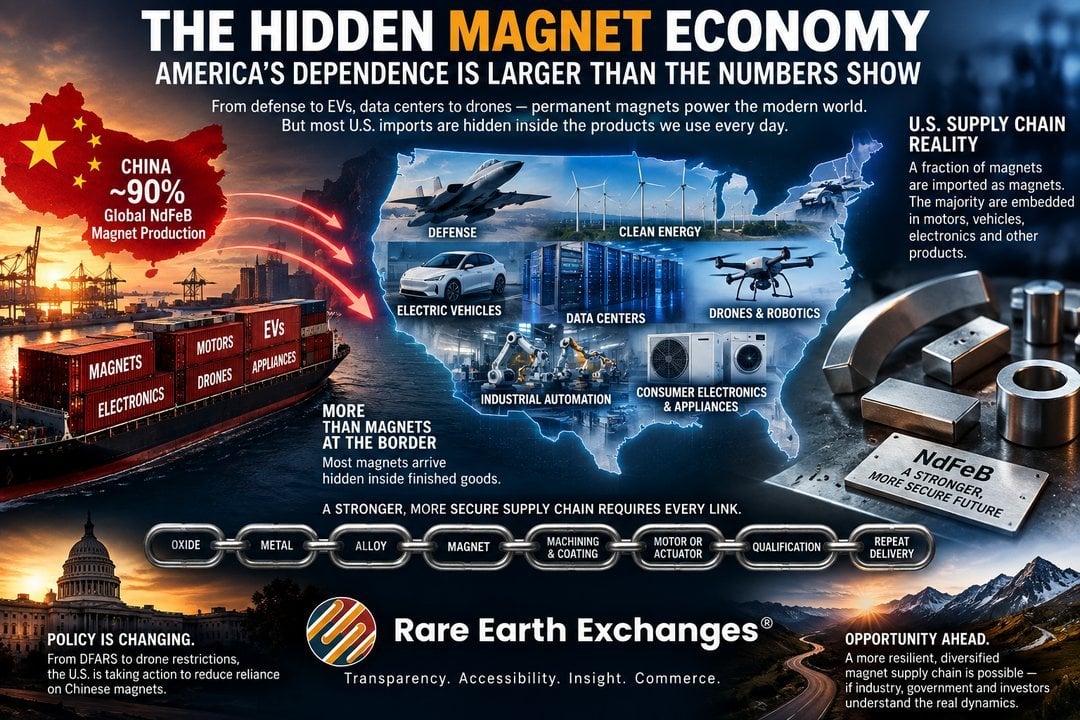
But those numbers measure magnets crossing the border as magnets. They largely miss the magnets already buried inside motors, compressors, vehicles, robots, drones, appliances and electronics. Commerce previously estimated that up to 60% of essential U.S. civilian NdFeB demand was satisfied through embedded imports. Columbia University's 2026 analysis confirms that this blind spot remains: customs magnet codes do not capture magnets entering inside finished goods.
Rare Earth Exchanges® has called this the Hidden Magnet Economy and estimates that embedded imports substantially exceed discrete magnet imports.
REEx Insight | America Is Building Magnet Factories for a Supply Chain That Does Not Yet Exist
This is the central Great Powers Era 2.0™ problem: Washington is trying to replace a Chinese industrial ecosystem, not merely Chinese magnets. China accounts for roughly 90%+ of global sintered NdFeB production, according to Columbia's analysis, and its advantage runs from separated oxides through metals, alloys, magnets, machining, motor integration and customer qualification. REEx's manufacturer rankings similarly place China at roughly 90% of rare-earth magnet manufacturing, with 2024 Chinese magnet exports approaching 58,000 tonnes.
The U.S. response is producing an impressive roster of announced factories. Yet nameplate capacity is not the same thing as qualified supply. Commerce identified foreign competition, feedstock availability and labor among the challenges facing U.S. producers. Its 2022 survey actually projected that announced projects could exceed 14,000 tons of U.S. sintered NdFeB capacity by 2026. Reality arrived more slowly.
Noveon Magnetics in Texas has established commercial U.S. production; eVAC began commercial production in 2025 and now has about 2,000 tonnes/year of nameplate capacity; MP Materials produced its first commercial-equipment magnets in 2025 and is building toward approximately 10,000 tonnes/year total U.S. capacity after its 10X facility begins commissioning in 2028. Others are making moves, including family-owned Bunting Magnetics and Advanced Magnet Lab (AML) in Florida. Other substantial players in the U.S. include Arnold Magnetics and Permag.
So there is substantial progress. But the harder question is who buys each magnet, for which motor, at which specification, after whose qualification process, at what price and for how many years? REEx has repeatedly warned that the pathway is not simply oxide → magnet. It is oxide → metal → alloy → magnet → machining/coating/finishing → motor or actuator → qualification → repeat commercial delivery. REEx's EV analysis and Energy Fuels-POSCO coverage show precisely why qualification—not announced tonnage—is the gatekeeper.
The Magnets Customs Cannot See
Consider EVs. The Department of Energy estimates roughly 1–2 kilograms of NdFeB magnet material per EV motor. The United States imported 451,575 EVs in 2025, including 251,371 from Mexico, 93,388 from Germany, 56,490 from Japan and 14,552 from South Korea. Except for Japan, those countries do not manufacture NdFeB at comparable scale, yet they are major destinations for Chinese magnets. A vehicle can therefore arrive "from Mexico" while its traction motor embodies Chinese magnetic material.
The same accounting problem applies to factory automation, pumps, servomotors, electronics and data-center cooling. High-efficiency permanent-magnet motors power fans, blowers and compressors; MP Materials explicitly identifies AI data centers, robotics and drones among future magnet markets, while Japan's Shin-Etsu (one of the top ex-China producers, according to REEx rankings) lists industrial motors, air-conditioner compressors and automotive drive motors among NdFeB applications.
That is why REEx's Hidden Magnet Economy matters: the unit of dependency is not the imported magnet. It is the imported electromechanical system.
China's Magnet Bench Versus the Ex-China Bench
A practical top-ten Chinese high-performance magnet watchlist—not a claimed audited market-share ranking—is: JL MAG Rare-Earth; Beijing Zhong Ke San Huan; Ningbo Yunsheng; Yantai Zhenghai Magnetic Material; Baotou Tianhe Magnetics; Earth-Panda Advanced Magnetic Material; Xiamen Tungsten/Golden Dragon Rare Earth; Ningbo Jintian; Hengdian DMEGC Magnetics; and Advanced Technology & Materials.
REEx rankings repeatedly identify the first six as global leaders; Reuters' 2025 export-license reporting additionally highlighted JL MAG, Yunsheng, San Huan, Tianhe, Earth-Panda and Jintian.
JL MAG illustrates the scale problem alone: REEx reported 29,300 tonnes of magnet blanks and roughly 20,900 tonnes of finished magnets in 2024, with much larger capacity planned.
Outside China, the technology bench is deeper than headlines imply. Japan remains the most sophisticated alternative, led by Proterial/NEOMAX, (opens in a new tab) Shin-Etsu Chemical, TDK and Daido Electronics. Proterial markets high-performance NEOMAX sintered NdFeB into advanced motors, while Shin-Etsu operates an unusually integrated system spanning rare-earth separation/refining through magnet production and has manufacturing throughout Asia, including its integrated Vietnam operation.
South Korea brings Star Group Industrial and a rapidly developing magnet/motor-core ecosystem around POSCO plus JS Link. REEx has tracked POSCO-linked efforts to qualify ex-China NdPr for EV supply chains. Germany's VACUUMSCHMELZE (eVac) remains a major Western technology incumbent and has now transferred that knowledge into eVAC's South Carolina operation.
The U.S. buildout includes Noveon Magnetics in Texas, MP Materials, eVAC, USA Rare Earth, Vulcan Elements and recycling/remanufacturing initiatives including HyProMag USA, alongside established specialty players such as Arnold Magnetic Technologies. REEx has tracked this expansion closely.
EVs and Drones Reveal the Plug-and-Play Problem
Automakers illustrate how procurement actually works. Traditionally, a Tier-1 supplier—Nidec, Denso, Bosch, ZF, BorgWarner and others—integrates magnets into a traction motor or e-axle built to the OEM's specification. REEx has documented this tiered dependency.
But geopolitics is pulling OEMs upstream. General Motors now contracts directly with magnet manufacturers including Noveon, while MP Materials has a major GM relationship. That is supply-chain insurance: the OEM increasingly wants visibility into the magnet even when another supplier builds the motor.
Drones provide an even sharper preview. REEx's "Drone Supply Chain Disruption" and "Drone Wars Meet Supply Chain Reality" showed that American drone assembly could remain dependent on Chinese motors, magnets, electronics and other critical components. The U.S. then escalated policy: in December 2025, the FCC added foreign-produced UAS and critical components to its Covered List, restricting new equipment authorizations subject to exemptions.
That policy can create demand. It cannot instantly create qualified suppliers.
REEx Bottom Line | Build Around Customers, Not Capacity Announcements
America does need more magnet factories. But ten aspiring magnet manufacturers chasing the same defense and premium automotive customers would not equal a resilient ecosystem, but rather overproduction and crisis.
The successful model must begin downstream: identify the qualified motor, compressor, actuator, robot, drone or traction-drive customer; lock specifications and long-duration demand; qualify an ex-China magnet; secure alloy and separated oxide; then scale manufacturing around that demand.
Otherwise, new U.S. plants face a brutal combination: Chinese-scale price competition, followed by Japanese, Korean and German competition, capital-intensive manufacturing, long qualification cycles, thin component margins and customers whose existing global factories were designed around Asian supply. Commerce precisely identified this challenge years ago when it concluded that domestic magnet viability required sufficient commercial demand—not defense demand alone.
Great Powers Era 2.0™ is therefore moving the battlefield downstream.
America does not win by producing a magnet. It wins when an American or allied magnet can plug directly into the motor, drone, robot, EV, cooling system or defense platform that industry is already building—at specification, at scale, on time and at a price the customer can survive.
Follow the link to subscribe and access REEx Insights rare earth supply chain rankings including sintered permanent magnet producers.
Citations
- U.S. International Trade Commission, DataWeb — U.S. imports under HTS 8505.11, permanent magnets and articles intended to become permanent magnets, 2024–2025. USITC DataWeb (opens in a new tab)
- U.S. International Trade Commission, Harmonized Tariff Schedule of the United States — HTS 8505.11.0070, sintered neodymium-iron-boron permanent magnets. USITC Harmonized Tariff Schedule (opens in a new tab)
- U.S. Department of Commerce, Bureau of Industry and Security, The Effect of Imports of Neodymium-Iron-Boron Permanent Magnets on the National Security, Section 232 Investigation, September 2022. Commerce/BIS Section 232 Investigation (opens in a new tab)
- Columbia University Center on Global Energy Policy, 2026 analysis of rare-earth permanent magnets, U.S. supply-chain dependence, embedded magnet imports and China's dominance of sintered NdFeB manufacturing. Columbia Center on Global Energy Policy (opens in a new tab)
- Rare Earth Exchanges, "The Hidden Magnet Economy: Why America's Rare Earth Dependence Is Far Larger Than Customs Data Suggest." REEx — The Hidden Magnet Economy
- Rare Earth Exchanges — coverage and rankings of global rare-earth permanent-magnet manufacturers and Chinese NdFeB production/export dominance. Rare Earth Exchanges
- Reuters, 2025 reporting on Chinese rare-earth magnet export licenses and manufacturers including JL MAG, Ningbo Yunsheng, Beijing Zhong Ke San Huan, Baotou Tianhe, Earth-Panda and Ningbo Jintian. Reuters (opens in a new tab)
- Rare Earth Exchanges — coverage of JL MAG Rare-Earth, including 2024 magnet-blank and finished-magnet production and capacity expansion. Rare Earth Exchanges — JL MAG coverage
- Proterial, NEOMAX rare-earth magnets — product specifications and applications for high-performance sintered NdFeB magnets. Proterial — NEOMAX (opens in a new tab)
- Shin-Etsu Chemical, Rare Earth Magnets — NdFeB magnet technology, manufacturing and applications including automotive drive motors, industrial motors and air-conditioner compressors. Shin-Etsu Chemical
- TDK Corporation — rare-earth magnet materials, technologies and automotive/industrial applications. TDK
- Daido Electronics — rare-earth magnet technology and manufacturing. Daido Electronics
- VACUUMSCHMELZE — high-performance permanent magnets and rare-earth magnet technology. VACUUMSCHMELZE
- eVAC Magnetics — U.S. rare-earth permanent-magnet manufacturing in Sumter, South Carolina. eVAC Magnetics
- Noveon Magnetics — commercial U.S. NdFeB magnet manufacturing and recycling/remanufacturing operations in Texas. Noveon Magnetics
- MP Materials — Fort Worth magnetics operations, GM supply relationship and planned 10X rare-earth magnet manufacturing facility. MP Materials
- General Motors — U.S. rare-earth magnet sourcing and supply-chain agreements involving MP Materials and Noveon Magnetics. General Motors (opens in a new tab)
- USA Rare Earth — Stillwater, Oklahoma rare-earth magnet manufacturing development and U.S. mine-to-magnet strategy. USA Rare Earth
- Vulcan Elements — U.S. rare-earth magnet manufacturing and domestic supply-chain development. Vulcan Elements
- Arnold Magnetic Technologies — U.S. manufacturer of permanent magnets, magnetic assemblies and specialty magnetic materials. Arnold Magnetic Technologies
- Advanced Magnet Lab — U.S. permanent-magnet technology and manufacturing development. Advanced Magnet Lab
- Bunting — U.S. magnetic technology, permanent magnets and magnetic assemblies. Bunting (opens in a new tab)
- HyProMag USA / Ionic Technologies — rare-earth magnet recycling and hydrogen-processing technology for recovering and remanufacturing NdFeB magnets. Ionic Rare Earths (opens in a new tab)
- U.S. Department of Energy, Vehicle Technologies Office — rare-earth permanent magnets and NdFeB requirements in electric-vehicle traction motors. DOE Vehicle Technologies Office (opens in a new tab)
- U.S. International Trade Commission, DataWeb — 2025 U.S. electric-vehicle import statistics by country of origin. USITC DataWeb (opens in a new tab)
- Rare Earth Exchanges — analysis of Energy Fuels/POSCO rare-earth supply arrangements and qualification of ex-China NdPr material for automotive supply chains. Rare Earth Exchanges
- Rare Earth Exchanges, "Drone Wars Meet Supply Chain Reality." REEx — Drone Wars Meet Supply Chain Reality
- Rare Earth Exchanges — "Drone Supply Chain Disruption" coverage of Chinese motors, magnets, electronics and other components embedded in U.S. drone supply chains. Rare Earth Exchanges
- Federal Communications Commission, Covered List — foreign-produced unmanned aircraft systems and critical components added to the Covered List in December 2025, subject to specified exemptions. FCC Covered List (opens in a new tab)
- U.S. Department of Commerce, Bureau of Industry and Security, 2022 Section 232 NdFeB investigation — findings concerning foreign competition, feedstock, workforce, projected domestic capacity, commercial demand and the limitations of relying solely on defense demand to sustain a U.S. magnet industry. Bureau of Industry and Security (opens in a new tab)


0 Comments
No replies yet
Loading new replies...
Moderator
Join the full discussion at the Rare Earth Exchanges Forum →