
Highlights
- Vulcan Elements and Noveon Magnetics share a five-year Army IDIQ to supply N52SH-class NdFeB magnets for SkyFoundry drone motors, covering a potential 6.72 million magnet segments.
- SkyFoundry is a distributed Army manufacturing ecosystem targeting roughly 10,000 drones per month, not a single million-drone factory—making Vulcan's mass-production readiness the key open question.
- Vulcan's $50 million CHIPS-backed Benson, NC facility and a planned 2027 feedstock agreement with Ucore Rare Metals represent future milestones, not current demonstrated supply.
- China still produces 90–95% of sintered rare earth magnets and processes ~98% of heavy rare earths, leaving the source of dysprosium and terbium in Vulcan's formulation publicly unresolved.
- The Army award was announced one day before a Trump-Xi summit where rare earth supply chain leverage was expected to feature prominently in negotiations.
Vulcan Elements (opens in a new tab) has won a competitive U.S. Army selection to supply high-performance NdFeB magnets for SkyFoundry's small-drone manufacturing effort—but investors should parse precisely what has been demonstrated. Vulcan says it was selected after submitting data sheets matching Army performance specifications and undergoing capability and past-performance reviews. The announcement does not establish that the Army independently tested and validated production magnets under this procurement, nor does it establish a large-volume purchase commitment. Firm timelines are not delineated either. Note that Vulcan also shares the five-year, multiple-award Indefinite Delivery, Indefinite Quantity— IDIQ with Noveon Magnetics (opens in a new tab). The award is nevertheless strategically significant. The Army is moving rare-earth security from policy language into actual component procurement.
SkyFoundry is a U.S. Army initiative and pilot program led by the Army Materiel Command designed to rapidly develop, test, and manufacture small uncrewed aircraft systems (drones) at a massive scale. REEx asks, among other things, where the heavy rare earths will come from. To date, China manufactures about 90%–95% of sintered rare earth magnets while processing about 98% of all heavy rare earth elements required.

REEx Insight: The Magnet Is Becoming Part of the Arsenal
This is Great Powers Era 2.0™ industrial policy becoming procurement. The Army's underlying requirement calls for N52SH-class NdFeB magnets for brushless DC drone motors. Its planning case covers roughly 480,000 motors using 14 magnet segments each—6.72 million individual magnets. At four motors per drone, that happens to align closely with SkyFoundry's reported initial industrial objective of roughly 10,000 drones monthly, although that conversion is an REEx inference, not an Army forecast.
That distinction matters because Vulcan has cleared a procurement gate, not yet proved mass production at SkyFoundry scale. And while Vulcan is privately held, interested investors must understand where in the value chain and Transition Vulnerability Window this deal emerges. Vulcan's own release says it was competitively selected after providing data sheets matching the required specifications. That is meaningful evidence of technical and organizational readiness. But matching specifications on paper, receiving an IDIQ award, and delivering qualified magnets repeatedly and economically at million-component scale are different milestones. That execution gap is now the principal Vulcan risk—and opportunity.
Tobyhanna Army Depot
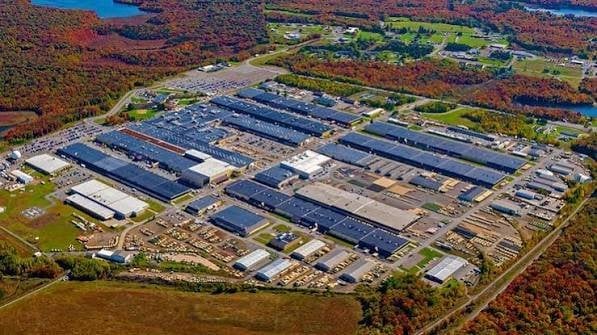
Source: Tobyhanna Army Depot
SkyFoundry Is Bigger Than Tobyhanna
SkyFoundry should not be reduced to a "million-drone factory" at Tobyhanna Army Depot. (opens in a new tab)
The Army is constructing a distributed manufacturing ecosystem. Tobyhanna has opened a brushless DC motor line capable of producing more than 500,000 motors annually. Other Army industrial facilities contribute airframes, additive manufacturing, integration, and other functions. The nearer-term production objective reported by Defense News has been approximately 10,000 drones per month, not one million annually today.
The million-unit figure is better understood as the strategic scale ambition rather than demonstrated present output. Congressional Research Service reporting also underscores how fluid the ramp remains: the Army's FY2027 request included $151 million for SkyFoundry, while CRS described an Army goal of producing 10,000 drones within a year of receiving funding.
This makes SkyFoundry less a factory than an experiment in reconstructing an American industrial stack:
minerals → separation → metals → alloys → magnets → motors → electronics → airframes → software → mass production.
The Hard Question: Where Do the Atoms Come From?
Vulcan says its platform is decoupled from China across materials, technology, software, intellectual property, and ownership. The Army award does not independently prove that entire proposition. REEx cites key issues above, including the Chinese monopoly on heavy rare earth separation and magnet making.
The company's planned upstream relationship with Ucore Rare Metals illustrates a point. Their March agreement contemplates Ucore providing NdPr and Dy oxide samples during 2026 and moving toward commercial-scale supply beginning in 2027. That is an important pathway—but currently an MOU toward future commercial supply, not evidence that Ucore material is already flowing into SkyFoundry magnets.
Nor should we automatically assume the Army's N52SH specification means substantial dysprosium consumption. The public procurement specification establishes magnetic performance, not Vulcan's proprietary chemistry. The relevant diligence question is therefore narrower and better: What formulation achieves Vulcan's required coercivity, does it require Dy or Tb, and—if so—where are those atoms separated and metallized?
That answer remains commercially important and publicly unresolved.
Benson Is the Real Scaling Test
Vulcan's much larger wager is its Benson, North Carolina expansion. The Commerce Department has finalized $50 million in CHIPS direct funding for equipment supporting rare-earth separation, metallization, and magnet manufacturing. NIST says Vulcan plans to manufacture, process, and produce up to 10,000 metric tonnes of NdFeB material over the next several years. That federal backing is substantial validation—but planned capacity remains different from demonstrated production.
REEx therefore sees the milestones sequentially: competitive selection → product qualification → repeat deliveries → Benson commissioning → documented ex-China feedstock → commercial yields and costs → high-volume production. Vulcan has advanced another step down that road. It has not reached the end of it. As we often state, we remain deep in the Transition Vulnerability Window.
The Timing Is Hard to Ignore
There is one final geopolitical wrinkle. Vulcan announced the Army selection on September 23—one day before President Donald Trump hosts Chinese President Xi Jinping in Washington. Rare earths are expected to feature in the discussions, and REEx has already reported that China's dominance of rare-earth processing and magnet supply has become a constraint on Washington's negotiating freedom. There is no public evidence that Vulcan or the Army deliberately timed the announcement to the summit, so causation should not be asserted. But the juxtaposition is remarkable.
As Washington prepares to negotiate with Beijing over a supply chain in which China retains enormous leverage, an American magnet manufacturer is simultaneously publicizing its selection for an Army program explicitly designed around domestic production.
That is Great Powers Era 2.0™ in miniature: diplomacy at the top, industrial reconstruction underneath.
And SkyFoundry exposes the fundamental lesson. A drone may cost thousands of dollars and contain sophisticated software, sensors, and communications. But without fourteen qualified pieces of magnet inside each motor, it does not leave the ground.
REEx Connect
| Organization | Role | REEx Relevance |
|---|---|---|
| Vulcan Elements / John Maslin | NdFeB manufacturer | Army awardee; Benson expansion; domestic magnet strategy |
| Noveon Magnetics / Scott Dunn | NdFeB manufacturer | Second Army IDIQ awardee |
| Tobyhanna Army Depot | Army manufacturing | 500,000+ motor/year production capability |
| Army Materiel Command | SkyFoundry industrial architecture | Coordinates distributed manufacturing model |
| Ucore Rare Metals / Pat Ryan | Rare-earth separation | Proposed 2027 NdPr/Dy oxide supply to Vulcan |
| NIST / CHIPS Program Office | Federal industrial support | $50 million final award supporting Vulcan equipment |


0 Comments
No replies yet
Loading new replies...
Moderator
Join the full discussion at the Rare Earth Exchanges Forum →