
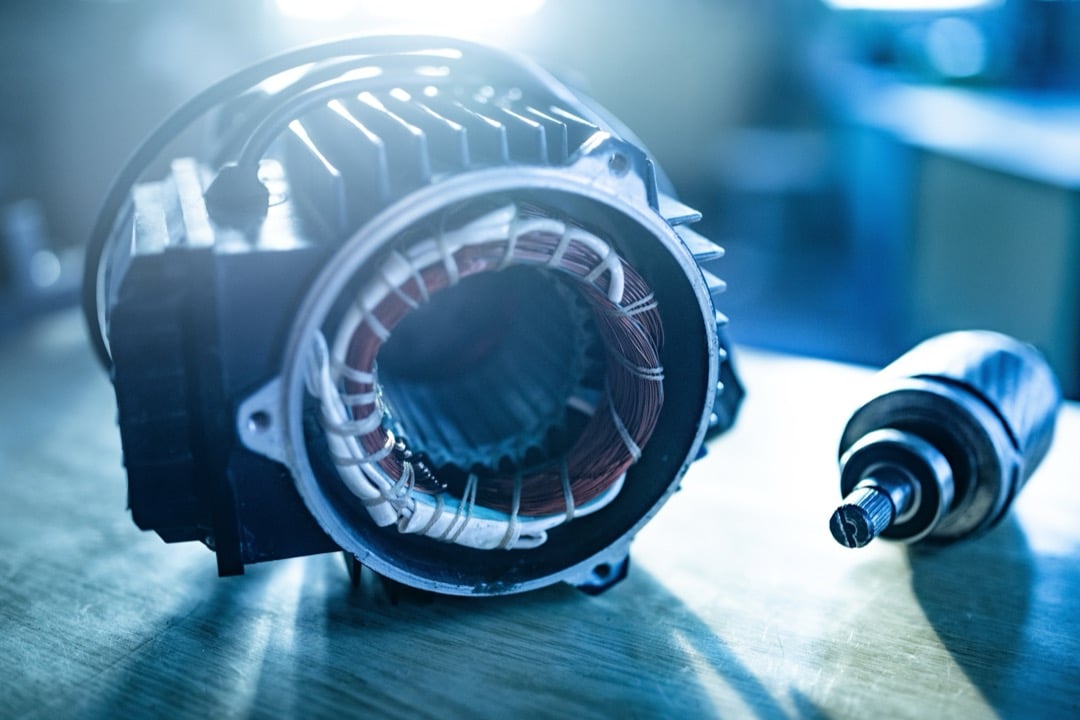
Today’s electric-motor-system industry is spending enormous effort trying to replace rare-earth permanent magnets. But almost everyone is leaving one fundamental assumption untouched: the passive rotor.
Editor’s summary. In this guest essay, Best Electric Machine’s chief technology officer argues that most rare-earth-free motor work replaces the permanent magnet with another passive rotor, and that the architecture itself deserves a second look. He describes his company’s SYNCHRO-SYM design, which pairs an active stator with a brushless, independently active rotor controlled by BEM’s BRTEC.
China’s dominance of the rare-earth permanent-magnet supply chain has created a strategic problem that reaches far beyond the price of neodymium, praseodymium, dysprosium and terbium.
Electric vehicles, industrial motors, wind generation, robotics, aerospace and defense increasingly depend upon high-performance electric motor-generator systems, more often called electric machine systems, which comprise a moving assembly (rotor), a stationary assembly (stator), a frame-bearing assembly, an excitation controller, and, where required, a gearbox to meet the application’s torque-speed requirements.
Excluding superconducting electric machine systems, usable air-gap flux density is constrained by the saturation limits of available electrical-steel cores—electric machine systems produce comparable torque under comparable air-gap flux density, effective electromagnetic area, optimized torque angle, and electrical loading. Therefore, rare-earth permanent-magnet electric machine systems have become particularly valuable as a high-performance benchmark—not simply because of the magnets’ high energy product but because precise torque-angle control is readily provided by today’s advanced excitation-control techniques and their permanent magnets provide a sufficient air-gap rotor magnetic field without electrical excitation.
The problem is that much of the world’s rare-earth processing and permanent-magnet manufacturing capacity is concentrated in China, while sufficient future global capacity remains a valid concern. Some physically smaller, ultra-high-speed machine systems can reduce permanent-magnet requirements, but may require a matching gearbox with additional size, loss and cost at the system level.
The motor industry knows this.
Consequently, substantial investment and enormous engineering resources are being directed toward reducing or eliminating rare-earth permanent magnets from electric motor systems. Induction, synchronous-reluctance, switched-reluctance, field-excited electromagnetic, and non-rare-earth permanent-magnet motor systems are all being reconsidered or developed as alternatives, but valid questions remain about comparable system performance.
That work is important.
But I believe the industry may be overlooking a more fundamental question.
Why are we assuming that the rotor must remain passive?
Contents
The Assumption Hidden Inside Today’s Motor Debate
Look inside virtually every conventional electric machine system, one common architectural relationship appears.
There is an active stator paired with a passive rotor.
The stator contains an independently excited multiphase winding set that actively establishes a controllable rotating electromagnetic field and independently delivers working electromagnetic power. The rotor magnetic field then passively responds through permanent magnets, induced currents, reluctance saliencies, or DC field excitation.
Although the technologies differ, the underlying electromagnetic architecture remains asymmetric: one independently active electromagnetic assembly of the stator works with a rotor whose electromagnetic function is not actively controlled as a second multiphase active winding system that independently contributes working power to the electric to mechanical conversion process.
That distinction matters.
The passive-rotor assembly consumes significant machine resources—mass, volume, materials, losses and cost—and also has compounding consequences for the power electronics and control system. Yet it does not independently contribute the additional working power of a second active rotor winding assembly alongside the universally essential active stator.
So perhaps the rare-earth question should not be limited to:
What can replace the rare-earth permanent magnet?
We should also ask:
Why must we replace it with another passive rotor?
Making Both Halves of the Machine Active
In the classic textbook, Electromechanical Dynamics (1968) (opens in a new tab), Woodson and Melcher derive the fundamental machine relationships using independently excited two-phase winding sets on both stator and rotor. The electromagnetically symmetrical two-phase representation simplifies the mathematical development of the symmetric electromagnetic relationships; the same fundamental principles extend to practical machines with more than two-phases. An independently excited multiphase winding set or active winding set produces a controlled rotating magnetic field relative to its frame and can therefore actively contribute working electromagnetic power. In the fundamental symmetric model, both the stator and rotor contain such active winding sets; therefore, both electromagnetic assemblies independently contribute working power to the electric-to-mechanical conversion process.
Conventional asymmetric machine relationships can then be derived by imposing passive rotor conditions corresponding to induction, permanent magnet, DC field wound, and reluctance rotor mechanisms. For example, in the induction machine case, short-circuiting the rotor winding set eliminates the independently controlled rotor electrical power port; only the stator assembly remains independently source-controlled through its active winding set.
The fundamental symmetric electromagnetic architecture concept is straightforward: if the rotor is going to occupy comparable machine resources anyway, make it an active contributor rather than merely replacing one passive-rotor mechanism with another.
Under matched package footprint and design conditions, changing the architecture from one independently active electromagnetic assembly to two, respectively placed on the rotor and stator, delivers 2× nominal power, up to 8× peak torque, and the elimination of rare-earth or rare-earth-free permanent magnets. These performance principles are not limited to computer simulation; the independently active stator/active-rotor architecture, essential need for real-time control, and associated performance improvement are supported by academic and controlled laboratory studies (opens in a new tab) dating back to the 1960s and early 1970s, before today’s widespread dependence on rare-earth permanent-magnet motor systems.
The Difficult Part: How Do You Control an Active Rotor?
The classic electromagnetically symmetric active stator, active rotor model therefore presents an intriguing engineering question: what if the rotor winding system is not reduced to a passive electromagnetic function, but instead remains independently active? Historically, the practical challenge was providing precisely controlled multiphase rotor power without brushes, slip rings, circular-rotating transformers, dependence on slip induction, susceptibility to instability from undamped line or rotor perturbations, or limitations historically associated with wound-rotor doubly-fed induction machines.
That practical control problem is central to why the active rotor architecture has not become commonplace. The academic and controlled laboratory studies demonstrated the active-rotor electromagnetic relationships and the associated need for precise real-time control. BEM subsequently developed BRTEC to address that requirement.
Best Electric Machine (BEM) has spent decades developing a practical implementation of this symmetric electromagnetic architecture called SYNCHRO-SYM™, which uses an active stator paired with a brushless, independently active rotor. BEM developed BRTEC™ — Brushless & Sensorless Real-Time Emulation Control — to provide the required active-rotor excitation and precise torque control to enable independence from slip-induction as the fundamental mechanism establishing the rotor’s working electromagnetic field. Instead, rotor excitation is actively controlled across the operating range through a brushless, independent, bidirectional multiphase electrical power port.
This distinction becomes especially revealing around synchronous speed. Conventional terminology often associates multiphase wound rotors with induction or asynchronous machines because slip-frequency relationships arise when rotor speed differs from the rotating stator field. At synchronous speed, however, slip becomes zero and slip-induction excitation ceases. Under BRTEC’s automatic speed-synchronized excitation and precision torque control, SYNCHRO-SYM’s active rotor does not rely on slip-induction nor cease functioning when slip disappears because slip induction is not required to establish its working rotor field while preserving controlled field-weakening capability.
The result is an independently active stator/active-rotor machine capable of controlled operation below, at and above synchronous speed. Under BEM’s matched comparison conditions, this provides twice the constant-torque speed range (CTSR) for a given torque, excitation voltage and frequency, corresponding to twice the power of a passive-rotor electric machine system whose CTSR ends at synchronous speed.
This Is Not Just a Computer Model
The distinction between a promising electric machine system concept and a commercially relevant alternative is critical.
SYNCHRO-SYM is not merely a theoretical proposal.
Best Electric Machine has built and tested multiple physical machines demonstrating the independently active stator/active-rotor principle and its brushless and sensorless real-time emulation control.
Although BEM demonstrated SYNCHRO-SYM by retrofitting its active-rotor technology to rotor modified standard-frame induction electric machines from a major motor manufacturer, another illustrative retrofit path would be simpler with today’s rare-earth-free electrically excited synchronous motor (EESM): remove its slip-ring or circular-rotating transformer excitation assembly and controller, expose the individual rotor pole-winding terminals, and replace the existing excitation control function with BRTEC, individually connecting the rotor pole-winding terminals to the active-rotor excitation system. This illustrates how an established passive-rotor package could conveniently provide a familiar mechanical retrofit platform for a SYNCHRO-SYM implementation designed around BEM’s active-rotor architecture and its 2× nominal-power and up-to-8× peak-torque principles.
This development history matters because today’s rare-earth discussion contains numerous emerging substitutes whose ultimate performance, manufacturability, cost and scalability at high production volumes are still being established.
With the underlying technology validated, BEM’s present objective is therefore not another motor research program.
The objective is U.S. commercialization of a validated technology as a manufactured motor-generator system.
Why Isn’t the Active-Rotor Alternative Part of the Discussion?
This may be the most interesting question.
Search today’s discussions of rare-earth-free motors and the alternatives repeatedly return to packaging variations of familiar asymmetric passive-rotor categories: induction, reluctance, switched reluctance, and electrically excited DC field-wound machine-system technologies.
Active stator plus independently active brushless rotor rarely appears as a distinct commercial category.
That absence can become self-reinforcing.
Engineers develop what they know. Universities teach established machine classifications. Government programs fund technologies fitting recognized categories. Manufacturers invest in production systems surrounding existing architectures. Technical literature then expands around those same technologies.
Eventually, an architectural assumption can become so familiar that it stops looking like an assumption.
I have even observed this problem using artificial intelligence to investigate rare-earth-free motor technologies. Initial searches repeatedly identified passive-rotor alternatives. The independently active-rotor architecture became visible only after the search was specifically directed toward that distinction, with SYNCHRO-SYM emerging as the active-rotor architecture under examination.
That does not by itself prove that SYNCHRO-SYM is superior, but it does demonstrate something different and perhaps more important at this stage:
The active-rotor alternative is largely missing from the comparison.
China’s Advantage Is More Than Its Resources
This distinction has consequences beyond motor engineering.
If an EV manufacturer replaces a rare-earth permanent-magnet motor with another technology but sacrifices torque density, efficiency, package size or system economics, the manufacturer has created a difficult commercial tradeoff.
That helps explain why rare-earth permanent magnets remain so difficult to displace.
China’s advantage therefore is not simply possession of rare-earth resources. It includes an enormous processing and magnet-manufacturing ecosystem combined with an electric-motor industry optimized around the performance those magnets make possible.
Trying to engineer around that chokepoint exclusively with alternative passive rotors may unnecessarily constrain the solution space.
An independently active rotor changes the question.
Instead of attempting to duplicate the function of China’s rare-earth magnets with another passive mechanism, the machine architecture itself becomes the alternative.
The Implications for the Rare-Earth Market
This subject should matter to people on both sides of the rare-earth market.
For EV manufacturers, defense contractors and industrial users, eliminating RE-PMs can reduce exposure to concentrated foreign processing and magnet manufacturing.
For policymakers, it potentially adds another approach to supply-chain resilience beyond opening mines, developing domestic separation capacity, and subsidizing alternative magnet materials.
And for rare-earth producers and investors, technologies capable of materially reducing rare-earth permanent-magnet demand in large markets, such as electric transportation and wind turbines, are themselves important market intelligence. Reduced demand could also preserve constrained rare-earth supplies for strategic applications that lack practical substitutes.
The question is therefore not whether rare earths remain strategically important. They unquestionably have important applications extending far beyond propulsion motors.
The question is whether every high-performance electric motor must remain dependent on a rare-earth permanent-magnet passive-rotor architecture.
Manufacturing Matters Too
Removing rare-earth magnets solves only part of the industrial problem if the resulting motor remains expensive or difficult to manufacture domestically.
BEM has therefore also been developing BEM-CAD™, an active-rotor computer-aided design tool, and MOTORPRINTER™, a portable and programmable additive-manufacturing approach for producing axial-flux motor cores from thin, high-electromagnetic-performance metallic ribbon, including advanced amorphous and nanocrystalline magnetic materials.
The larger objective is not simply to invent a rare-earth-free motor.
BEM’s commercialization strategy is to establish a scalable U.S. design and manufacturing platform capable of producing high-performance electric motor-generator systems without dependence on rare-earth permanent magnets or a geographically concentrated manufacturing infrastructure—and to become a U.S.-based motor-system manufacturer rather than merely a developer or licensor of another motor concept.
A Different Path Out
The electric-machine industry has made extraordinary advances in materials, semiconductor switching, digital control, magnetic design and manufacturing. By changing the electromagnetic architecture from the asymmetry of an active stator/passive rotor architecture to the symmetry of an independently active stator/active rotor architecture enabled by BRTEC, SYNCHRO-SYM leverages these same advances in materials, semiconductor switching, digital control, magnetic design and manufacturing.
But the fundamental active-stator/passive-rotor architecture has remained remarkably persistent.
Perhaps that persistence is justified.
Or perhaps it has simply gone largely unquestioned.
As the United States and other nations substantially fund efforts to reduce their exposure to China’s rare-earth permanent-magnet supply chain, this seems like the right time to ask the question again:
What if we do not need another passive-rotor electric motor system?
Instead of continually asking what material or mechanism can replace the rare-earth permanent magnets, perhaps part of the answer is to reconsider the architecture that made us so dependent upon it.
That is the proposition behind SYNCHRO-SYM:
Make the rotor active. Make the electromagnetic system symmetric. Eliminate permanent magnets, including rare-earth permanent magnets. Strategically secure the IP. Restore advanced electric machine system technology and competitive motor-generator system manufacturing to the United States.
Frequently asked questions
What is the "passive rotor" assumption in electric motors?
According to the author, in virtually every conventional electric machine an active stator with an independently excited multiphase winding set works with a rotor whose field responds through permanent magnets, slip-induced currents, reluctance saliencies or DC field excitation. He argues the rotor’s electromagnetic function is not actively controlled as a second multiphase winding system contributing additional electric-to-mechanical working power alongside the active stator. Under the matched torque, voltage, and frequency of excitation rating, the passive rotor machine’s constant-torque speed range ends at synchronous speed, providing a rated mechanical power equal to the product of torque and synchronous speed.
What is SYNCHRO-SYM?
Best Electric Machine describes SYNCHRO-SYM as an architecture that pairs an active stator with a brushless, independently active rotor, so both electromagnetic assemblies independently contribute controlled working electromagnetic power in a similar package footprint. The company says the design eliminates permanent magnets, rare-earth or otherwise. Under the same matched comparison, BEM states that SYNCHRO-SYM extends the constant-torque speed range to twice synchronous speed, providing a rated mechanical power equal to twice the product of torque and synchronous speed.
How does the author say an active rotor gets its excitation without brushes or slip rings?
The author says BEM developed BRTEC, Brushless & Sensorless Real-Time Emulation Control, to supply active-rotor excitation and precise torque control independent of slip induction. Rotor excitation is actively controlled through a brushless, independent, bidirectional multiphase electrical power port, allowing continuously controlled operation below, at and above synchronous speed.
Why does the author say rare-earth magnets are hard to replace?
He says replacing them with another technology can cost torque density, efficiency, package size or system economics, and that China’s advantage includes a large processing and magnet-manufacturing ecosystem plus an electric-motor industry optimized around what those magnets make possible.
Where do the article’s performance claims come from?
The author cites independent academic literature on double-armature/doubly-fed electric machines, along with BEM’s laboratory studies and physical-machine testing. BEM applies those underlying electromagnetic principles to its SYNCHRO-SYM architecture and BRTEC implementation. REEx has not independently verified BEM’s implementation or commercial performance claims.
How does BEM propose to manufacture SYNCHRO-SYM in the United States?
BEM says its commercialization platform includes BEM-CAD™, an active-rotor computer-aided design tool, and MOTORPRINTER™, a portable and programmable additive-manufacturing process for producing axial-flux motor cores from thin metallic ribbon, including advanced amorphous and nanocrystalline magnetic materials. The company’s objective is to combine SYNCHRO-SYM, BRTEC, BEM-CAD and MOTORPRINTER into a scalable, reprogrammable U.S.-based motor-generator design and manufacturing platform.
Disclaimer: This article is a guest contribution. The views and opinions expressed are those of the author, Frederick Klatt, and do not necessarily reflect the views of Rare Earth Exchanges. The author is an executive of Best Electric Machine, which develops the technology described, and the performance claims are the author’s and the company’s own. Rare Earth Exchanges has not independently verified them and does not endorse any product or company.
This article is for informational purposes only and is not investment advice. Rare Earth Exchanges has received no compensation from any company named in this article. Figures and claims can change, so verify them independently and speak with a licensed financial advisor before making investment decisions.
