
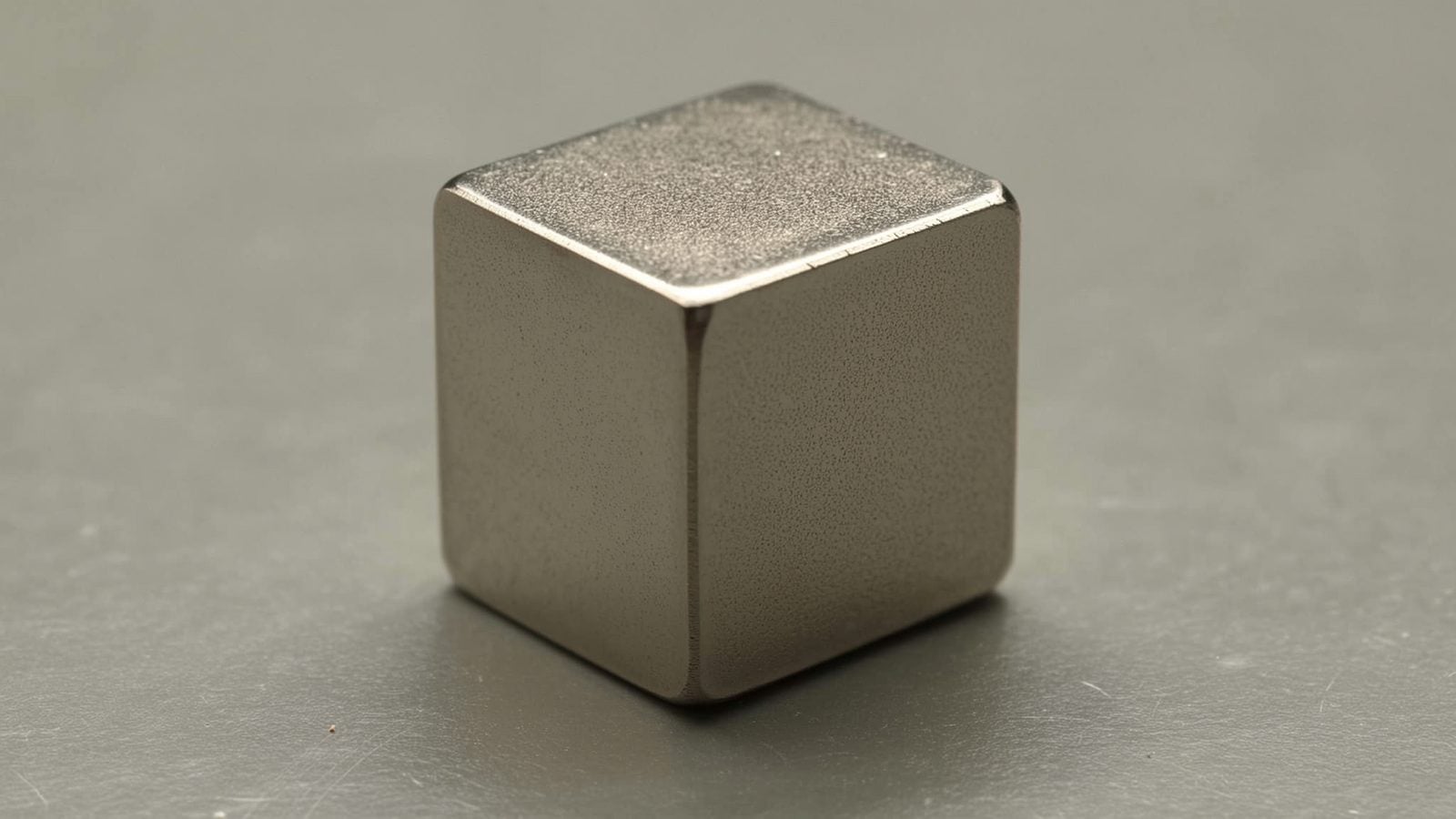
If you buy magnets by number alone, you can overpay for strength you cannot use or pick a part that fails in heat; understanding neodymium magnet grades fixes that. Each grade pairs a letter that names the magnet family with a number that marks its strength, and some grades carry extra letters that set how hot the magnet can run. This guide covers what N35 through N52 mean, what the temperature letters tell you, and how to match a grade to your size and heat needs without paying for more than you need. The material at the center of all this is neodymium.
Table of Contents
What do neodymium magnet grades mean?
In a standard grade like N42, the letter marks the magnet family and the number is the maximum energy product, so a higher number means a stronger magnet of the same size. The N stands for neodymium, meaning sintered NdFeB, and the number is the material's maximum energy product measured in MGOe. Grades you can readily buy run from N30 to N52, while the broader commercial range stretches a little wider at each end. Wikipedia puts the full commercial range at N28 to N55 and the theoretical maximum energy product at about 64 MGOe.
The letter and the number
The N is short for neodymium. The number that follows is the maximum energy product, often written as BHmax. First4magnets explains this grade naming in its guide to neodymium magnet grades (opens in a new tab). A larger number means more stored magnetic energy packed into the same volume.
The commercial range and the theoretical ceiling
The neodymium magnet grades you can readily buy fall in a narrow band. The wider commercial set runs past that band at both ends, and there is a hard physical limit above the highest grade you can buy. Both limits come from the Wikipedia overview of neodymium magnets (opens in a new tab) and from Stanford Magnets on neodymium magnet grades (opens in a new tab).
Remanence, coercivity and energy product in plain terms
Three properties sit behind neodymium magnet grades. Remanence, or Br, is how strong the magnetic field is after you magnetize it. Coercivity, or Hcj, is how well the magnet resists being demagnetized by heat or an opposing field. The maximum energy product combines both into a single figure of merit, which is the number in the grade.
Key figures (verified 2026-10-26)
| Item | Value | Source | As of |
|---|---|---|---|
| Grade naming (N = neodymium; number = BHmax in MGOe) | N = neodymium; number = max energy product in MGOe | First4magnets - Grades of Neodymium Magnets (opens in a new tab) | 2026-10-26 |
| Grades commonly available to buy | N30 to N52 | Stanford Magnets - Neodymium Magnet Grades (opens in a new tab) | 2024-10-22 |
| Commercial range and theoretical maximum | N28 to N55; theoretical max ~64 MGOe | Wikipedia - Neodymium magnet (opens in a new tab) | 2026-10-26 |
| Strongest grade at room temperature | N52 | K&J Magnetics - Magnet Grades (opens in a new tab) | 2024-12-30 |
| N42 vs N52 residual flux density (Br) | N42 13,200 G; N52 up to 14,800 G | K&J Magnetics - Magnet Grades (opens in a new tab) | 2024-12-30 |
| N35 standard properties | Br 1,170-1,220 mT; BHmax 33-36 MGOe | First4magnets - Grades of Neodymium Magnets (opens in a new tab) | 2026-10-26 |
| N42 standard properties | Br 1,280-1,320 mT; BHmax 40-43 MGOe | First4magnets - Grades of Neodymium Magnets (opens in a new tab) | 2026-10-26 |
| N52 standard properties | Br 1,430-1,480 mT; BHmax 50-53 MGOe; Hcj at least 876 kA/m (vs at least 955 kA/m for N35-N48) | First4magnets - Grades of Neodymium Magnets (opens in a new tab) | 2026-10-26 |
| Relative strength and price steps | N52 ~20% over N42 at ~2x price; N42 ~20% over N35 | Stanford Magnets - Neodymium Magnet Grades (opens in a new tab) | 2024-10-22 |
| Pull force, 1/2 x 1/8 in disc | N35 5.4 lb; N42 6.5 lb; N52 8.15 lb | Total Element - What Does the N Rating Mean? (opens in a new tab) | 2026-10-26 |
| N42 may outperform N52 at warm temperature | 60-80 C (140-176 F) | K&J Magnetics - Magnet Grades (opens in a new tab) | 2024-12-30 |
| Temperature suffix maximum operating temperatures | None 80 C; M 100 C; H 120 C; SH 150 C; UH 180 C; EH 200 C; AH 230 C | First4magnets - Grades of Neodymium Magnets (opens in a new tab) | 2026-10-26 |
| One producer's divergent ratings | N52 and N55 rated 60 C; AH 220 C | Arnold Magnetic Technologies - Neodymium Magnets (NdFeB) (opens in a new tab) | 2026-10-26 |
| SH version same pull force, 1 x 3/8 in disc | N42 and N42SH both 37.8 lb | Total Element - What Does the N Rating Mean? (opens in a new tab) | 2026-10-26 |
| Minimum intrinsic coercivity (Hcj) by suffix | Standard 955; M 1,114; H 1,353; SH 1,592; UH 1,990; EH 2,388; AH 2,624 kA/m | First4magnets - Grades of Neodymium Magnets (opens in a new tab) | 2026-10-26 |
| Temperature coefficients | Br -(0.09-0.12) %/K; Hci -(0.40-0.65) %/K | Wikipedia - Neodymium magnet (opens in a new tab) | 2026-10-26 |
| Grain boundary diffusion effect | Lowers Dy/Tb use; favors thickness under 6 mm | Arnold Magnetic Technologies - Neodymium Magnets (NdFeB) (opens in a new tab) | 2026-10-26 |
| Price pattern for grade and letter | Higher grade and letter cost more; N35SH > N38/N40 | SM Magnetics - Understanding Magnet Grades and Materials Tables (opens in a new tab) | 2026-10-26 |
| Sintered NdFeB general properties | Br 1.0-1.4 T (typically 1.3 T); density 7.3-7.7 g/cm3 | Wikipedia - Neodymium magnet (opens in a new tab) | 2026-10-26 |
| Standard corrosion coatings | Ni, Ni-Cu-Ni, Zn | Wikipedia - Neodymium magnet (opens in a new tab) | 2026-10-26 |
| China share of sintered permanent magnet output | 94% (2024); around 50% (2005) | IEA - Rare Earth Elements: Executive summary (opens in a new tab) | 2026-10-26 |
| Chinese export controls | April 2025, seven heavy rare earths, compounds and magnets | IEA - Rare Earth Elements: Executive summary (opens in a new tab) | 2026-10-26 |
How much stronger is each grade? Comparing the common grades
Higher grades are stronger, and the price climbs with them. N42 is about 20% stronger than N35, and N52 is about 20% stronger than N42, though that top step comes at roughly twice the price. Pull force on a small disc shows the same steps. One caution matters for real jobs: the top grade can give up its lead once the magnet runs warm, and its coercivity floor sits lower than the middle grades.
Remanence and energy product by grade
Remanence and energy product both climb from N35 to N42 to N52. First4magnets lists a maximum energy product of 33-36 MGOe for N35, 40-43 MGOe for N42 and 50-53 MGOe for N52, with remanence rising from 1,170-1,220 mT to 1,280-1,320 mT to 1,430-1,480 mT. N52 is the strongest grade generally available at room temperature, a point K&J Magnetics makes in its breakdown of magnet grades (opens in a new tab).
Pull force for the same size magnet
Numbers on a datasheet turn into pull force on a real part. For a half-inch disc an eighth of an inch thick, the listed pull force rises with grade, as Total Element shows in its explainer on the N rating (opens in a new tab). The listed pull is 5.4 lb in N35, 6.5 lb in N42 and 8.15 lb in N52.
When a lower grade beats the top grade
Warm operating conditions change the ranking. At slightly elevated temperatures, an N42 magnet can outperform an N52 of the same size. K&J Magnetics puts that range at 60-80°C (140-176°F). So when you weigh n35 vs n52, check the operating heat as well as the room-temperature strength. For a worked example of this trade-off in traction motors, see our coverage of magnet grade choices in electric vehicle motors.
What the temperature letters mean
The suffix letters describe heat tolerance. A grade with no suffix is rated to a base maximum operating temperature, and each letter up the ladder raises that ceiling, from M through H, SH, UH, EH and AH. As the ceiling rises, the minimum intrinsic coercivity rises with it. First4magnets gives the ceilings as 80°C with no suffix, 100°C for M, 120°C for H, 150°C for SH, 180°C for UH, 200°C for EH and 230°C for AH. One producer rates its highest standard grades to a lower temperature than the general chart, so treat the letters as a guide and check the chart for each brand.
The temperature ladder
The suffix sets how hot the magnet can run before it loses performance. Each letter in that ladder raises the ceiling by one step.
Why a heat-rated magnet is not stronger
An SH magnet holds its strength to a higher temperature than the plain grade, yet it does not pull harder at room temperature. Total Element lists a one-inch disc at the same pull force in N42 and N42SH. Both are listed at 37.8 lb for a 1 x 3/8 inch disc.
Producer tables do not always agree
Grade charts vary by maker. Arnold Magnetic Technologies rates its standard N52 and N55 to a lower maximum temperature than the general chart, as shown in its NdFeB product page (opens in a new tab). When a part runs near its limit, confirm the rating with the supplier rather than assuming the common chart applies.
Browse rare earth magnet suppliers on the REEx Marketplace (opens in a new tab)
Why high-temperature grades depend on heavy rare earths
Magnet strength fades as the temperature climbs. Heavy rare earth additions curb heat losses at a cost, and grain boundary diffusion cuts how much of those elements a magnet needs.
How heat erodes a magnet
Both remanence and coercivity drop as a magnet heats up. The Wikipedia overview gives the temperature coefficient of remanence as about -0.09 to -0.12% per kelvin, against -0.40 to -0.65% per kelvin for coercivity. Coercivity falls several times faster than remanence per degree.
What heavy rare earth additions do
Adding dysprosium or terbium curbs the loss of performance as temperature rises. Those additions make the magnets more costly to produce, a point the Wikipedia overview states directly.
Grain boundary diffusion
Grain boundary diffusion lowers the amount of dysprosium and terbium a magnet needs while keeping its temperature stability. Arnold Magnetic Technologies notes the method favors magnets thinner than 6 mm or laminated materials. For the equipment side of this processing, see our report on the machines behind the magnets.
Choosing a grade, and what drives the price
When comparing neodymium magnet grades, a simple decision rule keeps cost down: buy the lowest number and the lowest letter that still meet your size and temperature need. As a general rule, both the number and the letter push the price up.
Matching grade to size and heat
Start with the space you have and the heat the magnet will see. If the part fits a larger magnet, a lower grade may do the job. If it runs hot, the temperature letter matters more than the number. Motor designers face this trade-off directly, as our look at rare earth magnets in electric vehicles shows.
Why higher grades and letters cost more
As a general rule, price rises with both the grade number and the temperature letter. SM Magnetics notes that an N35SH will most likely cost more than an N38 or even an N40, a point it makes in its guide to magnet grades and materials tables (opens in a new tab). The heat rating is what pulls that price up.
Supply concentration and export controls
Magnet supply is also concentrated. China produced 94% of the world's sintered permanent magnets in 2024, up from around 50% in 2005, as the IEA executive summary on rare earth elements (opens in a new tab) reports. In April 2025, China introduced export controls on seven heavy rare earth elements, related compounds and magnets.
Browse rare earth magnet suppliers on the REEx Marketplace (opens in a new tab)
Frequently asked questions
What is the strongest neodymium magnet grade?
N52 is the strongest grade you can buy at room temperature, giving the highest strength in the smallest package. It carries the highest remanence and energy product of the common grades. At 60-80°C, though, an N42 might outperform it, so check the operating heat before you choose. The exact figures sit in the key figures table on this page.
N35 vs N52: which grade is stronger?
N52 holds more remanence and a higher energy product than N35, making it stronger for the same size at room temperature. N42 is about 20% stronger than N35, and N52 is about 20% stronger than N42. N52 also costs more and has a lower coercivity floor, and at 60-80°C an N42 may outperform it.
Does an SH magnet pull harder than a standard grade?
No. The SH suffix raises the maximum operating temperature and does not make the magnet stronger. Total Element lists a 1 x 3/8 inch disc at 37.8 lb in both N42 and N42SH. The SH version simply holds that strength to a higher temperature before it starts to fade.
What do the letters after the grade number mean?
The letters set the maximum operating temperature. No suffix is the base rating, and M, H, SH, UH, EH and AH each raise the ceiling in turn, with minimum coercivity rising alongside. The ceiling runs from 80°C with no suffix to 230°C for AH. Producer charts can differ, so confirm the rating with the supplier for parts near their limit.
Why do high-temperature magnet grades cost more?
Adding dysprosium or terbium curbs the loss of performance as temperature rises, and it makes magnets more costly to produce. Magnet supply is also concentrated: China produced 94% of the world's sintered permanent magnets in 2024. Grain boundary diffusion can cut how much of them a magnet needs, especially in thinner parts.
Are neodymium magnets prone to rust?
Sintered NdFeB is vulnerable to corrosion, especially along its grain boundaries. Standard protection comes from plating, most often nickel, nickel-copper-nickel or zinc. Choose a coating suited to the magnet's working environment, and confirm the finish with the supplier when corrosion resistance matters for the application.
