
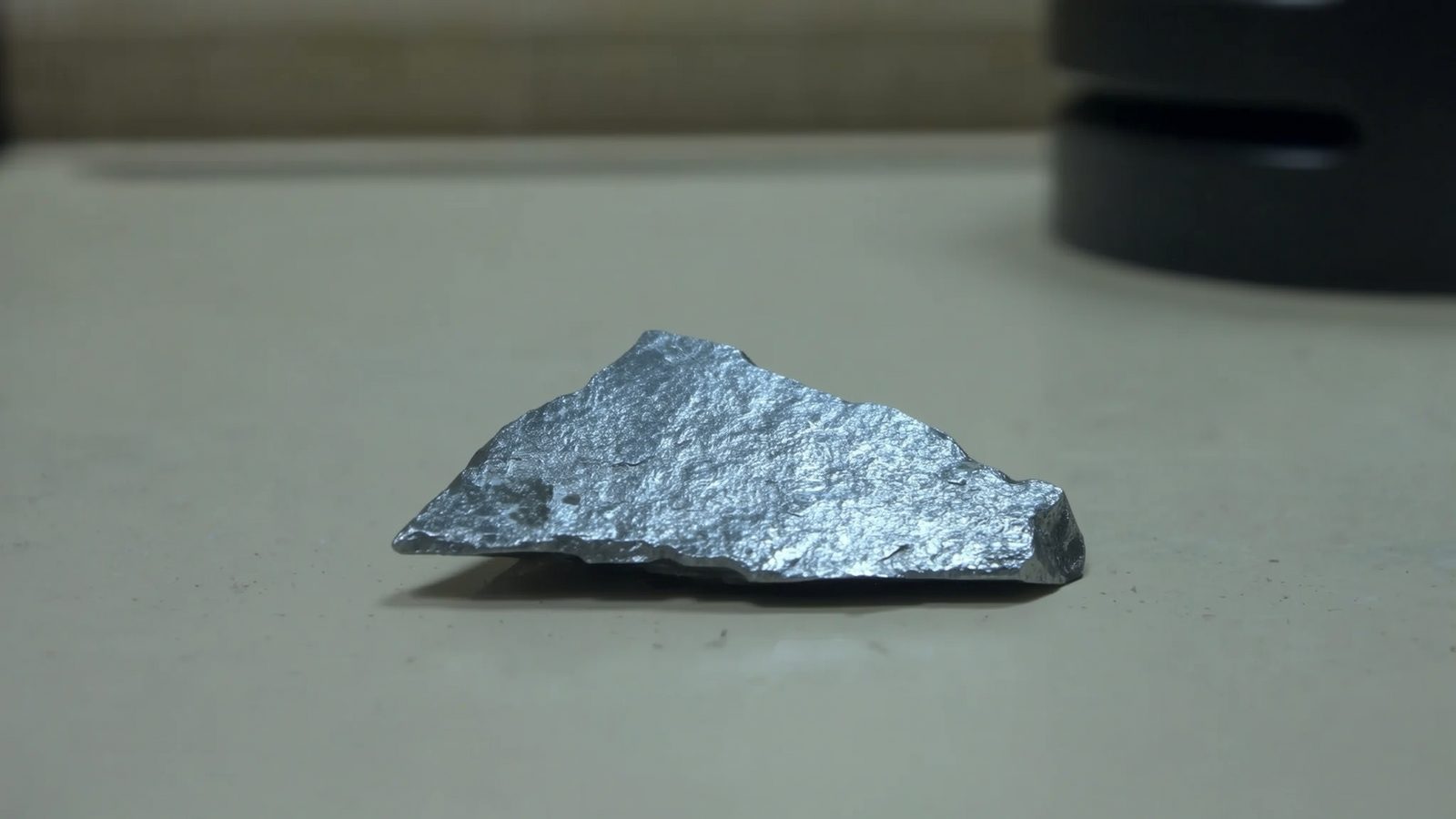
The densest metal is a title that comes down to two elements separated by a tiny margin. Osmium and iridium sit at the top of every density chart, so close that the ranking has flipped as measurement methods improved. This guide explains what density actually measures, how "heaviest metal" differs from "heaviest element," and where the familiar heavy metals like gold, tungsten and lead really fall. It also shows where the rare earth elements land on the same scale, and who controls supply of the dense platinum group metals and tungsten the modern economy depends on.
Table of Contents
What is the densest metal on earth?
Osmium is the densest metal, with iridium so close behind that the title has repeatedly changed hands as laboratory tests were refined. The reference values used on this page put osmium ahead, and the Royal Society of Chemistry describes osmium as the densest of all the elements and about twice as dense as lead. Density here means mass per unit volume, usually written in grams per cubic centimeter. A cube of osmium weighs far more than the same-size cube of a common metal. You can see their exact figures in the key figures table on this page.
Osmium and iridium: a near tie
The gap between the two is tiny. Some measurements rate osmium densest, while others argue iridium just edges it out. The Royal Society of Chemistry entry for osmium (opens in a new tab) notes that the title of densest element has shifted between them as tests were refined. For everyday purposes they are treated as a near tie at the top.
What density measures
Density is the mass of a unit volume of a material, as Britannica's explainer on density (opens in a new tab) lays out. It is commonly expressed in grams per cubic centimeter. A high density number means a lot of mass packed into a small space.
Heaviest metal versus heaviest element
"Heaviest metal" and "heaviest element" are two different questions. Heaviest metal usually means densest, the mass packed into a given volume. Heaviest element usually means the highest atomic number, the count of protons in the nucleus. These do not point to the same material. The element with the highest atomic number is oganesson, a highly radioactive metal made only a few atoms at a time, with a density that is unknown; its atomic number appears in the key figures table on this page. Uranium is the heaviest element that occurs naturally. So the two questions have different answers.
Heavy by density
When people say heaviest metal, they almost always mean the one with the most mass per unit volume. By that measure osmium and iridium lead. This is the sense this guide uses most often.
Heavy by atomic number
Atomic number counts protons. The highest known belongs to oganesson, whose atomic number appears in the key figures table on this page. Only a few atoms of it have ever been made, its density is unknown, and the Royal Society of Chemistry entry for oganesson (opens in a new tab) notes it is used only in research.
The heaviest naturally occurring element
Among elements found in nature, uranium holds the top spot by atomic number. The Royal Society of Chemistry entry for uranium (opens in a new tab) calls it the heaviest naturally occurring element.
The heaviest metals on earth ranked by density
By density, the order runs osmium first, then iridium, platinum, rhenium, plutonium, with gold and tungsten tied, and uranium just below them. The exact numbers sit in the key figures table on this page. The everyday heavy metal, lead, is far lighter than any of these leaders, at roughly half the density of osmium.
The top tier: osmium, iridium, platinum and rhenium
In the reference data, the four highest densities belong to osmium, iridium, platinum and rhenium, in that order. Platinum and rhenium both sit above the twenty grams per cubic centimeter mark.
Gold, tungsten and uranium
Gold and tungsten share the same density figure in the reference data. Uranium comes in just under them. These three are dense by any normal standard, yet each falls short of the osmium-iridium pair at the top.
Is tungsten heavier than gold?
The reference figures list gold and tungsten at the same density. Neither is heavier than the other by that measure. For the matching figures, see the key figures table on this page.
Why lead is not on the list
Lead feels heavy in the hand and anchors many people's sense of a heavy metal. On the density scale it does not come close to the leaders. Osmium is about twice as dense as lead.
Read the latest rare earth news on REEx
What the densest metals are used for
The dense metals earn their keep in places where weight, hardness or heat resistance matter. Osmium goes into very hard alloys for fountain pen tips, instrument pivots, needles and electrical contacts. Iridium also forms an alloy with osmium. Platinum's main use is in catalytic converters. Rhenium is used as an additive to tungsten- and molybdenum-based alloys and in nickel alloys for single-crystal turbine blades. Tungsten carries the highest melting point of any metal and forms an immensely hard carbide. Depleted uranium works as dense ballast and counterweights.
Osmium and iridium alloys
Osmium forms very hard alloys used for pen tips, instrument pivots, needles and electrical contacts. Iridium forms an alloy with osmium that is used for pen tips and compass bearings, according to the Royal Society of Chemistry entry for iridium (opens in a new tab).
Platinum in catalytic converters
Platinum's main use is in catalytic converters for cars, trucks and buses, according to the Royal Society of Chemistry entry for platinum.
Tungsten carbide and heat resistance
Tungsten has the highest melting point of all metals. Its carbide is immensely hard and important to the metal-working, mining and petroleum industries. The Royal Society of Chemistry entry for tungsten ties both traits together.
Depleted uranium as ballast
Depleted uranium is dense enough to serve as ballast for ships and counterweights for aircraft. The weight does the work.
Where rare earth elements sit on the density scale
The rare earth elements fall well below the top tier. Lutetium, the densest of the rare earths listed here, still lands far under osmium. Neodymium sits lower, and scandium is lighter still. The light and heavy rare earth groups are split by atomic number and atomic weight.
From scandium to lutetium
Among the rare earths listed here, density runs from the low end at scandium up to lutetium at the high end, with neodymium in between. The full figures are in the key figures table on this page.
Why 'heavy rare earth' does not mean dense
The heavy rare earth group is defined by higher atomic numbers and atomic weights, as the Congressional Research Service overview of rare earth supply chains (opens in a new tab) explains. The heavy group includes terbium, dysprosium, holmium, erbium, thulium, ytterbium and lutetium, plus scandium and yttrium. Lutetium belongs to the heavy group. If you want the full split between rare earths and other critical materials, see rare earths versus critical minerals.
Key figures (verified 2026-10-27)
Who supplies the heaviest metals?
Supply of the dense metals is concentrated in a handful of countries. South Africa leads the world in mined platinum group material, while Russia leads in mined palladium. US supply of platinum depends heavily on imports. For tungsten, China mines most of the world's output. The exact production and import figures sit in the key figures table on this page.
Platinum group metals: a two-country story
South Africa is the leading producer of PGM-containing mined material, and Russia leads mined palladium, per the USGS summary for platinum-group metals (opens in a new tab). US platinum supply leans on imports to a high degree.
Tungsten: one country dominates
China was the leading producer, importer and consumer of tungsten concentrates, mining the bulk of world output, as the USGS summary for tungsten records. Supply news on this front is worth tracking.
Frequently asked questions
What is the densest metal on earth?
Osmium ranks first by the reference figures used here, with iridium a very close second. The two are separated by a tiny margin, and the ranking has flipped as measurement methods improved. The exact density values appear in the key figures table on this page.
Is osmium or iridium denser?
Osmium edges out iridium in the figures used on this page, but the gap is small enough that the title has changed hands between them as tests were refined. Some measurements put osmium first, others argue iridium just wins. For most purposes they are treated as a near tie at the top of the density chart.
Is tungsten heavier than gold?
No. Gold and tungsten carry the same density figure in the reference data, so neither is heavier than the other by that measure. Both figures are listed in the key figures table on this page.
What is the heaviest naturally occurring element?
Uranium is the heaviest naturally occurring element, measured by atomic number. Oganesson has the highest atomic number of any known element, but it is made only a few atoms at a time and its density is unknown.
Where do rare earth elements rank by density?
The rare earth elements all fall below the densest metals. Lutetium, the densest of the rare earths listed here, still lands below lead. Scandium is the lightest of those listed. The heavy rare earth group is defined by atomic number and atomic weight.
Why does lead feel so heavy if it is not the densest?
Lead is dense compared with everyday metals, so it feels heavy in the hand and anchors most people's sense of a heavy metal. On the full density scale it falls far short of the leaders. Osmium is about twice as dense as lead, with its exact figure in the key figures table on this page.
Conclusion
Osmium and iridium hold the title of Earth's densest metals, but density alone does not determine a metal's industrial value. Platinum, tungsten, and other heavy metals serve essential roles in manufacturing, transportation, and advanced technology. Rare earth elements fall much lower on the density scale, yet their magnetic and chemical properties make them equally important to modern industries. From platinum production in South Africa to tungsten mining in China, concentrated supply chains underscore the strategic importance of these materials, regardless of their weight.
