
Highlights
- The Khanneshin carbonatite complex holds an estimated 1.29 million metric tons of light rare-earth oxides, but no drill-defined reserve or feasibility study exists.
- Afghanistan's $1 trillion mineral valuation covers all minerals, not rare earths alone, and lacks element-by-element distribution critical for pricing.
- Chinese companies hold key mining contracts, but large-scale extraction at Mes Aynak remained unstarted after 18 years of delays as of mid-2026.
- Any U.S. investment would require transaction-by-transaction legal review under OFAC rules, as designated Taliban parties remain sanctioned.
- Without roads, power, processing, and separation capacity, Afghanistan's deposits are potential feedstock—not a viable alternative to Chinese rare earth supply.
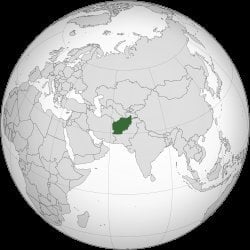
Afghanistan’s Taliban government publicly welcomed U.S. investment in mining in August 2026. The offer is real, but the widely repeated $1 trillion estimate covers Afghanistan’s entire mineral endowment—not rare earths alone. Rare Earth Exchanges® finds possibly credible rare-earth geology, but no defined commercial reserve, processing route, or investment-ready project. The Taliban is marketing buried treasure. Investors must decide whether it is an asset, an option—or merely an impressive geological inheritance.
REEx Insight—The Missing Discount Rate Is Sovereign Reality
The Khanneshin carbonatite complex (opens in a new tab) in Helmand Province (opens in a new tab) is more than rumor. A 2012 U.S. Geological Survey study (opens in a new tab) estimated at least 1.29 million metric tons of light rare-earth oxides in part of the complex. Sampled mineralized rocks averaged roughly 3.25% to 3.77% combined lanthanum, cerium, praseodymium, and neodymium oxides.
Those numbers justify further exploration—not a valuation. The estimate used assumptions and simple geological geometry. It is not a modern, drill-defined reserve supported by metallurgy, recoveries, operating costs, or a feasibility study. Investors also need the individual element distribution: one million tons dominated by lower-value lanthanum and cerium carries a very different value than a basket rich in magnet-grade neodymium and praseodymium.
The real constraint is the conversion chain. Afghanistan would need secure roads, power, water, concentration, chemical separation, waste management, oxide-to-metal capacity, and qualified customers. Every additional border and processing jurisdiction adds cost, delay, and provenance risk. Without that chain, the deposit is not an alternative to China. It is potential feedstock still searching for an industry.
Geologic map of the Khanneshin carbonatite complex showing its principal bedrock divisions (bottom to top in Explanation): (1) Neogene sedimentary strata, partly metasomatized, that form an upturned section of outwardly-dipping strata away from the central intrusive vent. (2) The central intrusive vent composed of sövite, medium-to fine-grained alvikite, and altered hematite-stained carbonatite. The zone of LREE enrichment is located in the northeast portion of the central vent. (3) The apron of volcanic and volcanosedimentary strata extending 5 km beyond from the central vent. (4) Small satellitic intrusions and volcanic plugs, mostly on the southern peripheral margin of the complex, of alvikite agglomerate and leucite phonolite. Our traverses, 1A, 1B, 2, and 3, as well as the zones of LREE, uranium, and phosphorus enrichment, are indicated by labels.
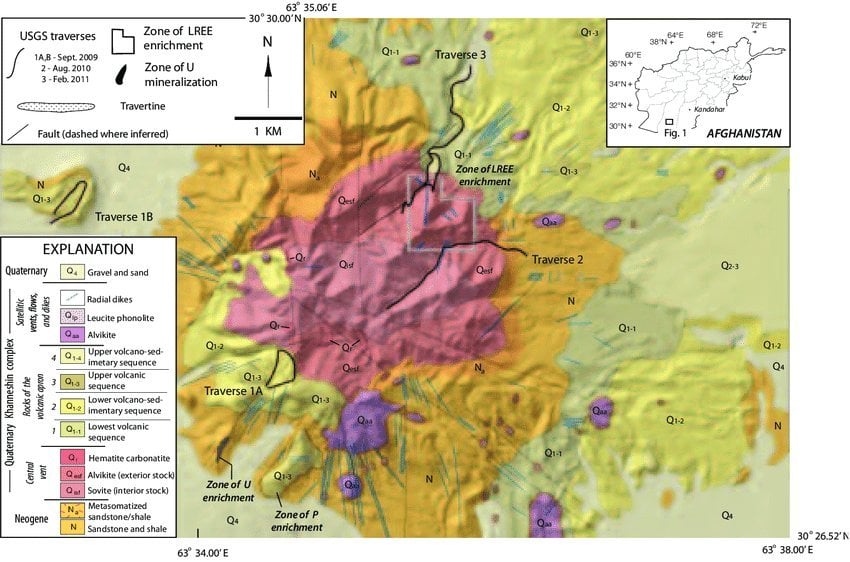
Source: ResearchGate: Stephen G. Peters
The $1 Trillion Headline Needs a Geological Haircut
Taliban Foreign Minister Amir Khan Muttaqi (opens in a new tab) told the Financial Times (opens in a new tab) that Afghanistan would welcome U.S. investment, although he did not confirm making a direct proposal to the White House. Claims that China is already Afghanistan’s “main extractor” also outrun the evidence. Chinese companies hold important contracts, but large-scale extraction at Mes Aynak remained unstarted in May 2026 after roughly 18 years of delays. Contracts measure access; production measures reality.
Afghanistan is not comprehensively sanctioned. However, designated Taliban parties remain blocked, and General License 20 does not broadly authorize direct financial transfers to them. Any project would require transaction-by-transaction legal diligence.
Bottom Line
Afghanistan offers possible future geological optionality, not near-term ex-China supply.
Sources
- Financial Times, August 31, 2026
- U.S. Geological Survey, Khanneshin assessment, 2012
- U.S. Treasury Office of Foreign Assets Control, FAQs 951 and 992


0 Comments
No replies yet
Loading new replies...
Moderator
Join the full discussion at the Rare Earth Exchanges Forum →