
Highlights
- America has an investment strategy for rare earths, not a true industrial strategy—and the difference could cost the nation its supply chain independence.
- China's rare earth dominance was built on an integrated ecosystem of infrastructure, processing, manufacturing, and workforce development—not geology alone.
- Shared national assets like separation hubs, magnet labs, and recycling networks are the industrial commons every rare earth company needs to compete.
- Fragmented efforts across the DoD, Commerce, and Wall Street risk producing a few wealthy insiders rather than a resilient, generational supply chain.
- A National Critical Minerals Infrastructure Initiative, financed through public-private partnerships, could serve as a 21st-century Industrial New Deal for critical minerals.
So you want to break up a Chinese monopoly? America has finally awakened to the strategic importance of rare earth elements and critical minerals. Government financing is accelerating. Major acquisitions are reshaping the industry. Mining companies are integrating into metals and magnets. Billions of dollars of primarily loans are flowing into projects once considered too risky. This is genuine progress. But it is not yet a national industrial strategy.
The uncomfortable question policymakers and investors should be asking is simple: Will today's collection of loans, grants, acquisitions, and agency initiatives produce a resilient, globally competitive rare earth supply chain within the next five years?
The answer is almost certainly no, according to all of our internal forecasts and projections.
What America has today is an investment strategy. What it needs is an industrial strategy.
Those are not the same thing.
Current efforts are fragmented. The Department of Defense supports certain projects. The Department of Commerce backs others. Export financing comes from one direction, tax incentives from another, permitting from yet another. Meanwhile, Wall Street is driving a wave of mergers intended to assemble vertically integrated rare earth companies.
None of this is inherently wrong. In fact, many of these investments are necessary.
But financing companies does not automatically build an industrial ecosystem.
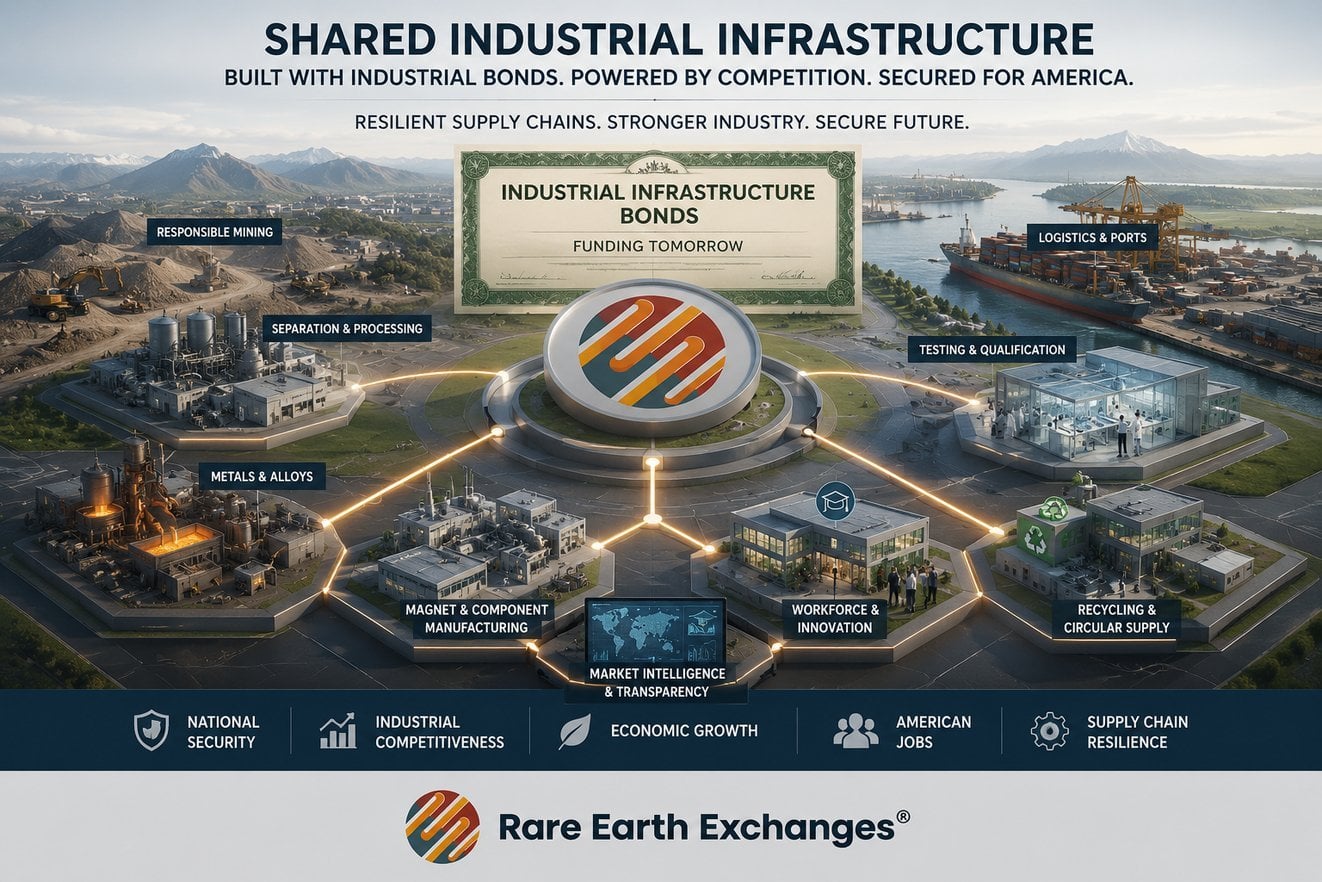
Rare earth competitiveness depends on far more than mines. It requires commercial-scale separation, metals and alloy production, magnet manufacturing, testing and qualification centers, recycling, logistics, workforce development, digital traceability, market transparency, and reliable long-term demand signals. These are shared capabilities that reduce costs and risks for the entire industry—not just one company.
This is where America remains dangerously underbuilt. China's advantage was never simply that it mined more rare earths. Over decades, it built an integrated industrial ecosystem in which infrastructure, research, financing, processing, manufacturing, and workforce development reinforced one another. That ecosystem—not geology alone—created its dominant position.
America should not attempt to replicate China's model of state direction. It’s a different nation, with different politics, culture, and economic way of life. But neither can it expect isolated corporate investments to achieve the same result.
Rather, what is needed is something closer to a twenty-first century Industrial New Deal for the rare earth and critical mineral supply chains. Imagine a National Critical Minerals Infrastructure Initiative financed through long-term Treasury-backed infrastructure bonds, public-private partnerships, or revenue-backed financing.
Rather than selecting corporate winners, it would invest in shared national assets: separation hubs, metallization facilities, magnet qualification laboratories, recycling networks, workforce training centers, logistics infrastructure, digital chain-of-custody systems, transparent market information, and importantly the downstream research and development the Chinese are now accelerating.
These are the industrial equivalents of the interstate highway system, deep-water ports, and the electric grid, and for that matter the internet backbone developed in years past. They enable private enterprise to compete more effectively.
So the United States is beginning to finance companies. That is encouraging.
The harder challenge is financing the industrial commons on which every company depends. If America gets that right, companies like MP Materials, Energy Fuels, USA Rare Earth, and future entrants will compete inside a resilient ecosystem. If it gets it wrong, billions of dollars may create a handful of firms while the nation remains dependent on fragile supply chains. True insiders will make a lot of money for their hard work. But will we have the results we truly need?
The objective should not simply be to produce a few national champions and more ultra-wealthy insiders.
It should be to build the industrial foundation that allows dozens of competitive companies to thrive for generations.
Register today: REEx Marketplace™ (opens in a new tab)


4 Comments
4 replies
Loading new replies...
Administrator
Member
New member
Member
Join the full discussion at the Rare Earth Exchanges Forum →