
Highlights
- China's suspended October 2025 rare-earth controls expire November 10, potentially restoring broad export restrictions that could devastate U.S. manufacturing and defense supply chains.
- U.S. neodymium magnet demand reached 48,000 metric tons in 2025, but domestic supply was only ~300 tons, with projected capacity of just 5,000 tons by end of 2026.
- Ford halted Explorer production during the 2025 shortage, and suppliers to Ford, GM, and Stellantis only received temporary Chinese licenses after major disruptions emerged.
- Meaningful U.S. mine-to-magnet relief is unlikely before late 2028, leaving defense contractors with no viable alternative as DFARS restrictions expand in January 2027.
- The September 24 Xi-Trump meeting is a critical test: without a durable minerals agreement, China could leverage rare-earth dominance to pull commercial manufacturing into its industrial orbit.
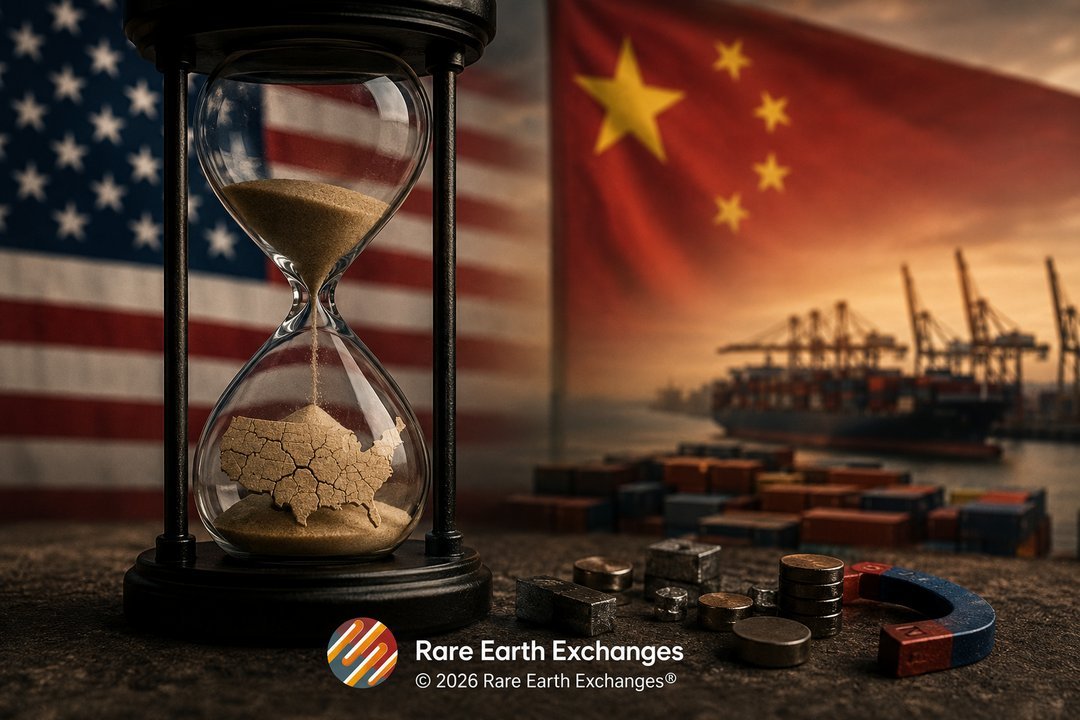
Chinese President Xi Jinping is scheduled to visit Washington on September 24—just 47 days before a critical rare-earth deadline. Unless both Xi and Trump reach a durable minerals agreement, China’s suspended October 2025 controls could return on November 10. That date is not an automatic embargo; it marks the expiration of a one-year pause on Beijing’s broadest measures. The older April 2025 licensing system never disappeared.
The Reprieve Never Restored Normal Trade
China’s April controls covered seven medium and heavy rare earths, related compounds and magnets. Exports plunged, automakers struggled to obtain permanent magnets, and factories reduced output or temporarily stopped. By June 2026, the U.S.-China Business Council said some materials remained “nearly unobtainable.” Of 38 affected companies, 29% were shifting toward non-Chinese suppliers and 47% were still searching without finding a viable alternative.
A November snapback would widen Beijing’s reach. The suspended rules were designed to require Chinese approval for certain foreign-made parts containing Chinese rare earths or produced with Chinese technology. Military users and some controlled customers would face presumptive denial. China would not need to ban trade: delays, end-user demands and selective approvals could determine which foreign factories receive materials—and which do not.
The Offshoring Trap
The evidence of production moving toward China is serious, but narrower than some more pervasive claims suggest. The Wall Street Journal reported in June 2025 that several automakers and suppliers were considering shifting parts manufacturing to China so magnets could be incorporated into finished components before export. Public reporting reviewed by Rare Earth Exchanges® does not establish that named American companies completed those moves.
Although from confidential sources we are hearing of such movement. Multiple persons on condition of anonymity report manufacturers actively looking at moves to China. But we do not have documented proof.
What is documented is the coercive pressure. Ford halted Explorer production for a week during the 2025 shortage, and suppliers to Ford, General Motors and Stellantis received temporary Chinese licenses only after disruptions emerged.
That is Beijing’s downstream advantage. A restriction on exporting a magnet can become an incentive to manufacture the motor, actuator, pump or sensor inside China. The policy can therefore pull not just orders, but tooling, engineering knowledge, employment and future investment into China’s industrial orbit. This is an inference supported by manufacturers’ reported consideration of moving parts production.
Defense Has Nowhere to Go
Commercial manufacturers can redesign products, remove features or shift component work to China. Defense contractors, on the other hand, cannot relocate sensitive production to China. Beginning January 1, 2027, DFARS 252.225-7052 (opens in a new tab) expands restrictions for covered procurements across the entire chain—from mining, refining and separation through finished neodymium-iron-boron and samarium-cobalt magnets—although limited exceptions and nonavailability findings remain.
The arithmetic is brutal. U.S. demand for neodymium magnets was approximately 48,000 metric tons in 2025, compared with roughly 300 tons of domestic supply. Projected American capacity by the end of 2026 was only 5,000 tons. Washington may therefore confront three unattractive choices: issue tightly controlled waivers, delay weapons deliveries or pay sharply higher prices for scarce compliant materials.
Billions Cannot Compress Metallurgy
The Trump administration’s investments are necessary, but announcements are not qualified industrial supply. MP Materials is producing at its first Texas facility, yet its much larger 10X plant is scheduled to begin commissioning in 2028. USA Rare Earth targets 1,200 tons of active Stillwater capacity in early 2027. Energy Fuels’ larger oxide expansion is planned for 2029. ReElement’s chromatography process has not yet operated at large mineral-processing volumes, while Phoenix Tailings’ initial facility is measured in hundreds—not tens of thousands—of tons.
Rare Earth Exchanges’ proprietary forecast—that meaningful U.S. mine-to-magnet relief is unlikely before late 2028 and may slip further—is therefore not a prediction of zero production. It is a warning that early plants will not provide the scale, product range, customer qualification history and heavy-rare-earth security required by the wider economy. Other agencies such as IEA and experts in the REEx network similarly identify, in confidence, refining and magnet manufacturing—not mining alone—as the central diversification bottlenecks.
The September Test
President Trump and the administration do not need another vague promise that minerals will “flow.” What’s needed is a multi-year arrangement with general licenses for verified civilian users, firm processing deadlines, transparent denials, protection for allied suppliers and a workable defense transition. Without it, November 10 could turn China’s rare-earth dominance into something even more powerful: an industrial-location policy that pushes commercial manufacturing toward China while leaving America’s defense base trapped between Chinese leverage and an American supply chain still under construction.


0 Comments
No replies yet
Loading new replies...
Moderator
Join the full discussion at the Rare Earth Exchanges Forum →