
Highlights
- Baotou Rare Earth High-Tech Zone hosted a technology commercialization event unveiling five rare-earth technologies targeting AI electrolysis control, automated smelting, polishing waste recycling, emissions reduction, and stronger rare-earth glass.
- Three industry-university cooperation agreements were signed between major rare-earth firms and Chinese universities, targeting critical functional materials and new processing technologies.
- China is training its first cohort of rare-earth 'technology brokers' to reduce friction between research institutions and industrial deployment—a model the West has yet to replicate at scale.
- The Tianjiao Seimi joint venture between China Northern Rare Earth and Japan's AGC Seimi Chemical illustrates China's downstream template: extending raw-material dominance into specialized materials, standards, and higher-value applications.
Baotou pushing rare earth research onto the factory floor. China's Baotou Rare Earth High-Tech Industrial Development Zone hosted an August 7 technology commercialization event that unveiled five rare-earth technologies, announced 15 additional university-developed projects online, and produced three industry-research cooperation agreements. The technologies target practical industrial problems: artificial intelligence (AI) control of rare-earth electrolysis, automated smelting operations, recycling of rare-earth polishing waste, low-temperature emissions control, and stronger rare-earth-containing glass. More than 50 major rare-earth companies participated. What makes the event noteworthy is China's effort to accelerate the difficult transition from laboratory research to industrial deployment.
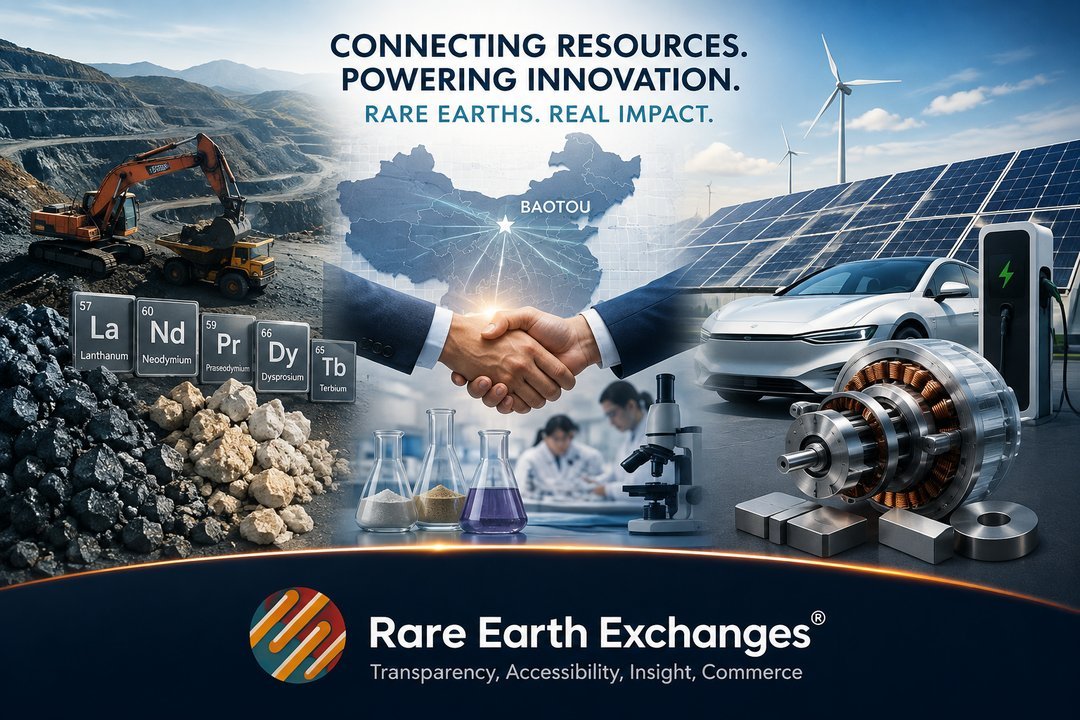
Baotou Downstream Template
The Downstream Template describes how China can leverage its dominant position across the rare-earth value chain not simply to sell minerals, but to convert control of materials, processing expertise, and accumulated know-how into downstream innovation and higher-value intellectual property. The model connects rare-earth capabilities with research and development across materials science, life sciences, clean energy, transportation, electronics, advanced manufacturing, and other strategic sectors, using privileged access to materials and industrial-scale experimentation to accelerate the movement from laboratory discovery to commercial application.
Over time, this can create a reinforcing cycle: resource and processing dominance enables faster R&D; R&D produces differentiated materials and applications; those applications create superior products, patents, and manufacturing expertise; and commercialization ultimately monetizes the original upstream advantage. For the West, the strategic risk is that China's rare-earth dominance becomes less about controlling commodities and increasingly about using those commodities as a platform for innovation, product differentiation, and competitive advantage across entire industries.
REEx Insight: China Is Attacking the Commercialization Gap
Western discussions about China's rare-earth advantage often focus on mines and processing capacity. Baotou is demonstrating another advantage: the infrastructure connecting universities, research institutes, engineers, and factories.
The event paired technology deployment with training China's first local cohort of rare-earth “technology brokers”—specialists intended to match companies with researchers, negotiate technology transactions, and reduce the friction involved in commercialization.
For the United States and Europe, that deserves attention. Building laboratories and funding research are not enough if promising technologies take years to reach operating plants. China is explicitly engineering the connective tissue between invention and production.
Five Technologies Move Into View
Researchers presented five technologies addressing specific industry needs: an AI-enabled sensing and digital-twin control system for rare-earth electrolysis; automated control of material-discharge operations in rare-earth smelting; recycling and resource recovery from spent rare-earth polishing powder; low-temperature denitrification catalysts for cleaner smelting; and strengthening and surface-stress control of rare-earth aluminosilicate glass.
The source provides no performance data, commercial deployment volumes, or economics. These should therefore be treated as technology presentations—not validated commercial breakthroughs.
Another 15 university rare-earth innovations were released digitally through Inner Mongolia's Mengkeju integrated science-and-technology innovation platform for potential industry matching.
What is the Mengkeju Innovation-Driven Platform?
The Mengkeju Innovation-Driven Platform is Inner Mongolia's flagship, integrated science and technology coordination hub. Headquartered in Hohhot, it functions as an "online and offline network" designed to merge technology R&D, project incubation, capital operation, intellectual property protection, and commercialization into a single ecosystem.
Three Deals Connect Universities With Industry
Three collaborations were signed: Inner Mongolia Zhongtian Hongyuan Rare Earth New Materials with the Inner Mongolia Academy of Science and Technology; Tianjiao Qingmei Rare Earth Polishing Powder with the University of Shanghai for Science and Technology; and Baogang Mining Research Institute with Northeastern University. The partnerships will target critical functional materials and new rare-earth processing technologies.
REEx Connect
| Organization | Status / Ownership | Primary Focus |
|---|---|---|
| Baotou Rare Earth High-Tech Industrial Development Zone | Government-administered industrial development zone | China's major rare-earth industrial cluster in Baotou; supports commercialization, manufacturing, R&D, investment, and development of downstream rare-earth applications. |
| Inner Mongolia Academy of Science and Technology | Public / government-backed research institution | Applied science, technology development, and commercialization; connects research institutions with Inner Mongolian industries, including rare earths. |
| Inner Mongolia Zhongtian Hongyuan Rare Earth New Materials Co., Ltd. | Commercial company; precise current ownership/public-listing status not independently established from available sources | Rare-earth new materials; participating in industry-research cooperation aimed at functional materials and technology commercialization. |
| Baotou Tianjiao Seimi Rare Earth Polishing Powder Co., Ltd. | Commercial Sino-Japanese joint venture; not independently listed | Develops and manufactures rare-earth polishing powders and related polishing materials. AGC Seimi Chemical identifies China Northern Rare Earth and AGC Seimi as its Chinese and Japanese investors. |
| Baogang Group Mining Research Institute | State-owned-enterprise research organization associated with Baogang Group | Mining and mineral-processing R&D, engineering, and technology development supporting Baogang's mining and rare-earth industrial operations. Historical Baogang filings identify the institute within the group's rare-earth industrial structure. |
| University of Shanghai for Science and Technology (USST) | Public university | Engineering and applied research. In this initiative, partnering with Tianjiao Seimi on rare-earth technology development and commercialization. |
| Northeastern University (China) | Public national university | Major engineering and research university with particular strengths in metallurgy, materials, mining, mineral processing, automation, and related industrial technologies; partnering with Baogang Mining Research Institute. |
One especially interesting company is Tianjiao Seimi. It is not simply another Chinese state-linked participant: AGC Seimi Chemical's (opens in a new tab) current corporate information identifies it as a China-Japan joint venture between China Northern Rare Earth and Japan's AGC Seimi Chemical, focused on polishing materials used for applications including photomask substrates, glass hard disks, LCD glass, and optical lenses. Chinese national standards records also show Tianjiao Seimi as a principal drafting organization for China's current GB/T 20165-2025 Rare Earth Polishing Powder standard. This is a useful example of the REEx Downstream Template: rare-earth capabilities extending from raw-material advantage into specialized materials, industrial know-how, standards, and higher-value applications.
REEx Source Disclaimer: This report originates from the Baotou Rare Earth High-Tech Zone and was republished by the China Rare Earth Industry Association. Both operate within China's state-directed rare-earth industrial ecosystem. Technology capabilities, performance claims, and anticipated outcomes should be independently verified. The source provides no independent technical validation, commercial-scale performance data, or project economics.


0 Comments
No replies yet
Loading new replies...
Moderator
Join the full discussion at the Rare Earth Exchanges Forum →