
Highlights
- China and the U.S. agreed to continue bilateral trade consultations following Paris talks, focusing on tariff arrangements, investment promotion, and establishing new working mechanisms for economic cooperation.
- Beijing signals willingness to maintain dialogue and reduce friction, but warns that companies dependent on critical minerals face significant exposure due to China's supply chain leverage.
- The talks represent procedural progress toward managed coexistence rather than breakthrough, with potential upside if both nations pursue reciprocal movement on market access and investment frameworks.
China’s Commerce Ministry said March 19 that Beijing and Washington will continue using their existing bilateral trade consultation mechanism to deepen dialogue, manage differences, and explore practical areas of cooperation. Speaking at a regular press briefing, Commerce Ministry spokesperson He Yongqian said the recent economic and trade talks in Paris were guided by the “important consensus” reached by the two countries’ leaders.
A Future Goal
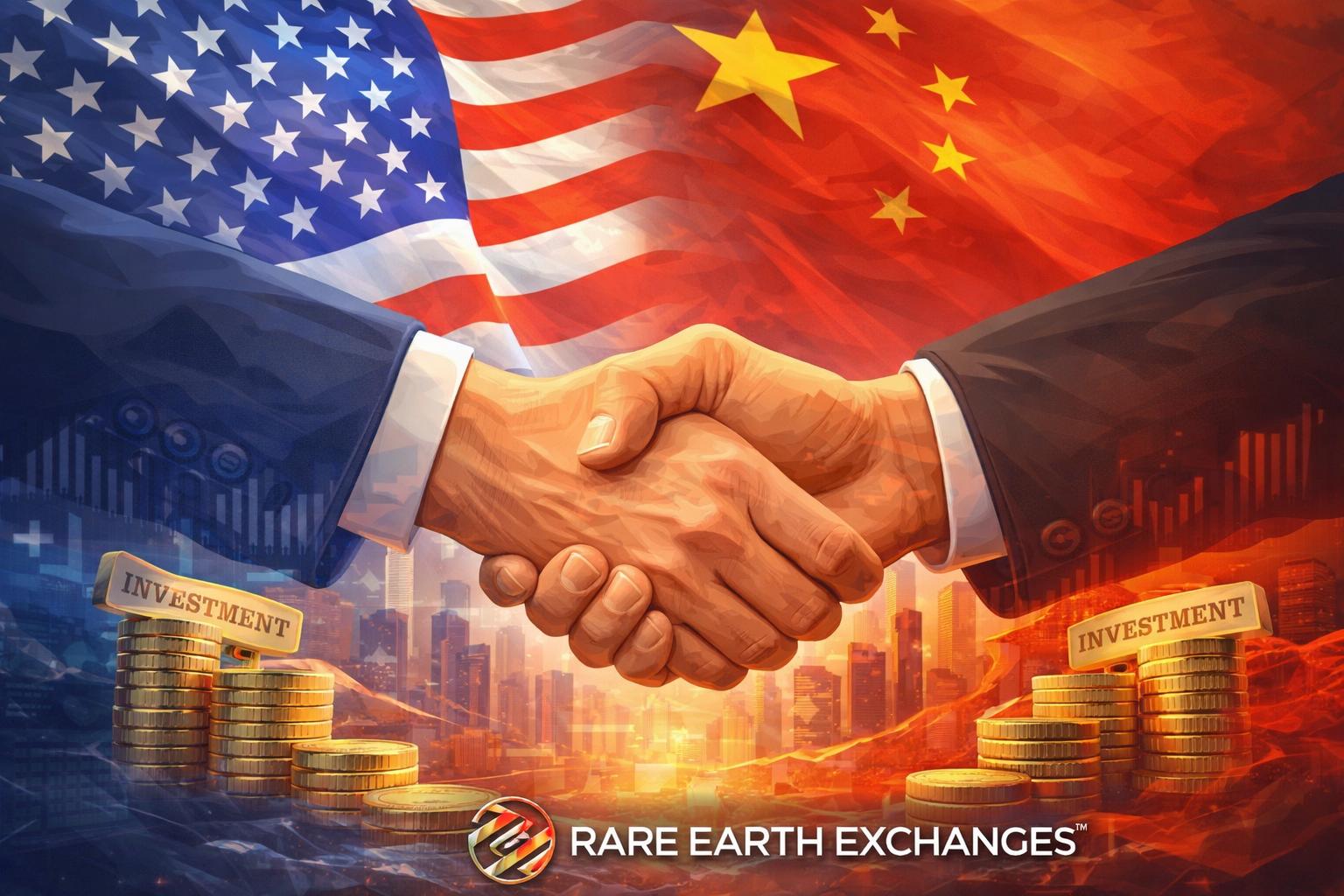
According to the official account, the two sides held “candid, in-depth, and constructive” discussions on tariff arrangements, ways to promote two-way trade and investment, and how to preserve earlier consultation outcomes. The ministry said the talks produced “some new consensus” and that both sides agreed to continue consultations.
More Process, More Structure
One notable outcome is the reported agreement to study the creation of a new working mechanism to expand economic and trade cooperation. That language matters. For a business audience, it suggests Beijing wants a more structured channel to prevent disputes from spiraling and to keep commercial engagement moving even when political tensions remain high.
The wording is cautious but meaningful. China is framing the talks not as a breakthrough, but as a stabilization effort—one aimed at preserving communication, managing disagreements, and creating room for practical cooperation.
He Yongqian, Commerce Ministry Spokesperson

Rare Earth Exchanges™ suggests that while China’s leverage via the rare earth and critical mineral supply chains is palpable, the execution of the meta Chinese plan (monetize verticals at scale, help govern currency, emerge as a dominant geopolitical player globally—think Great Powers Era 2.0) is arriving. And part of a true sustainable accord will be the American recognition of this emerging reality.
Why This Matters for U.S. Business
Toward a Managed Coexistence—and a Potential Upside
For U.S. companies, investors, and supply-chain strategists, the signal here is not immediate liberalization—it is strategic continuity with latent upside. Beijing is indicating a willingness to keep dialogue open, reduce friction at the margins, and prevent further deterioration in bilateral commercial ties. But beneath that is a deeper implication: the early contours of a “Great Powers 2.0” economic framework, where competition persists—but coexistence becomes structured and intentional.
For that to work, both sides must move. The U.S. may need to accept a sustained Chinese presence in global industrial systems, particularly across EVs, batteries, and critical minerals. At the same time, China will need to open further to Western capital, governance standards, and investment access if it wants to unlock the next phase of growth.
If that alignment begins to take hold—even partially—the upside could be significant. A coordinated easing of tensions, paired with targeted market access, could catalyze a powerful new investment cycle across industrial, energy, and advanced manufacturing sectors.
This matters acutely for industries exposed to tariffs, cross-border capital restrictions, and supply-chain volatility—including automotive, semiconductors, clean energy systems, and rare earth/critical minerals. These sectors sit at the center of both geopolitical tension and potential cooperation.
That said, the current signal remains preliminary. There is no tariff rollback, no defined investment framework, and no binding timeline. What we are seeing is diplomatic scaffolding—not yet economic transformation. No one should be overly optimistic. And multinational corporations dependent on rare earth and critical mineral supply chains remain in a deep red risk zone.
Layered on top of this is a fragile global backdrop. Escalating geopolitical tensions—including rising conflict risks in the Middle East—leave the global economy exposed to sudden shocks. Yet within that volatility lies real opportunity. If Washington and Beijing can stabilize the downside while selectively rebuilding economic bridges, a pathway to renewed global growth—and a meaningful U.S. industrial resurgence—begins to emerge. That benefits the world economy
This is a moment where U.S. leadership must act decisively; history tends to reward those who move early when structural shifts are underway.
REEx Reflection
This is a modest but meaningful step toward a more structured coexistence. The breakthrough is procedural, not transformational—but it opens the door to something larger: a recalibrated U.S.–China economic relationship that blends competition with selective cooperation. Whether that evolves into a true investment and growth cycle will depend on reciprocal movement—America meeting China halfway, and China opening the door wider to global capital and a pathway to economic liberalization over time.
Make no mistake—we are operating in a period of heightened geopolitical risk, and any company reliant on critical minerals or rare earth supply chains now faces real and growing exposure, first and foremost in the form of implications linked to China's leverage.


0 Comments
No replies yet
Loading new replies...
Moderator
Join the full discussion at the Rare Earth Exchanges Forum →