
Highlights
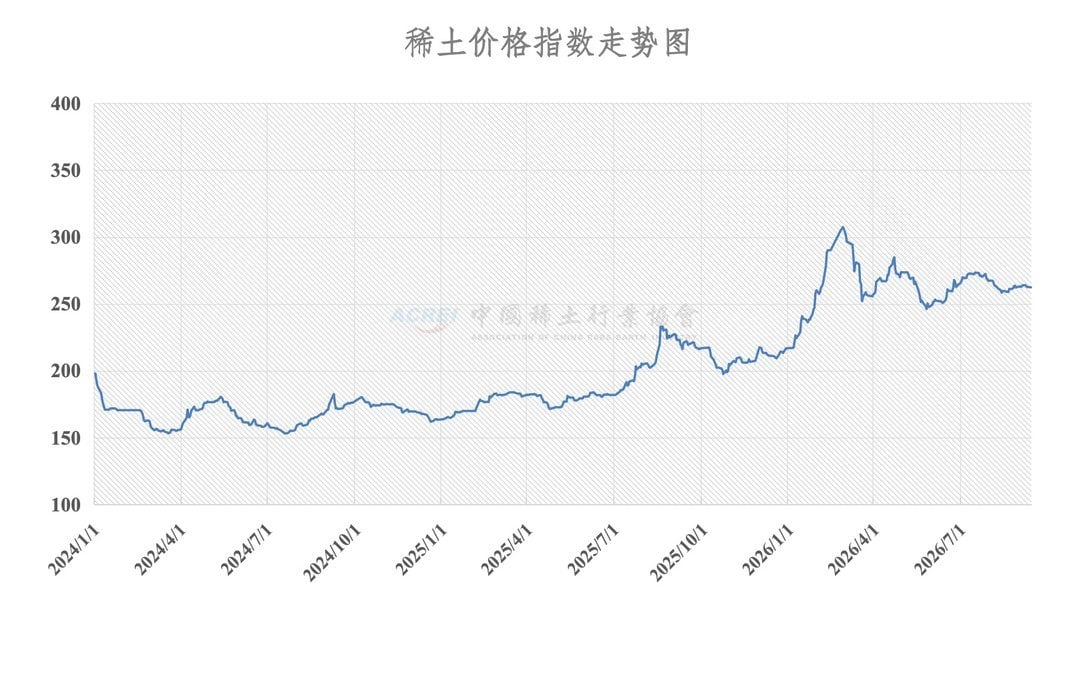
- CREIA's Rare Earth Price Index sits at 262.4, but ex-China prices for heavy rare earths like terbium can run four to five times higher than domestic Chinese benchmarks.
- China controls roughly 85% of rare-earth refining, making Western transactions bilateral, confidential and sporadic—creating a price archipelago rather than a single global market.
- Pentagon-backed price floors for NdPr, dysprosium and terbium are contractual support mechanisms, not industry-wide spot prices, and should not be generalized across transactions.
- China's suspended October 2025 rare-earth export controls are set to expire November 10, creating a potential volatility date for heavy rare earths if U.S.-China talks stall.
- Yttrium supply remains constrained and intermittent following Chinese controls, underscoring that physical availability—not published benchmarks—is increasingly the dominant price signal.
China's Rare Earth Industry Association (CREIA) reported its Rare Earth Price Index at 262.4 on September 15, versus a 2010 base of 100. The headline looks orderly. The physical market outside China can be anything but. For Western buyers—particularly of dysprosium, terbium and yttrium—the relevant question is increasingly not what is the price? but can qualified material actually be procured, in the required quantity, provenance and timeframe?
REEx Insight — A Price Is Not Necessarily a Market
CREIA's numbers are useful indicators of China's domestic market, but investors should not mistake them for Western-style global price discovery. China's rare-earth ecosystem operates amid production controls, export licensing, industrial policy and national-security objectives. The ex-China market has the opposite problem: too little liquidity. China still accounts for roughly 85% of rare-earth refining, according to recent IEA data reported by Reuters. Western transactions can be bilateral, confidential, specification-sensitive and sporadic. Published assessments may reflect relatively few observations.
The result is not one global price but a price archipelago.
| Product | CREIA ¥/kg | China US$/kg* | Ex-China evidence/context |
|---|---|---|---|
| NdPr oxide | ¥718.9–738.9 | $108–111 | ~$110 floor for MP; export/Western prices can differ materially |
| Dy oxide | ¥1,415–1,455 | $212–218 | $285–337 FOB China; $575 floor; ~$931 packaged material |
| Tb oxide | ¥6,645–6,705 | $997–1,006 | $2,050 floor Serra Verde; ~$4,000–4,030, in some cases $5K+ documented ex-China indications |
| Y oxide | ¥57.8–61.8 | $8.67–9.27 | Highly fragmented; at times availability matters more than quotation |
| Ho oxide | ¥636–656 | $95–98 | Thin, bespoke market; qualified availability can dominate price |
*Using requested ¥1 = US$0.15. The third column deliberately mixes documented reference points rather than asserting a universal ex-China range. They include different specifications, quantities and delivery terms and are not directly comparable. SMM, for example, recently assessed Dy oxide FOB China at $285–337/kg, while packaged Dy oxide was offered around $931/kg and Tb around $4,029/kg.
Floors Are Insurance, Not Spot Prices
This distinction is critical. The Pentagon's $110/kg NdPr floor for MP Materials is a contractual support mechanism, not an industry-wide American price.
Likewise, Serra Verde's U.S.-backed arrangement establishes floors of $110/kg Nd and Pr, $575/kg Dy and $2,050/kg Tb. USA Rare Earth's April presentation separately showed then-current non-China reference prices around $1,100/kg Dy and $4,000/kg Tb. Neither the floors nor those snapshots should be generalized across every transaction.
Buyer beware: purity, oxide versus metal, qualification, lot size, delivery location, chain of custody and—above all—physical availability can overwhelm a published benchmark.
November 10 — The Clock Behind the Price
Now geopolitics enters the spreadsheet. President Donald Trump and President Xi Jinping are scheduled to meet September 24 amid negotiations over the broader U.S.-China economic relationship. China's suspension of its sweeping October 2025 rare-earth controls is scheduled to expire November 10. That does not mean exports automatically stop; China's earlier licensing controls already remain in place.
But if Washington and Beijing fail to reach a durable arrangement and the suspended controls return, scarcity risk could intensify—particularly for heavies where alternative separation capacity remains painfully limited. Yttrium demonstrates the danger. REEx has described the supply as constrained and intermittent following Chinese controls, despite its importance to aerospace, semiconductors and thermal-barrier coatings.
That makes November 10 a potential volatility date, not a forecast. The lesson of CREIA's deceptively calm 262.4 is therefore larger: China has prices. The West has quotations, contracts, premiums—and sometimes no material at all. Until substantial ex-China separation and metallization capacity arrives, scarcity itself may be the most important price signal.
Source qualifier: CREIA's figures originate from a Chinese industry association operating within China's state-directed rare-earth system. CREIA itself states the information is collected from industry enterprises, is for reference only and does not constitute investment advice.


0 Comments
No replies yet
Loading new replies...
Moderator
Join the full discussion at the Rare Earth Exchanges Forum →