
Highlights
- China's GDP grew 4.7% in H1 2026, with high-tech manufacturing up 13.3% and exports surging 13.4%, but domestic retail sales rose only 2.7%.
- Economist Wang Yiming acknowledges a persistent 'strong supply, weak demand' imbalance that drives aggressive export pressure into global markets.
- State-backed financing and provincial subsidies may allow Chinese rare earth producers to operate below true economic cost, distorting global pricing signals.
- IMF warns of capital misallocation from industrial policy and off-budget LGFV liabilities, obscuring the true fiscal support beneath Chinese industrial output.
- China's capacity concentration may accelerate Western efforts to build parallel rare earth supply chains, insulated from Chinese leverage despite higher initial costs.
China's industrial machine remains formidable. GDP grew 4.7% in the first half of 2026, high-tech manufacturing jumped 13.3%, and exports increased 13.4%. Yet domestic retail sales grew only 2.7%, while prominent economist Wang Yiming (opens in a new tab) acknowledges (opens in a new tab) a persistent “strong supply, weak demand” imbalance. For rare-earth investors, this tension helps explain both China's extraordinary manufacturing dominance and the increasingly aggressive export pressure confronting Western supply chains.
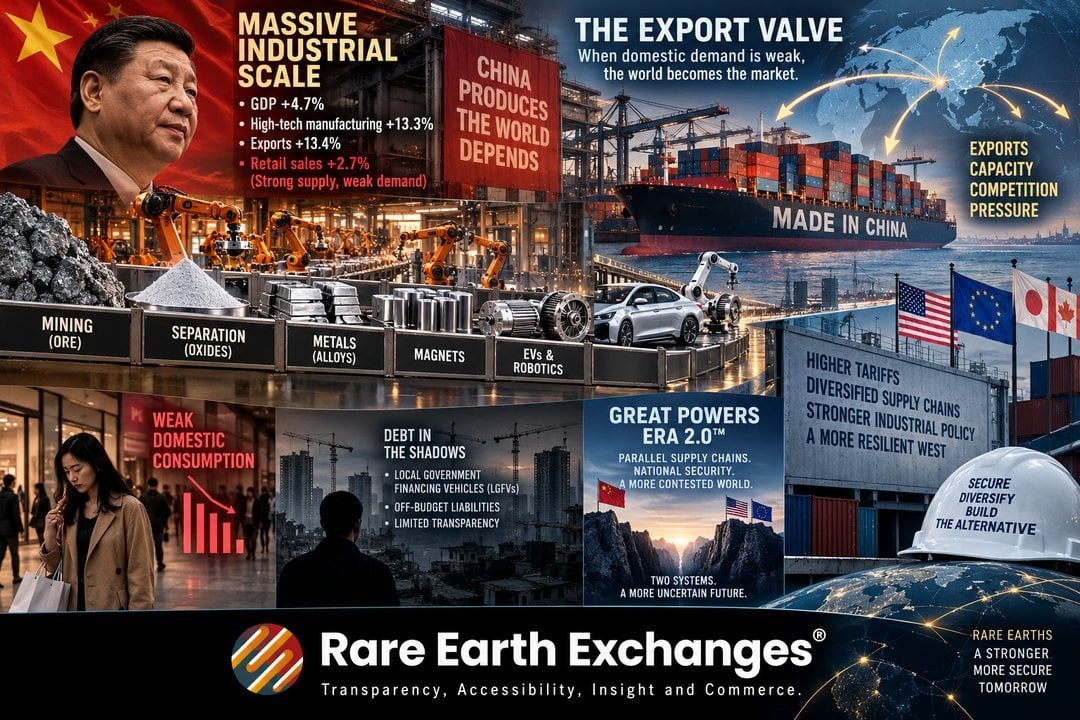
REEx Insight — China Is Brilliant at Scaling. The Harder Question Is When to Stop.
China's rare-earth achievement should not be minimized. Beijing helped assemble mining, separation, metals, magnets, and downstream manufacturing into an ecosystem the West still cannot easily reproduce. But REEx sees an increasingly consequential contradiction: central coordination is extremely effective at creating capacity, yet weaker market signals can make it harder to determine when capacity has become excessive.
Cheap capital, provincial incentives, industrial targets, and strategic subsidies can keep factories expanding even as margins fall. Entrepreneurship is not disappearing—China remains highly innovative—but greater political and state direction can narrow the space in which private capital decides what deserves funding and what should fail.
Wang Yiming works as Vice Chairman of China Center for International Economic Exchanges (CCIEE) and Member of the 13th National Committee of the Chinese People's Political Consultative Conference (CPPCC).

That matters for rare earths. If Chinese producers can operate through lower returns, state-supported financing, or strategic mandates, Chinese prices may not represent the economic cost required to build equivalent ex-China capacity. Western price floors, grants, offtakes, and government-backed loans increasingly represent a response to that structural asymmetry. The IMF itself has warned about industrial-policy-driven capital misallocation and international spillovers.
The Export Valve
Weak household demand leaves production searching for buyers elsewhere. China's 13.4% export growth therefore reflects genuine competitiveness—but also functions as a pressure-release valve for domestic capacity. Opacity compounds the investor challenge. IMF analysis estimates off-budget local government financing vehicle (LGFV) liabilities substantially above China's narrower official “hidden debt” measure, making the true fiscal support beneath some industrial activity harder to assess.
China's advantage and vulnerability are becoming two sides of the same machine: extraordinary capacity creation, followed by an ever-greater need to keep that capacity running. When domestic demand cannot absorb the output, that machine increasingly turns outward—exporting not only products, but excess capacity and price pressure into global markets. The danger for Beijing is that the industrial model that built China's dominance may now provoke the tariffs, supply-chain diversification, and competing Western industrial policies designed to weaken it.
This is central to REEx's Great Powers Era 2.0™ thesis: strategic industries are no longer competing within a largely shared global market; rival power blocs are increasingly building parallel supply chains, financing systems, trade barriers, and industrial policies around national security. Rare earths and select critical minerals sit near the center of that transition. China's very success in concentrating industrial capacity may therefore accelerate the Western effort to build an alternative system—more expensive and less efficient at first, but increasingly insulated from Chinese leverage.


0 Comments
No replies yet
Loading new replies...
Moderator
Join the full discussion at the Rare Earth Exchanges Forum →