
Highlights
- China's Baotou Rare Earth Research Institute opened a Hangzhou branch to attract top scientists while staying connected to Bayan Obo mining operations in Inner Mongolia.
- R&D priorities include nano rare earth oxides, samarium-iron-nitrogen permanent magnets, aluminum-scandium alloys, and miniature specialty electric motors targeting commercial production by 2026.
- Chinese leadership is directing researchers to align projects with market demand and move innovations rapidly from laboratory to large-scale factory production.
- China is treating advanced rare earth processing know-how as a strategic national asset, with directives to expand patents, tighten IP protection, and prevent technology leakage.
- China's competitive advantage is shifting downstream into specialty alloys, magnetic materials, and electric motors—where the greatest economic value and geopolitical leverage reside.
China is sharpening a strategy that reaches far beyond mining rare earths. During a visit to the Baotou Rare Earth Research Institute's Hangzhou Branch, Liu Peixun, Vice General Manager of Baogang (Group) and Party Secretary and Chairman of China Northern Rare Earth Group, outlined a vision that links China's vast rare earth resources with eastern China's research talent to accelerate industrial innovation.
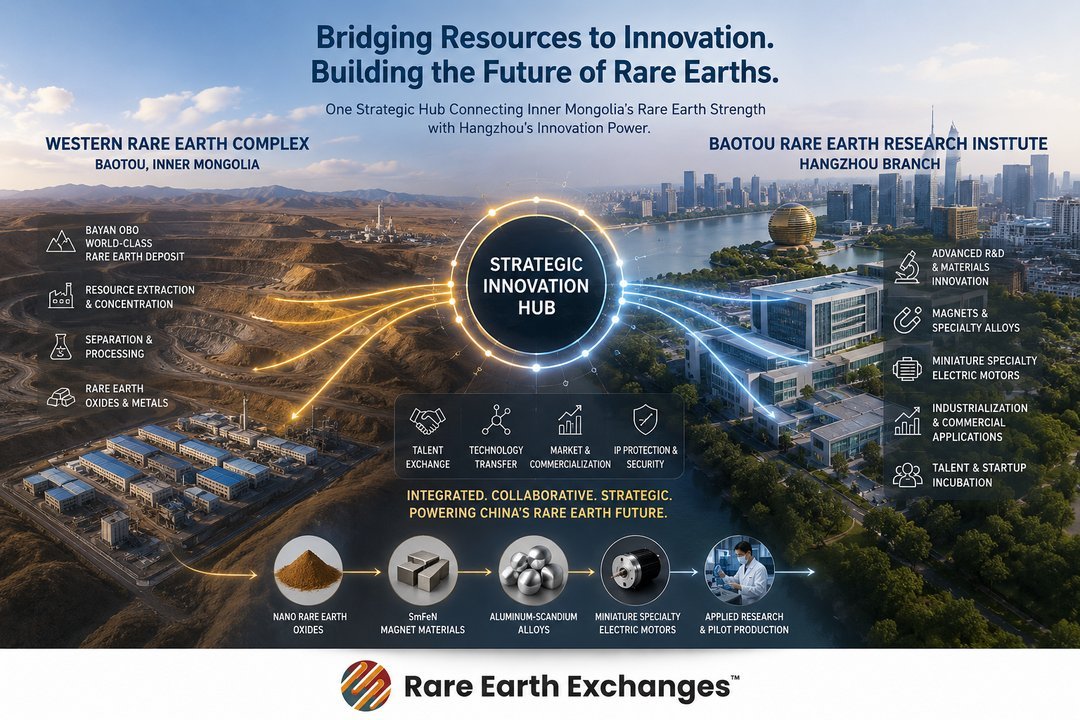
The Hangzhou branch serves as what Chinese officials call a "science and innovation enclave"—an off-site R&D center designed to attract top scientists and engineers while remaining tightly connected to manufacturing operations in Baotou, Inner Mongolia, home to the world-renowned Bayan Obo rare earth deposit.
From Laboratory to Factory Floor
Liu toured laboratories and pilot production facilities focused on several strategic technologies:
- Nano rare earth oxides
- Samarium-iron-nitrogen (SmFeN) permanent magnetic materials
- Aluminum-scandium alloys
- Miniature specialty electric motors
His message was clear: research should solve industrial problems, not simply produce academic papers. Liu urged scientists to work closely with production facilities, align projects with market demand, and prioritize technologies capable of reliable, large-scale manufacturing.
The visit reinforces a broader trend in China's rare earth strategy—integrating resource extraction, applied research, pilot-scale production, manufacturing, and commercialization into a coordinated industrial ecosystem designed to move innovations rapidly from laboratory to factory floor.
Protecting Technology as a Strategic Asset
One of the strongest themes of the visit was safeguarding China's technological advantage.
Liu instructed the institute to strengthen protection of core rare earth processing technologies, prevent leakage of proprietary know-how, expand patent filings, rigorously protect intellectual property, and tighten confidentiality surrounding strategic manufacturing processes.
For Western observers, this is an important signal. As Rare Earth Exchanges® has continued to chronicle, China increasingly appears to view advanced rare earth processing expertise and manufacturing know-how—not simply raw materials—as strategic national assets deserving the same protection as critical infrastructure.
Industrial Targets Already on the Calendar
The Hangzhou branch has been directed to achieve stable commercial production of miniature specialty electric motors by the end of 2026 while expanding high-value industrial applications for scandium-based materials. Liu also called for deeper collaboration among industry, universities, and research institutes, expanded enterprise incubation, stronger market-based talent recruitment, and closer coordination with Baotou's manufacturing operations.
For investors and policymakers, the takeaway is becoming increasingly difficult to ignore. China's competitive advantage is no longer confined to mining or separating rare earths. It is steadily extending into advanced materials, specialty alloys, magnetic technologies, electric motors, and the manufacturing expertise that transforms raw minerals into high-value industrial products. The strategic competition is moving downstream—where much of the economic value, technological leadership, and geopolitical leverage ultimately reside.
Source Disclaimer: This report is based on information published by media affiliated with Baogang Group and China Northern Rare Earth Group, both state-owned enterprises of the People's Republic of China. The reported initiatives, production targets, and technological developments should be independently verified before being relied upon for investment, commercial, or policy decisions.


0 Comments
No replies yet
Loading new replies...
Moderator
Join the full discussion at the Rare Earth Exchanges Forum →