
Highlights
- China Rare Earth Group and GRINM agreed to expand cooperation across mining, separation, advanced materials, and pilot-scale production platforms.
- The partnership signals Beijing's strategy to integrate state-owned enterprises, research institutes, and industry into a unified rare earth innovation ecosystem.
- No specific technologies or financial commitments were disclosed, but a regular coordination mechanism was established for ongoing institutional collaboration.
- Western nations risk focusing on matching China's current capabilities while China continuously advances its technological frontier in rare earth processing.
- Competitive advantage in the rare earth sector increasingly belongs to nations that can shorten commercialization cycles and move innovations rapidly from lab to factory.
China Rare Earth Group (CREG) and the China Research Institute of Nonferrous Metals (GRINM) have agreed to deepen cooperation across the rare earth value chain, focusing on pilot-scale production platforms, technology commercialization, mining and separation technologies, advanced materials, and coordinated industrial innovation. Although no specific technologies or financial commitments were announced, the agreement reinforces Beijing's long-term strategy of integrating research, state-owned enterprises, and manufacturing into a unified rare earth innovation ecosystem.
REEx Insight
Western governments continue to announce funding for mines and processing plants. China is investing in something equally important—and arguably harder to replicate: the innovation system itself.
This announcement demonstrates that Beijing is not standing still while the United States, Europe, Australia, and Japan race to diversify supply chains. Instead, China is tightening coordination among its largest state-owned producers, research institutes, and industrial partners to accelerate commercialization of next-generation rare earth technologies.
In the Great Powers Era 2.0™, competitive advantage belongs not simply to the nation that owns resources, but to the one that can continuously improve processing, reduce costs, shorten commercialization cycles, and move innovations rapidly from laboratory to factory floor.
An Integrated Industrial Strategy
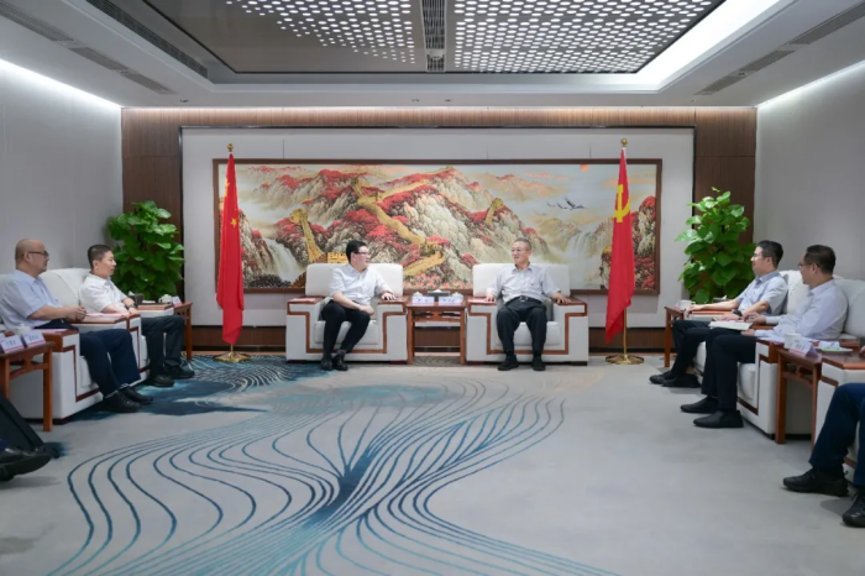
Meeting in Beijing, China Rare Earth Group Chairman Liu Leiyun and GRINM General Manager Ai Lei agreed to strengthen collaboration in rare earth mining, beneficiation, separation technologies, advanced materials, technology transfer, and pilot-scale industrial platforms.
Executives also discussed establishing a regular coordination mechanism, signaling an ongoing institutional partnership rather than a one-time research initiative. The repeated emphasis on integrating industry, academia, research, and application reflects one of China's longstanding industrial policy priorities: reducing the time between scientific discovery and commercial deployment.
Why This Matters to the West
Nothing announced here immediately changes rare earth supply. What matters is the direction.
China already dominates much of the world's rare earth separation, metals, alloys, and magnet production. This partnership seeks to reinforce that advantage by continuously improving the technologies underlying those industries.
That presents a strategic challenge for Western nations. Even as governments invest billions to build alternative supply chains, China is simultaneously working to make its own production more efficient, more technologically advanced, and more difficult to surpass.
The risk is that the West focuses on catching today's China while China continues moving the technological frontier forward. Success will require more than building mines or separation plants. It will require sustained investment in pilot facilities, engineering talent, process innovation, materials science, and commercialization—the same institutional capabilities this announcement seeks to strengthen.
REEx Connect
Organizations: China Rare Earth Group (CREG); China Research Institute of Nonferrous Metals (GRINM)
Key Executives: Liu Leiyun (Chairman, CREG); Li Zhihui (General Manager, CREG); Ai Lei (Deputy Party Secretary & General Manager, GRINM); Guo Liangjin (Chief Accountant, CREG); Qi Shuyong (Chief Accountant, GRINM)
Key Topics: Rare earth commercialization; pilot-scale production; technology transfer; beneficiation; separation; advanced materials; industrial policy; industry-academia integration; Great Powers Era 2.0™.
Disclaimer: This report is based on information released by China Rare Earth Group, a Chinese state-owned enterprise. The information reflects official statements and should be independently verified before being relied upon for investment, commercial, or policy decisions.
REEx Note
One point deserves emphasis because it fits the broader REEx thesis: the West should not assume China's current dominance is static. Much commentary treats China's lead as something that can simply be replicated with sufficient capital investment. This announcement suggests the opposite. China is investing in the institutions that generate the next generation of processing technologies and manufacturing capabilities. That is a more difficult competitive challenge than merely matching today's production capacity and is precisely the kind of dynamic that defines the Great Powers Era 2.0™.


0 Comments
No replies yet
Loading new replies...
Moderator
Join the full discussion at the Rare Earth Exchanges Forum →