
Highlights
- CREG's May 2024 roster lists 35 operating smelting and separation enterprises spanning light and heavy rare earth feedstocks across nine Chinese provinces.
- China imported 41,700 tonnes of Myanmar heavy rare earth oxides in 2023—more than twice China's domestic mining quota—with CREG-linked facilities documented as consumers.
- Laos provides the clearest corporate ownership bridge via a CREG-linked joint venture in Houaphanh; Myanmar mine ownership remains largely opaque despite documented purchasing.
- Malaysia's MCRE Resources has exported rare earth carbonate into the CREG system since February 2023, using technology supplied by a Chinalco subsidiary.
- Approximately 98% of heavy rare earth elements are separated and processed into oxides in China, making midstream concentration—not mine location—the true strategic chokepoint.
China Rare Earth Group (CREG) sits at the controlled midstream of Asia’s heavy rare-earth (HREE) trade. Its May 2024 roster names 35 operating smelting and separation enterprises, while public records connect CREG subsidiaries to feedstock from Myanmar, Laos and Malaysia. Rare Earth Exchanges® (REEx) separates documented ownership and purchasing from allegations that remain unproved.
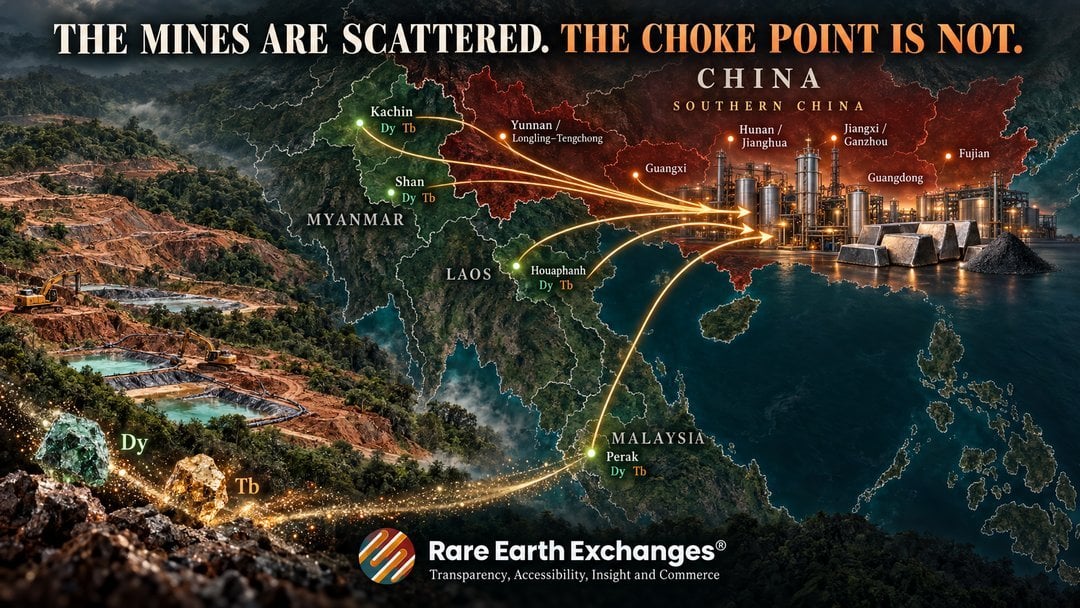
The mines look scattered. The choke point is not. Dysprosium- and terbium-bearing ionic clay moves through opaque border operators into a Chinese system concentrated under two state-controlled groups—with CREG dominating the southern ionic-clay chain.
Brief Primer on HREE Importance
Heavy rare earth elements (HREEs)—particularly dysprosium and terbium—help neodymium-iron-boron magnets retain coercivity and performance at the elevated temperatures found in electric-vehicle motors, wind turbines, robotics, aerospace systems and advanced defense equipment. Other HREEs such as yttrium support specialized applications in medical imaging, lasers, sensors, phosphors and electronics. Economically attractive deposits occur in the ionic-adsorption clays of southern China and Southeast Asia, while Australia, Brazil, Africa and North America host additional deposits and development projects, including hard-rock and mineral-sand resources.
Yet geology is not supply: HREE ores require technically demanding, multi-stage chemical separation into individual high-purity oxides. China controls the dominant commercial separation capacity, operating expertise and downstream metal-and-magnet infrastructure. That midstream concentration—not simply the location of the ore—is the strategic chokepoint. Approximately 98% of heavy rare earth elements are separated and processed into oxides in China.
REEx Insight—Control Without a Visible Corporate Chain
CREG does not need to own a Myanmar hillside to control its economics. Chinese suppliers provide much of the leaching chemistry and technical know-how; imported mixed rare-earth compounds then enter licensed processors. Global Witness calculated that China imported 41,700 tonnes of Myanmar material classified as heavy rare-earth oxides in 2023—more than twice China’s domestic heavy-rare-earth mining quota—and found public plans for CREG-linked facilities in Longling, Yunnan, and Jianghua, Hunan, to consume Myanmar material.[1]
This creates a crucial investor distinction: mine ownership is opaque; midstream dependence is demonstrable. China Southern Rare Earth Group (opens in a new tab) previously said its parent, Ganzhou Rare Earth Group (opens in a new tab), had opened Myanmar import channels and captured more than half of “overseas” rare-earth resources.[2] Longling’s government identifies a CREG mixed-oxide project. CREG affiliate Yunnan Baoshan Rare Metals and Rare Earth Co. is authorized to trade, warehouse and import mineral products, although that business scope does not prove purchases from particular Myanmar mines.[3] No reliable public record proves that “nearly all” Myanmar material terminates in Kunming. REEx judges Kunming a logistics and trading node—not the evidenced endpoint. Border-adjacent Longling/Tengchong and processors across Hunan, Jiangxi and Guangdong form the stronger documented chain.
The Roll-Up Behind the Gate
Beijing incorporated CREG in December 2021 with six founding shareholders: the State-owned Assets Supervision and Administration Commission (SASAC) (31.21%); Chinalco, China Minmetals and Ganzhou Rare Earth Group (20.33% each); and China Iron & Steel Research Institute Group and GRINM Group (3.90% each). Those formation percentages should not be read as a current shareholder register. The transferred core included Chinalco Rare Earth & Metals, Minmetals Rare Earth Group, China Southern Rare Earth Group, Ganzhou Zhonglan and related trading assets.[4]
In April 2024, CREG completed the transfer (opens in a new tab) of 100% of Guangdong Rare Earth Industry Group, becoming the ultimate controller of 38.45% of Guangsheng Nonferrous. The listed company adopted the name Zhongxi Nonferrous in December 2025.[5]
The result is not merely a miner. CREG spans deposits, hydrometallurgical separation, metals, recycling, trading and two listed platforms: China Rare Earth Resources and Technology (000831.SZ) and Zhongxi Nonferrous (600259.SH).[5]
Laos Reveals the Ownership Bridge; Myanmar Conceals It
Laos supplies the clearest corporate bridge. Reporting based on company records identifies Beijing Platinum World Technology Development (opens in a new tab) (55%)—a subsidiary of state-owned China Southern Rare Earth International Trade, now within CREG—and Lao state-owned Phadang Hungheuang Huaphan Mining Sole Co. (opens in a new tab) (45%) as owners of the Lao–China Northern Rare Earth project in Houaphanh.[6] A Chinese trade-promotion account also named producing/exporting ventures Guangjianxin, Beijing Boyu, Donglisheng and Zhongli, while Chifeng Gold subsidiary CHIJIN Laos pursued exploration permits.[7] Only the Beijing entity has a documented CREG bridge in the reviewed record.
Myanmar is different. Myanmar remains highly relevant—the Myanmar Rebels are ranked number one for the REEx Insights Rankings for heavy rare earth upstream assets. Chinese-speaking operators and militias control mines, but multiple media reports on the matter, such as Reuters, could not identify most owners; output moves to China under poor corporate disclosure.[8] Sources name China Southern Rare Earth Group, Chinalco Rare Earth and Guangdong Rare Earth as buyers—each now inside CREG—but that proves purchasing, not ownership of individual mines.[9] Claims of disguised CREG mine affiliates remain credible intelligence requiring registry, customs or beneficial-ownership confirmation.
Malaysia is an emerging CREG-linked source, although still far smaller than Myanmar. MCRE Resources, 40%-owned by Southern Alliance Mining, operates the Perak ionic-clay project using technology supplied by Chinalco Guangxi Nonferrous Rare Earth. Southern Alliance Mining disclosures say MCRE has exported rare-earth carbonate into the CREG system since February 2023.[10]
Processing Entities, Not a Verified Hundred
CREG’s May 2024 official roster lists 35 operating smelting and separation enterprises—not necessarily 35 physical plants. The list covers light- and heavy-rare-earth feedstocks and mixes controlled, minority-owned and “integrated/cooperating” companies.[11] It comprises Dingnan Dahua; Ganzhou Longnan Smelting; Ganzhou Longnan Nonferrous; Longnan Heli; Jiangxi Mingda; Jiangxi Jinshiji; Longyi HREE; Quannan New Resources; Guangxi Jinyuan; Guangxi Guosheng; Guangxi Yuxiao Xijun; Zhongxi Yongzhou; Hunan Rare Earth Metals Institute; Zhongxi Changshu; Zhongxi Changzhou; Jiangyin Jiahua; Changzhou Hailin; Yixing Xinweili Cheng; Guangzhou Jianfeng; Guangdong Fuyuan; Qingyuan Jiahe; Deqing Xingbang; CNMC Southern Xinfeng; Zhongxi Jinlong; Zhongxi Shouguang; Zibo Jiahua; Shandong Zhongkai; Zhongxi Liangshan; Mianning Fangxing; Leshan Ruifeng; Mianning Feitian; Dechang Zhineng; Leshan Shenghe; Baotou Xinyuan; and Baoding Huabao.
REEx has heard of over 100 such processors, but many may count dormant, private, tolling, recycling or illegal lines across southern China. Until a plant-level list appears, investors should be careful citing these as CREG capacity.
Bottom Line—The Border Moves; the Bottleneck Stays
Conflict disrupted Kachin supply and encouraged new Chinese-operated mining in United Wa State Army-controlled Shan State; Laos and Malaysia provide additional feedstock. None breaks China’s grip on separation. The geopolitical risk is therefore not only mine disruption. Non-Chinese manufacturers cannot reliably audit origin, while Beijing can influence availability through production quotas, export licensing controls and state-owned procurement.
Profile
China Rare Earth Group Co., Ltd. (CREG) is a central state-controlled enterprise established in Ganzhou, Jiangxi, in December 2021 by consolidating rare-earth assets from Chinalco, China Minmetals and Ganzhou Rare Earth Group, with participation from China Iron & Steel Research Institute Group and GRINM Group. Directly supervised by the State-owned Assets Supervision and Administration Commission, CREG operates across mining, smelting and separation, metals and advanced materials, recycling, research and international trade, with particular strength in southern China’s medium- and heavy-rare-earth resources. Its network spans nine Chinese provinces and parts of Southeast Asia, while its listed platforms—China Rare Earth Resources and Technology (000831.SZ) and Zhongxi Nonferrous (600259.SH)—provide access to processing, trading and downstream assets. CREG’s strategic importance lies less in any single mine than in its state-backed control of quotas, ionic-clay feedstock channels and separation capacity, making it the principal institutional gatekeeper for China’s dysprosium- and terbium-intensive supply chain.
Sources
- Global Witness, (opens in a new tab)Myan mar’s rare earth boom (opens in a new tab)
- Global Witness, (opens in a new tab)Myanmar’s poisoned mountains (opens in a new tab)
- Longling County Government, CREG mixed-oxide project (opens in a new tab)
- China Rare Earth Resources and Technology acquisition filing (opens in a new tab)
- Zhongxi Nonferrous, 2025 annual report (opens in a new tab)
- Business & Human Rights Resource Centre, Houaphanh project ownership (opens in a new tab)
- Beijing CCPIT, Laos project survey (opens in a new tab)
- Reuters, Chinese-backed Myanmar mines (opens in a new tab)
- Shanan Foundation, KIO/A rare-earth governance (opens in a new tab)
- Southern Alliance Mining, MCRE investor presentation (opens in a new tab)
- CREG, first batch of operating mines and smelting/separation enterprises (opens in a new tab)


0 Comments
No replies yet
Loading new replies...
Moderator
Join the full discussion at the Rare Earth Exchanges Forum →