
Highlights
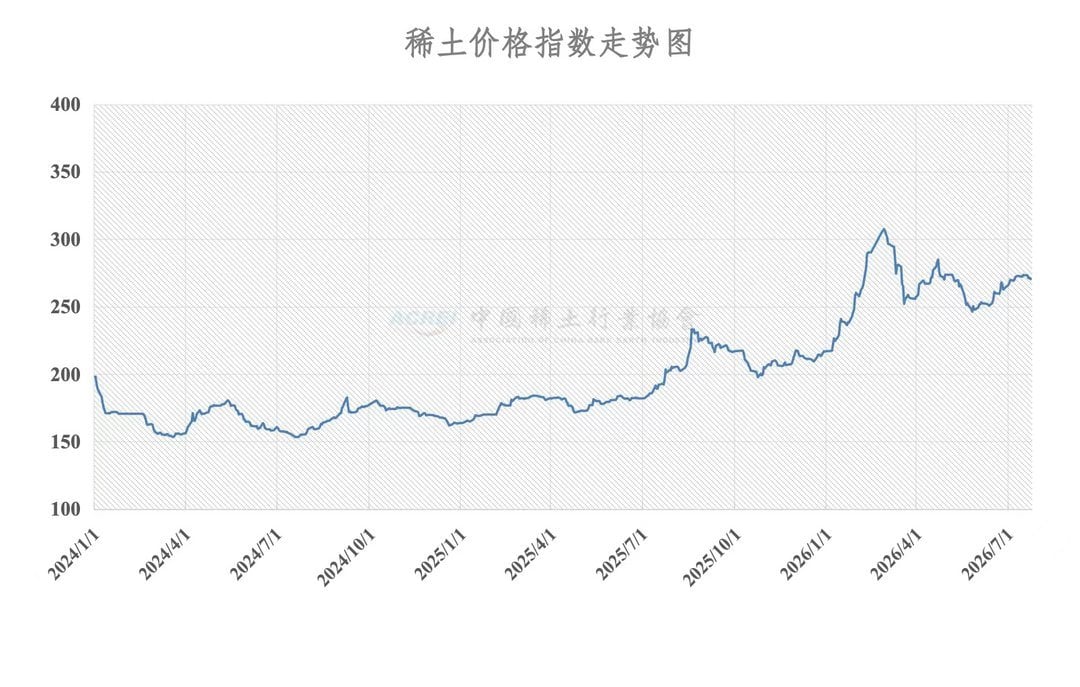
- China's Rare Earth Price Index reached 270.5 on July 24, 2026, sitting 170.5% above its 2010 baseline amid ongoing supply controls.
- NdPr oxide climbed to ¥747–¥767/kg (approx. US$112–$115/kg), approaching the US DoD price floor tied to the MP Materials arrangement.
- Dysprosium and terbium quotations appear stable in China but remain extremely difficult to procure at commercial volumes outside Asia.
- Serra Verde's Brazilian ionic-clay deposit is strategically significant, but its 6,400 MT TREO annual target by end-2027 remains a projection, not a proven operating rate.
- Heavy rare earth supply outside southern China and Southeast Asia is still marked by execution risk, limited price transparency, and concentrated state control.
China’s Rare Earth Price Index registered 270.5 on July 24, 2026, according to the Association of China Rare Earth Industry. The index uses 2010 transaction data as a base of 100 and daily average transaction data submitted by domestic Chinese companies. At 270.5, the index is 170.5% above its 2010 base. That comparison shows the scale of the long-term increase, but it should not be presented as proof that recent export controls alone caused the rise.
Magnet Materials Move Higher
The day’s clearest market signal came from mixed neodymium-praseodymium products used in high-performance permanent magnets:
| Product | China reference price | At US$0.15 per yuan | Change |
|---|---|---|---|
| NdPr oxide | ¥747–¥767/kg | US$112.05–US$115.05/kg | Higher |
| NdPr alloy | ¥908.1–¥928.1/kg | US$136.22–US$139.22/kg | Higher |
The conversion assumption supplied—US$0.15 per yuan—is equivalent to approximately US$1 = ¥6.67
NdPr oxide is trading close to the US$110-per-kilogram price floor contained in the U.S. Department of Defense arrangement supporting MP Materials. That floor applies to the specific MP transaction; it should not automatically be treated as an industry-wide U.S. benchmark.
Heavy Rare Earths: Calm Quotations, Troubled Supply
Key domestic reference prices included:
- Dysprosium oxide: ¥1,390–¥1,430/kg, or US$208.50–US$214.50, unchanged
- Terbium oxide: ¥6,760–¥6,820/kg, or US$1,014–US$1,023, unchanged
- Holmium oxide: ¥608.6–¥628.6/kg, or US$91.29–US$94.29, lower
- Gadolinium oxide: ¥206.4–¥226.4/kg, or US$30.96–US$33.96, lower
- Yttrium oxide: ¥57.2–¥61.2/kg, or US$8.58–US$9.18, unchanged
The business significance lies in stronger NdPr pricing and the disconnect between apparently stable Chinese quotations and severe ex-China availability risk. Dysprosium, terbium, yttrium, and specialized metals can be difficult to procure outside China, particularly at qualified commercial volumes.
Neither Market Offers Clean Price Discovery
China’s quotations are policy-shaped domestic references, influenced by state ownership, production quotas, export licensing, industrial planning, and national-security directives. China’s rare earth regulations explicitly strengthen state control, while quota access has become concentrated among major state-owned groups.
The ex-China market is not a transparent commodity exchange either. Transactions are predominantly confidential, bilateral, and customized by purity, volume, qualification, financing, and delivery terms. Pricing-agency assessments can therefore be useful—but may rest on small samples or trader submissions that do not represent the buyer’s actual market.
Heavy Rare Earths: Strategic Scarcity Meets Execution Risk
Heavy rare earth supply remains the West’s most dangerous mineral vulnerability. Commercially meaningful ionic-clay production is still concentrated in southern China and China-linked supply corridors in Myanmar and Laos; Malaysia has processing capabilities and prospective resources, but it is not yet a comparable independent source of dysprosium and terbium. Southern Alliance Mining (SGX.QNS) shows real promise yet today remains a Chinese supplier.
Serra Verde’s Brazilian operation is therefore strategically important—but investors should separate geological promise from demonstrated, repeatable production. The deposit has often been portrayed as a relatively straightforward, selectively mined ionic-clay operation amenable to simple leaching, yet industry observers contend that the geology, extraction behavior, and designated mining zones are more complicated than promotional summaries imply. They also question whether reported production figures reflect sustained commercial capability, arguing that references to roughly 100 metric tons annually may have been extrapolated from limited or one-off pilot performance. Serra Verde officially targets approximately 6,400 metric tons of total rare earth oxides annually by the end of 2027, but that remains a forward projection—not an established operating rate. Rare Earth Exchanges has raised questions for investors about the probability of that projection. The proposed $2.8 billion USA Rare Earth acquisition should therefore be understood primarily as a strategic valuation placed on one of the few potentially scalable sources of dysprosium and terbium outside Asia, supported by U.S. financing and long-term offtake arrangements—not as proof that the promised volumes have already been achieved.
Public Western contracts illustrate scarcity economics, but not universal prices. The Serra Verde–USA Rare Earth arrangement reportedly contains floors of approximately US$575/kg for dysprosium and US$2,050/kg for terbium under that specific long-term agreement. Those values are not transferable spot benchmarks.
In heavy rare earths, announcements are plentiful; consistent recoveries, qualified products, and dependable annual output remain exceedingly rare outside of southern China and Southeast Asia.
Buyer beware: in rare earths, a published number is often a reference point, not a price at which material can actually be secured.
Source disclaimer: The underlying information comes from an officially approved Chinese industry association operating within China’s state-directed rare earth system. The association itself should not be described as a state-owned company. Its data should nevertheless be independently verified before being used for procurement, valuation, or investment decisions.


0 Comments
No replies yet
Loading new replies...
Moderator
Join the full discussion at the Rare Earth Exchanges Forum →