
Highlights
- China controls ~70% of rare-earth mining, 85-90% of refining, and 90%+ of magnet production, giving Beijing physical supply-chain leverage that tariffs cannot quickly counter.
- After April 2025 export controls on terbium, dysprosium, scandium and other critical elements, U.S. imports effectively halted, exposing the difference between financial and industrial coercion.
- Musk's CGTN interview signals that even America's top industrialists must navigate China's manufacturing dominance, especially as humanoid robots and EVs deepen rare-earth demand.
- REEx concludes U.S. dependence on Chinese rare earths will persist into the 2030s despite accelerating domestic investment, absent a true Manhattan Project-scale effort.
- Investors must distinguish between ore deposits and integrated supply chains: a mine announcement is not a qualified magnet approved for defense or automotive applications.
Eighteen months after Donald Trump declared “Liberation Day” and launched a tariff offensive intended to restore American economic sovereignty, Elon Musk—then one of Trump's most visible advisers—has appeared on Chinese state television owned by the Communist Party (opens in a new tab) calling Xi Jinping a “great leader,” praising Chinese manufacturing and artificial intelligence, and declaring that words cannot capture the “incredible majesty” of China. Musk's language is striking. The deeper story for investors, however, is not flattery. It is leverage. China demonstrated after April 2025 that control over rare-earth separation, metals, alloys, magnets and other critical-material chokepoints can constrain America's freedom of economic action. Days before the September 24 Trump-Xi summit, Rare Earth Exchanges® (REEx) amplified news that rare earth leverage was contributing to a less confrontational U.S. posture toward Beijing; after the meeting, we characterized the summit as producing no major breakthrough.
Welcome to Great Powers Era 2.0™, where industrial capacity increasingly determines the boundaries of geopolitical power.
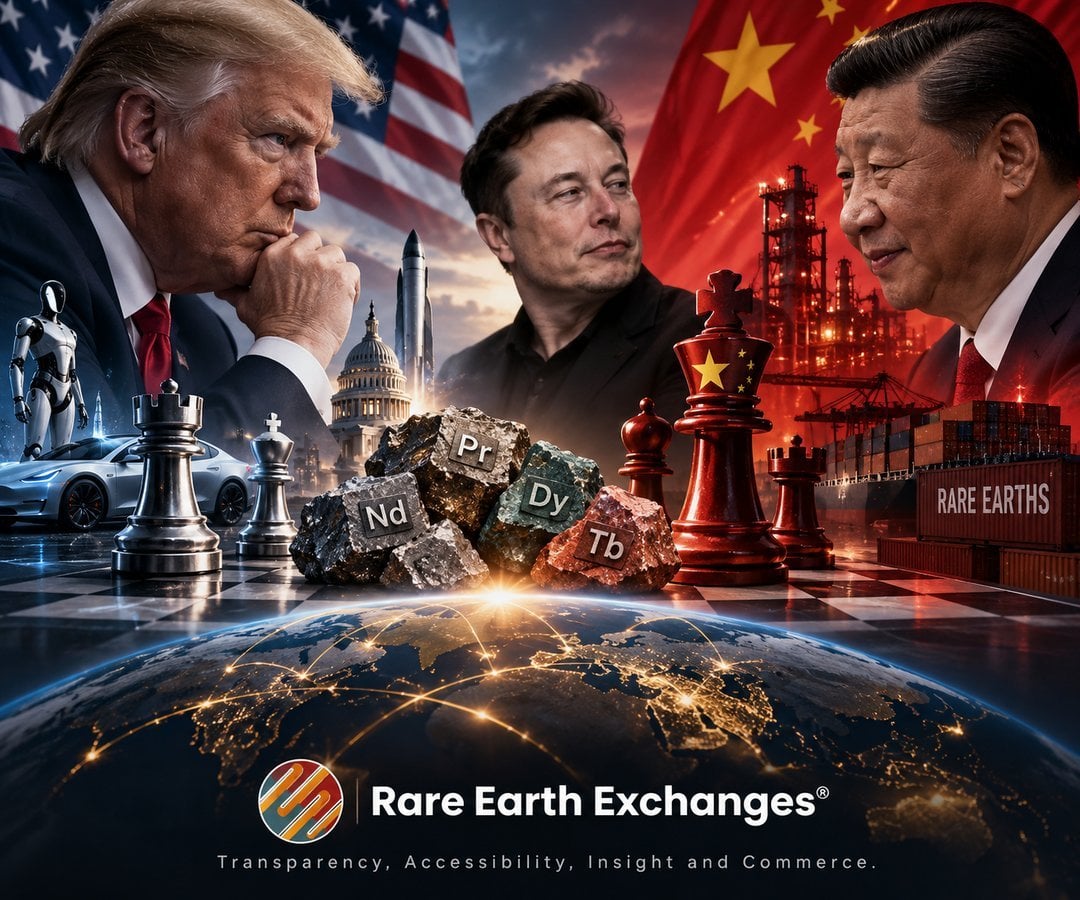
REEx Insight: Musk's Interview Is Really About Industrial Power
There is an extraordinary dialectic running through Musk's interview (opens in a new tab). America possesses some of the world's most valuable technology companies. China possesses much of the industrial ecosystem required to turn technology into physical products. America leads at important frontiers of AI, aerospace and software. China dominates numerous processing and manufacturing chokepoints. And of course U.S. consumer markets are second to none, as are our capital markets.
Yes, Washington can restrict semiconductor technology. Beijing can restrict critical materials.
America can impose a tariff overnight. It cannot build a qualified rare-earth separation plant, metallization operation or magnet supply chain overnight.
That asymmetry is the story investors should be watching. Before and after this summit, China controls up to roughly 70% of rare-earth mining, 85%-90% of refining capacity and about 90% or more of rare-earth metal-alloy and magnet production. REEx modeled forecasts suggest that U.S. dependence on China is expected to persist well into the 2030s despite accelerating American investment. The balance of power therefore cannot be read simply from GDP, tariffs or defense spending. Yes, the factory matters. The separator matters. The metallization furnace matters. The magnet plant matters. And Elon Musk understands factories.
The Remarkable Opening: Xi Is a ‘Great Leader’
China's interviewer did not wait long. Asked for his impression of Xi Jinping, Musk responded:
“He seems like a great leader.” He continued that China had “prospered immensely” under Xi, described the country's physical transformation and concluded that Xi had done an “excellent job” and was “very capable.”
The venue makes the exchange more consequential. The interview was conducted by CGTN/China Media Group. Chinese government descriptions of CMG note it’s a public institution directly under the State Council and under the leadership of the Communist Party's Central Publicity Department, with responsibilities that include promoting Party theory and policies and strengthening China's international communications.
It is therefore accurate to describe CMG as Chinese state media operating under CCP propaganda/publicity leadership. Calling Musk's appearance itself “propaganda” goes beyond the documentary evidence. But Beijing obtaining such effusive statements from perhaps America's most recognizable industrialist on that platform unquestionably provides material useful to China's international messaging. The distinction matters.
Not surprisingly, largely absent from the discussion was the other side of China’s extraordinary capital accumulation: an export-led industrial model that has generated enormous manufacturing surpluses while suppressing domestic consumption and intensifying trade tensions abroad. Nor did Musk dwell on the increasingly centralized, top-down role of the Chinese Communist Party, its tighter control over private enterprise, restrictions on cross-border capital movement, or the persistent concerns among parts of China’s business and entrepreneurial classes about regulatory unpredictability and political intervention. Equally missing was much celebration of enduring American power—from frontier technology, capital markets and energy to aerospace, entrepreneurship and the dollar-centered financial system. Not to mention our culture of individualism.
That omission matters. China’s industrial rise and leverage are formidable, but they coexist with significant structural weaknesses. Musk, whose Tesla empire has enormous commercial interests in China, appears to understand the environment in which he is speaking and is playing the game accordingly. That is a reasonable interpretation of the interview, not proof of his private motivations—and investors should recognize the distinction.
But now to the five ironies embedded in this remarkable interview—and, more importantly, in the geopolitical and industrial dynamic unfolding under Trump 2.0.
Irony No. 1: From Liberation Day to Supply-Chain Reality
April 2025 was supposed to demonstrate American leverage. Instead, it helped demonstrate China's.
Beijing responded to escalating trade tensions on April 4, 2025 by imposing export controls covering seven medium and heavy rare-earth categories: samarium, gadolinium, terbium, dysprosium, lutetium, scandium and yttrium, including specified metals, compounds and downstream materials. China's Ministry of Commerce said the controls were intended to safeguard national security and fulfill international obligations.
Whatever Beijing's stated rationale, the market consequences exposed Western vulnerability.
REEx continues to report that exports of yttrium, terbium, scandium and dysprosium to the United States effectively halted after the April 2025 measures, while companies complained of slow and opaque licensing. That revealed a fundamental difference between financial-economic coercion and industrial coercion.
A tariff changes a price. A physical chokepoint can determine whether production happens at all.
Irony No. 2: Musk Was Inside Trump's Tent—but Opposed the Tariff Strategy
There is another important nuance. Musk should not be portrayed as an architect of Liberation Day.
He was deeply associated with the Trump administration at the time, but publicly favored freer trade and clashed with tariff advocate Peter Navarro. That actually sharpens the story.
Musk straddles the two competing visions of American power. One is Washington's attempt to force industrial rebalancing through tariffs and state intervention. The other is the multinational manufacturer's need to operate wherever the world's most efficient industrial ecosystems already exist. Musk's answer is visible in Shanghai—and welcome to Great Powers Era 2.0!
He told CCTV that China has an extraordinary inherent manufacturing capability and said: “The magic of Tesla Shanghai is because of Chinese.” He praised Tesla's Chinese employees as talented, hardworking and trustworthy, and called Gigafactory Shanghai a “gem.”
For investors, strip away the diplomacy and listen carefully. One of America's most accomplished manufacturing executives is telling the market where he sees exceptional industrial capability.
Irony No. 3: America Wants to De-Risk From China While Tesla Wants More Robots
This contradiction becomes even more important when Musk discusses Optimus.
Musk predicts at least one billion humanoid robots within ten years. That is Musk's forecast—not an established industry projection—and investors should treat the number accordingly. But directionally, robotics matters enormously for critical minerals.
Humanoid robots require motors, actuators, sensors, electronics, batteries and sophisticated manufacturing. High-performance permanent-magnet motors can require NdFeB magnets containing neodymium-praseodymium and, depending on operating requirements and magnet design, dysprosium or terbium.
Thus the paradox: The more physical AI succeeds, the more strategically important physical supply chains become.
Silicon intelligence ultimately needs copper, power, steel, lithium, graphite, rare earths, motors, magnets and factories.
The digital revolution does not abolish materials. It magnifies their importance.
Irony No. 4: Washington Controls Advanced Chips; Beijing Controls Different Chokepoints
Musk supplied another remarkable observation. He called Chinese AI models “outstanding” and argued that China was achieving exceptional performance relative to available computing resources. More provocatively, he predicted China could overcome important lithography and chipmaking constraints in approximately two or three years.
That is Musk's forecast and may prove too optimistic. But consider the strategic dialectic.
The United States has attempted to preserve advantages in leading-edge computing by restricting China's access to advanced semiconductor technologies. China has demonstrated its ability to constrain access to materials required throughout Western automotive, defense, semiconductor and advanced-manufacturing systems.
Washington is betting that technological chokepoints endure long enough to rebuild industrial ones. Beijing is betting that industrial scale buys enough time to overcome technological chokepoints.
That contest may define the next decade.
Irony No. 5: Even Trump Called Xi a ‘Great Leader’
Musk's language becomes still more revealing when placed in the political chronology. During Trump's May 2026 visit to Beijing, Trump himself publicly told Xi: “You're a great leader.” ABC News reported Trump saying he tells people this even when they dislike hearing it.
Four months later, Musk used essentially the same formulation. This does not establish coordination or common motive.
But the juxtaposition is extraordinary. In April 2025, Washington's rhetoric centered on “Liberation.” By September 2026, experts saw Chinese rare-earth leverage as one reason Washington had become less confrontational before Xi's visit. Even media such as Reuters quoted former U.S. officials describing Washington as seeking stability and secure access to critical minerals after the earlier rare-earth confrontation.
That does not mean America has “lost” the economic confrontation. Under Trump 2.0, Washington is investing heavily in alternative mines, separation and processing capacity, metals, alloys and magnets—an industrial rebuilding effort that could materially alter the balance over time. But as REEx concluded yesterday, the United States is not yet executing anything resembling the “Manhattan Project” for rare earth and critical minerals that some administration officials and allies have invoked. The deeper lesson is more consequential: China has accumulated meaningful retaliatory capacity. Beijing can now answer American pressure not merely with tariffs or diplomatic protests, but by reaching into physical supply chains where substitution is difficult, qualification takes years and disruption can quickly become an industrial problem. That is a very different form of economic power with profound implications.
The Most Important Dialectic: Ore Is Not Power—Processing and Magnet Production Is
This is where investors routinely misunderstand the rare-earth story. The West possesses rare-earth deposits.
That does not mean it possesses a rare-earth supply chain. Brazil has resources. Australia has resources. America has resources. Africa has enormous geological potential. Malaysia is emerging as an important processing jurisdiction.
But a deposit is not separated oxide. Oxide is not metal. Metal is not alloy. Alloy is not a qualified magnet.
And a magnet plant announced today is not necessarily a magnet approved tomorrow for a General Motors drivetrain, an F-35 subsystem, a data-center component or a humanoid robot.
China's competitive moat is not geology alone. It is accumulated industrial integration. That distinction explains why REEx has continued to conclude (as unpopular as it is) that America is likely to remain dependent on Chinese rare earths into the 2030s even while rapidly developing alternative capacity.
Great Powers Era 2.0: The Return of the Physical Economy
For three decades, Western markets rewarded asset-light businesses, software, financial services, globalization and just-in-time supply chains. Great Powers Era 2.0 is forcing capital markets to rediscover something much older: Physical capacity is strategic power. Separation columns matter. Metallization furnaces matter. Magnet presses matter. Electricity matters.
Engineers matter. Permits matter. Qualification matters. And time matters enormously.
China spent decades assembling interconnected industrial ecosystems. America cannot reproduce them merely by announcing projects or appropriating capital in 12, 24 or even 36 months. Not without a true Manhattan Project.
So all of this creates potentially enormous opportunity—but also enormous risk—for investors. A Western rare-earth company should therefore not be valued simply because it owns ore.
The questions become: Can it separate it? Can it metallize it? Who buys it? Where is the equipment sourced? Where does intermediate material travel? Is the product qualified? What is the actual element basket? What is recoverable? What is payable? And does the supply chain truly terminate outside China? Those questions separate strategic assets from PowerPoint mines and lifestyle explorations.
The Investor Takeaway: Watch Dependency, Not Diplomacy
The September 24 summit produced ceremony but no major breakthrough on the most difficult bilateral issues (including rare earths) as we reported. Simply, the can was kicked down the road a few months to January 10, 2027. The more important signal may therefore have arrived the day before.
Elon Musk—the entrepreneur building electric vehicles, rockets, AI infrastructure and humanoid robots—sat before CCP media and praised China's leader, manufacturing system, AI models and national development. He ended with something approaching a paean: “Any words I say do not do justice to the incredible majesty that is China.” And then: “China is awesome.”
Those statements should not be mistaken for an objective assessment of the Chinese political system. Musk has enormous commercial exposure to China, and the interview occurred on Chinese state media. But investors should not dismiss them as mere flattery either.
The most consequential message was embedded beneath the rhetoric. China built an industrial machine powerful enough that the world's richest industrialists and the world's most powerful governments must account for it. That is the uncomfortable dialectic of September 2026. Liberation Day demonstrated America's willingness to use economic power. China's subsequent critical-mineral/rare earth element supply chain controls demonstrated Beijing's capacity to answer with physical supply-chain power.
And eighteen months later, the contest has exposed a fundamental reality: Tariffs can be declared in an afternoon—and often were, seemingly impulsively, in this Trump 2.0 administration. But industrial ecosystems take decades to build. That gap—between political time and industrial time—is where the next generation of rare-earth fortunes, failures and geopolitical leverage will be made.
That is the emerging global order we at Rare Earth Exchanges call Great Powers Era 2.0—the emerging era in which industrial capacity, strategic resources and control of critical supply-chain chokepoints are once again becoming instruments of national power.
Follow the link to watch the interview on CGTN (opens in a new tab).


0 Comments
No replies yet
Loading new replies...
Moderator
Join the full discussion at the Rare Earth Exchanges Forum →