
Highlights
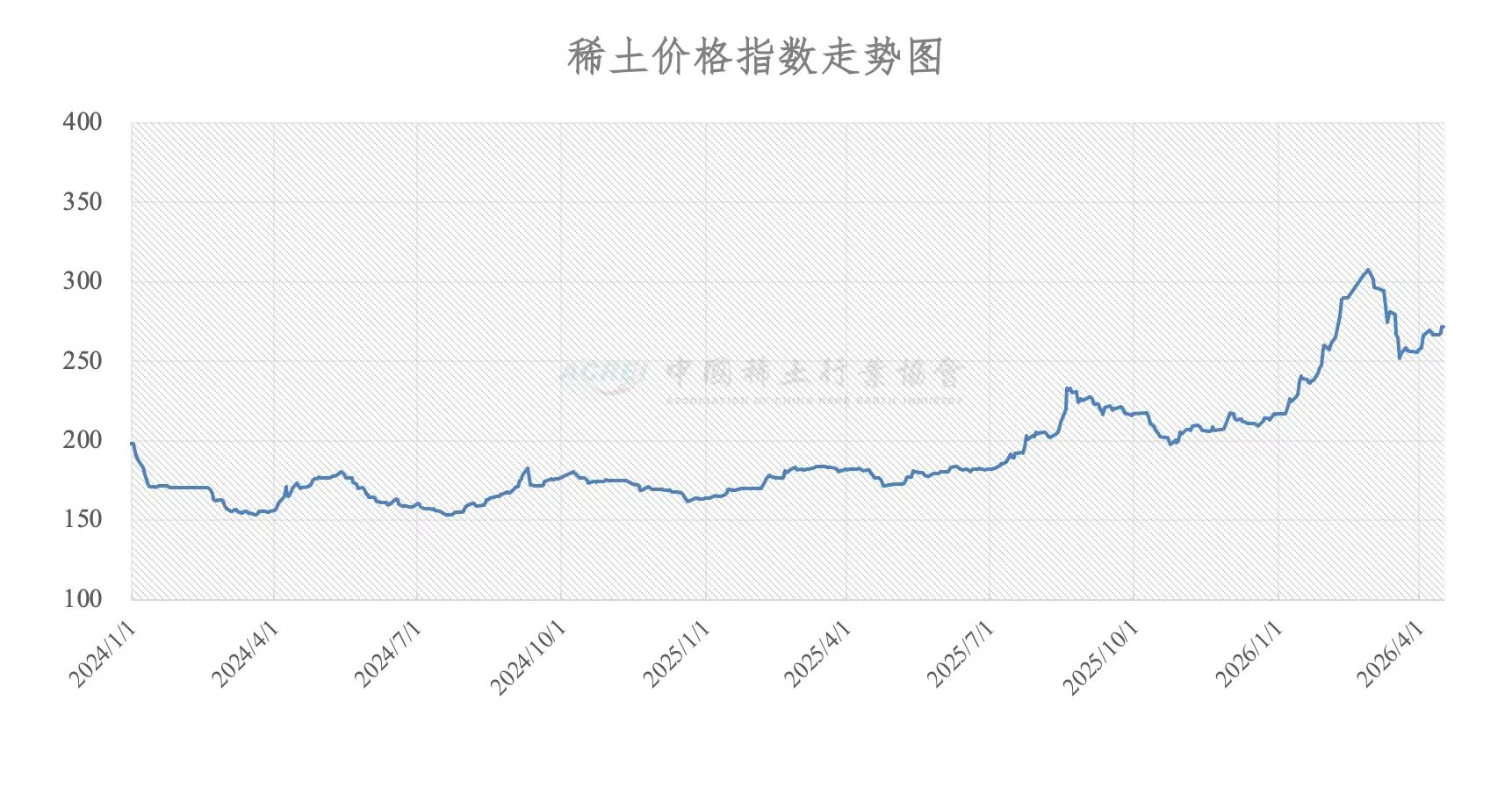
- China's rare earth price index stood at 271.8 on April 16, with neodymium oxide at ~$31.6–$34.4/kg and dysprosium at ~$187–$193/kg; however, these figures reflect state-managed domestic transactions, not transparent global market-clearing prices.
- Chinese pricing exists within a system shaped by production quotas, state consolidation, and export controls—serving as managed price signaling rather than Western-style spot market discovery.
- A bifurcated global market is emerging where China's published prices anchor expectations, but real ex-China supply often clears at higher, less visible prices due to strategic constraints and opaque bilateral agreements.
China’s rare earth industry association on April 16 reported its rare earth price index at 271.8 (base year 2010 = 100), reinforcing that domestic pricing remains structurally elevated despite recent volatility. The index is derived from average daily transaction data reported by Chinese enterprises, then fed into a proprietary model.
In practical terms: China is signaling relative price strength and stability, but not necessarily revealing a transparent market.
What the Prices Actually Show (With USD Context)
Select benchmark prices from the April 16 bulletin (converted at ~7.2 RMB/USD). These reflect domestic Chinese reference pricing, not fully transparent global market-clearing levels:
- Neodymium Oxide (Nd₂O₃): 227.8 – 247.8 RMB/kg → ~$31.6 – $34.4/kg
- Praseodymium Oxide (Pr₆O₁₁): 167.0 – 187.0 RMB/kg → ~$23.2 – $26.0/kg
- NdPr Oxide (composite, ~75% Nd₂O₃ basis): 763.7 – 783.7 RMB/kg → ~$106 – $109/kg
- Dysprosium Oxide (Dy₂O₃): 1,350 – 1,390 RMB/kg → ~$187 – $193/kg
- Terbium Oxide (typically Tb₄O₇ in market convention): 8,138 – 8,338 RMB/kg → ~$1,130 – $1,160/kg
- Gadolinium Oxide (Gd₂O₃): 91.0 – 111.0 RMB/kg → ~$12.6 – $15.4/kg
- Lanthanum Oxide (La₂O₃): 4.0 – 6.0 RMB/kg → ~$0.55 – $0.83**/kg**
Important Context for Western Readers
These figures are indicative, not definitive:
- Prices are derived from domestic Chinese transactions, influenced by quotas, state consolidation, and industrial policy
- They do not capture export pricing, strategic offtake agreements, or ex-China premiums
- Heavy rare earths like dysprosium and terbium often trade at higher effective prices outside China, particularly under constrained supply conditions
The numbers are directionally accurate—but they represent a managed pricing environment, not a fully open market.
Across the board, most categories were reported as “flat”, with limited upward movement in select magnet-critical materials like praseodymium and neodymium. Remember, prices outside China, or “ex-China,” are substantially higher because policy, security, and other factors affect the process.
What This Really Means: Stability by Design
The index methodology—based on domestic transaction averages—sounds market-driven. But in reality, these prices exist inside a system shaped by:
- Production quotas
- State-backed consolidation (e.g., “Big Six”)
- Export controls and industrial policy
- Opaque, non-public transaction terms
This is not a Western-style spot market. It is managed price signaling.
Even the association’s own disclaimer underscores this: the data is “for reference only” and carries no liability.
The Illusion of Price Discovery
China’s pricing bulletins continue to serve an important function: they anchor global expectations. But they do not reflect:
- Bilateral contract pricing
- Strategic offtake agreements
- Defense or ESG-constrained supply premiums
- Ex-China scarcity, especially for heavy rare earths
In short, they are a reference point, not a clearing price.
Why It Matters for the U.S. and Allies
The West remains in early-stage price formation:
- Deals are bespoke and most frequently confidential
- Volumes are thin outside China
- Government-backed floors (e.g., DoD offtakes) are emerging—at least for some deals
- Purported price indices are touted—but they are really NOT real market prices, not yet
- A bifurcated market is forming: China vs. ex-China pricing regimes
This creates a paradox: China’s numbers dominate headlines around the world, but real marginal supply outside China often clears at higher, less visible prices.
Bottom Line
China’s April 16 price bulletin reinforces one thing: Beijing still frames the narrative.
But framing is not the same as functioning market discovery. Until transparent, liquid markets emerge outside China, global rare-earth pricing will remain a hybrid of signals, policy, and negotiation—not a true market equilibrium.
Disclaimer: This item is based on data published by a Chinese state-linked industry association. Pricing should be independently verified. Chinese rare-earth prices reflect a state-influenced system and may not reflect true market-clearing levels. Ex-China pricing remains opaque, fragmented, and evolving.


0 Comments
No replies yet
Loading new replies...
Moderator
Join the full discussion at the Rare Earth Exchanges Forum →