
Highlights
- China's Rare Earth Price Index rose to 252.4 on June 5, 2026, with heavy rare earths like terbium and dysprosium showing continued price strength.
- Ex-China prices for heavy rare earths dwarf domestic Chinese references, with terbium oxide trading around $4,500–$4,700/kg versus roughly $914–$923/kg inside China.
- Dysprosium availability outside China is so constrained that market participants report the key question is no longer price but whether the material can be obtained at all.
- The divergence between Chinese and ex-China rare earth prices reflects two fundamentally different systems: state-directed industrial policy versus scarcity-driven strategic procurement.
- Western supply chain efforts increasingly must focus on securing heavy rare earth separation, refining, and magnet manufacturing capacity, not just mining and NdPr production.
China's Rare Earth Price Index rose to 252.4 on June 5, 2026, according to data released by the China Association of Rare Earth Industry (CAREI). The index is calculated using daily transaction data reported by domestic rare earth enterprises and measured against a 2010 base year index value of 100.
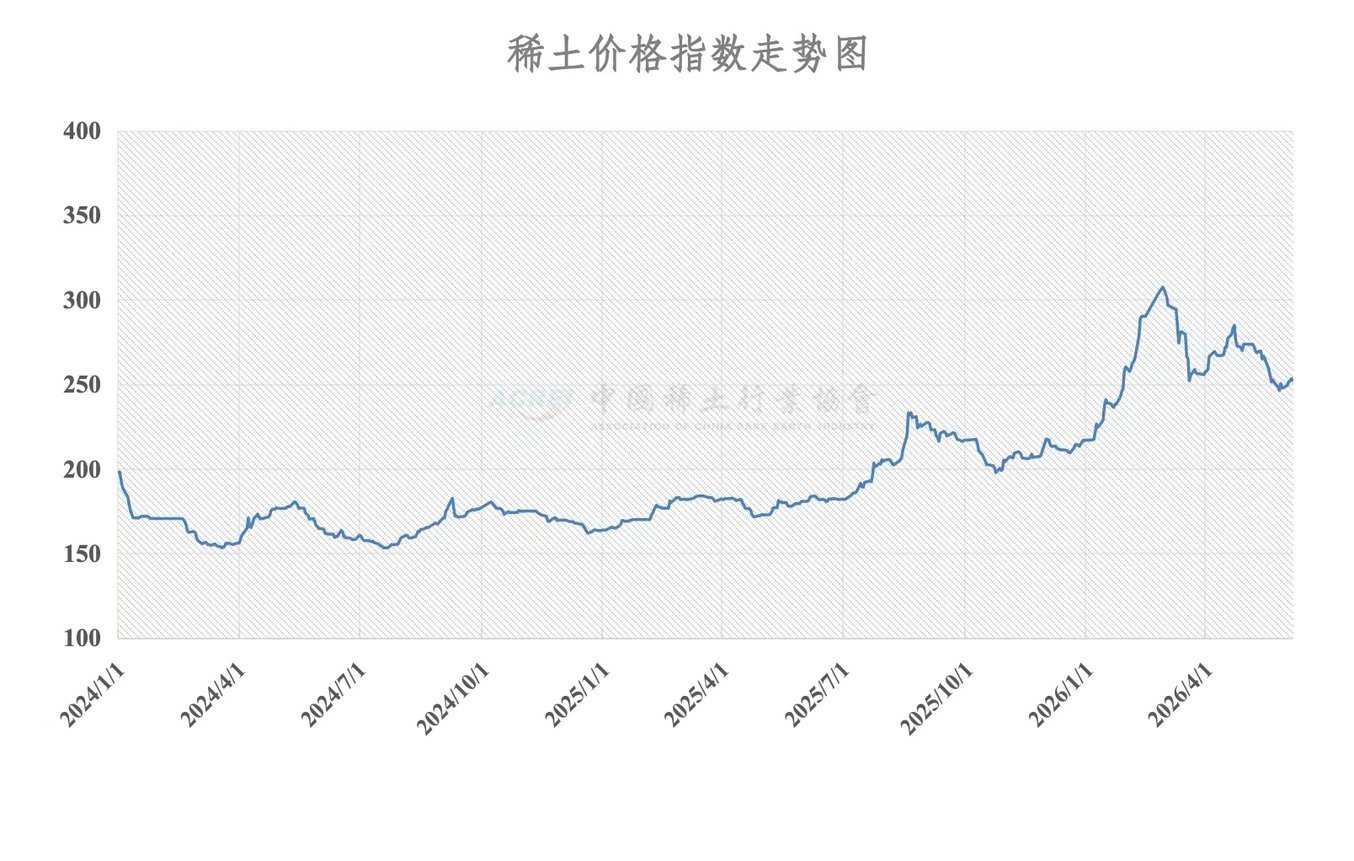
While the overall move was modest, the accompanying pricing data suggests a market increasingly characterized by stability in many light rare earth products and continued firmness in several strategically important heavy rare earth materials.
Where the Strength Is Showing
Several critical heavy rare earth products registered gains in China:
*Converted at approximately ¥6.67 per US dollar (¥0.15 = US$1). Note ex-China prices can be several times higher.
The strongest pricing remains concentrated in the heavy rare earth segment, particularly terbium and dysprosium, two materials essential for high-performance permanent magnets used in defense systems, electric vehicles, robotics, aerospace applications, wind turbines, and advanced industrial equipment.
Meanwhile, the benchmark magnet feedstock NdPr oxide edged lower:
- ¥688.9–708.9/kg ($103.34–106.34/kg)
NdPr alloy also softened:
- ¥841.1–861.1/kg ($126.17–129.17/kg)
The divergence highlights an increasingly important reality: not all rare earths are moving together. A problem in the West may be a glut of light rare earths and insufficient access to heavy rare earths.
The Price Discovery Problem
Investors should avoid treating Chinese rare earth prices as equivalent to transparent commodity market prices.
China's rare earth sector operates within a framework shaped by production quotas, export licensing requirements, state-owned enterprises, strategic stockpiling, environmental controls, and industrial policy objectives. The Chinese Communist Party exerts various controls over the China market, and thus the world. Consequently, domestic prices reflect both commercial activity and state-directed market management.
At the same time, a truly liquid and transparent ex-China rare earth market remains underdeveloped. China still accounts for roughly 90% of global rare earth separation and refining capacity (98% or so of heavy rare earth refining), leaving only a small portion of the market exposed to independent price formation.
Most transactions outside China occur through private bilateral contracts containing customized specifications, volume commitments, freight terms, and confidential pricing provisions. As a result, published ex-China prices should be viewed as indicative rather than definitive market-clearing benchmarks.
Adding further complexity is the U.S. government's recent support package for MP Materials, which established an effective $110/kg NdPr floor price under specific contractual conditions. While some observers have interpreted this as a broader Western benchmark, the arrangement appears specific to MP Materials and should not automatically be extrapolated across the industry.
Ex-China updates
As of June 5, 2026, ex-China heavy rare earth pricing remained dramatically higher than corresponding Chinese domestic references, reflecting the continuing impact of Beijing's export-control regime, constrained non-Chinese refining capacity, and a fragmented global market that still lacks meaningful independent price discovery. Market intelligence from pricing agencies, company disclosures, traders, and industry participants suggests terbium oxide was trading around $4,500–$4,700/kg and possibly significantly higher outside China, depending on volume, delivery terms, jurisdiction, and security-of-supply requirements, compared with CAREI's domestic reference of ¥6,095–6,155/kg ($914–$923/kg). Yttrium oxide represents perhaps the most striking divergence. Rare Earth Exchanges® discussions with traders and review of company disclosures indicate pricing around $1,500/kg and higher in North America and Europe, compared with Chinese domestic pricing of roughly ¥58–62/kg ($8.70–$9.30/kg).
Dysprosium is increasingly becoming a different story altogether of late. Published assessments from the past months have generally placed dysprosium oxide in Europe near $1,100–$1,300/kg, while some North American transactions have reportedly approached or exceeded $2,000/kg or far more depending on circumstance. However, those figures should be viewed cautiously because the market is no longer behaving like a conventional commodity market. The more relevant question today is often not "What is the price?" but rather "Can the material be obtained at all?" Multiple market participants report extremely limited spot availability of dysprosium outside China, with certain forms and specifications effectively unavailable regardless of quoted prices. In such an environment, a single industrial buyer seeking meaningful tonnage can materially move the market. Likewise, a small number of marginal suppliers can command dramatically different prices for similar material within the same month—or even the same week—depending on urgency, qualification status, delivery requirements, and geopolitical considerations.
Why This Matters
The most significant signal from this week's data is not the overall index level. It is the continued resilience of heavy rare earth pricing.
For the United States, Europe, Japan, and allied economies seeking to build independent magnet supply chains, dysprosium and terbium remain among the most difficult materials to replace outside China. The challenge facing Western industrial policy is increasingly shifting from mining and NdPr production toward securing sustainable heavy rare earth separation, refining, alloying, and magnet manufacturing capacity.
In that sense, the latest pricing data may be less a story about prices than a reminder of where the global supply chain remains most vulnerable.
REEx Assessment
Chinese rare earth prices remain an important signal, but they should not be confused with globally transparent market-clearing prices. Neither the Chinese domestic market nor the still-emerging ex-China market currently provides the liquidity, transparency, breadth of participation, or independent price discovery associated with mature commodity markets such as copper, oil, gold, or iron ore. In fact, one could reasonably argue that the world today has no true market for heavy rare earth elements at all.
China's heavy rare earth sector functions less as a conventional market and more as a strategically managed industrial ecosystem. Prices emerge from real commercial transactions, but those transactions occur within a framework shaped by production quotas, export controls, licensing approvals, state-owned enterprises, strategic inventories, environmental mandates, and national security considerations. The resulting prices convey useful information, but they do not necessarily represent what economists would recognize as unconstrained market-clearing prices.
Outside China, the situation is different but equally unusual. The ex-China heavy rare earth market resembles a collection of private negotiations rather than a market in the traditional sense. Trading volumes are extremely small, liquidity is sporadic, contract terms are confidential, and many transactions occur between a limited number of qualified buyers and sellers. In some cases, the material is so scarce that availability becomes more important than price. A single industrial buyer seeking a meaningful quantity of dysprosium or terbium can materially influence reported pricing, while a handful of marginal suppliers may quote dramatically different prices for essentially similar material depending on urgency, delivery schedules, geopolitical risk, financing terms, or strategic relationships.
In economic terms, heavy rare earths increasingly resemble a strategic allocation system rather than a commodity market. Prices exist, transactions occur, and contracts are signed, yet the market lacks sufficient depth, transparency, and competition to establish a universally accepted benchmark. What many participants call a "price" is often better understood as the negotiated outcome of a specific transaction between a limited number of counterparties under unique circumstances.
This reality helps explain why the spread between Chinese and ex-China prices continues to widen. The divergence is not merely a pricing anomaly. It reflects the emergence of two fundamentally different systems: one shaped by state-directed industrial policy and the other defined by scarcity, strategic procurement, and supply security concerns in more market-based systems. Until substantial heavy rare earth separation, refining, alloying, and magnet production capacity exists outside China, the world may continue to operate without a truly transparent global market for these strategically important materials. Consequently, any so-called price indices should be interpreted cautiously.
Source Reliability Notice: The Chinese information originates from the China Association of Rare Earth Industry, a Chinese industry organization operating within a state-managed rare earth sector. The association states that the data is collected from participating enterprises and provided solely for industry reference. Investors should independently verify pricing and market conditions whenever possible and recognize that Chinese rare earth prices exist within a market framework heavily influenced by national industrial and strategic policy considerations.


0 Comments
No replies yet
Loading new replies...
Moderator
Join the full discussion at the Rare Earth Exchanges Forum →