
Highlights
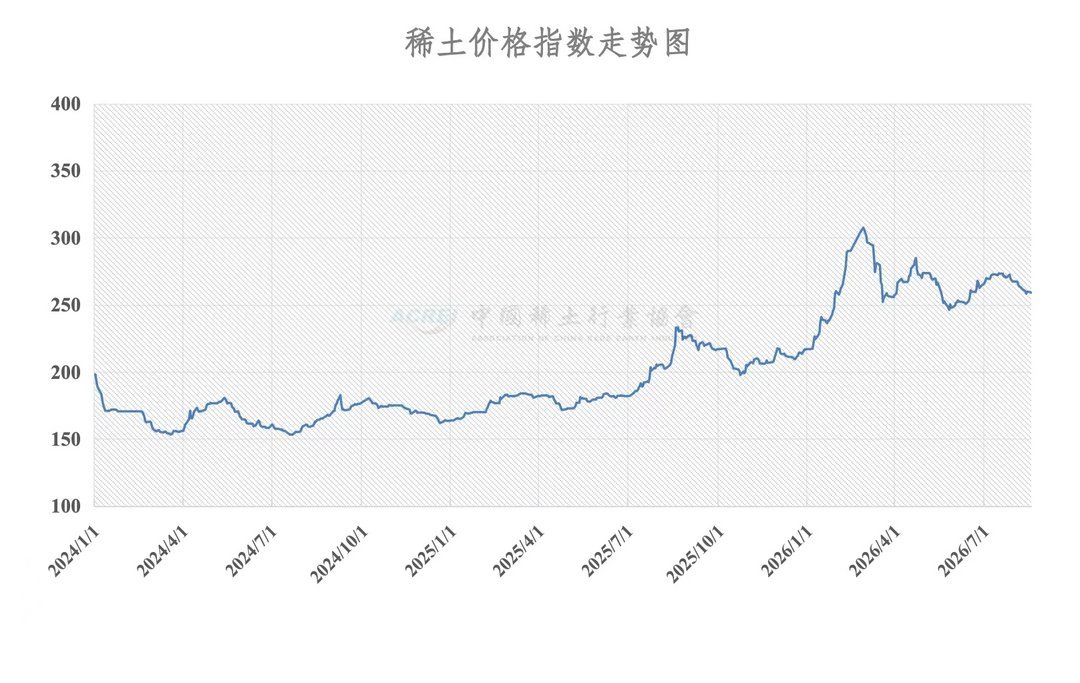
- China's ACREI rare earth price index fell to 259.1 on August 18, 2026, with NdPr and gadolinium products declining while terbium, holmium, and erbium rose.
- Heavy rare earths like dysprosium and terbium show extreme price gaps between Chinese domestic quotes and ex-China transactions, with terbium reaching up to $5,000/kg outside China.
- China controls over 90% of magnet rare earth refining, making its domestic prices the gravitational center of global rare earth economics despite export restrictions.
- Ex-China rare earth spot pricing remains immature, with bilateral and confidential contracts making true price discovery difficult for Western buyers.
- Pentagon NdPr floor prices and Serra Verde dysprosium floors are transaction-specific terms, not universal benchmarks for the broader market.
China’s Association of China Rare Earth Industry (ACREI) reported its August 18, 2026 Rare Earth Price Index at 259.1, with 2010 set at 100. The accompanying sheet shows neodymium-praseodymium (NdPr) mixed oxide and alloy declining, gadolinium products weakening, while terbium oxide, holmium products, and erbium oxide rose; dysprosium oxide and metal were flat. The larger story remains the increasingly dramatic separation between China’s domestic reference prices and what Western buyers may actually pay—or fail to procure—outside China.
REEx Insight: Two Price Worlds, One Supply Chain
Rare Earth Exchanges® does not consider Chinese quotations conventional free-market price discovery. Beijing controls mining and separation through quotas, state-dominated producers, export licensing, and national-security policy. China’s rare earth industry is a strategic component of its hybrid state-capitalist system, not the equivalent of the transparent markets for copper or gold.
But ignoring Chinese pricing would be equally dangerous. China still accounts for more than 90% of magnet rare earth refining and nearly 90%+ of permanent-magnet production. Its domestic market therefore remains the gravitational center of global rare earth economics. Export controls have restricted rather than completely eliminated flows: licensed material and China-origin products continue reaching overseas supply chains. Investors need to watch China and ex-China pricing together—one signals the dominant production system; the other increasingly measures scarcity, security, and access.
August 18: The Magnet Materials That Matter
Using ¥1 = US$0.15:
| Strategic product | China ¥/kg | China US$/kg | Indicative ex-China US$/kg* |
|---|---|---|---|
| NdPr mixed oxide – Light REE | ¥708.9–728.9 | $106–109 | ~$120–140+ |
| NdPr alloy/metal – Nd 75% | ¥862.4–882.4 | $129–132 | ~$140–170+ |
| Dysprosium oxide – Heavy REE | ¥1,365–1,405 | $205–211 | $575–2,500+ |
| Terbium oxide – Heavy REE | ¥6,595–6,655 | $989–998 | $2,050–5,000+ |
| Yttrium oxide | ¥57.8–61.8 | $8.67–9.27 | Highly variable; scarcity can dominate price |
REEx tracking has found dysprosium and terbium quotations reaching multiples of Chinese references and, in extreme specialty transactions, yttrium above $1,200/kg.
A Price Floor Is Not a Benchmark
The Pentagon’s $110/kg NdPr floor applies to MP Materials’ specific 10-year agreement; it is not an industry-wide U.S. floor. Likewise, Serra Verde’s reported $575/kg dysprosium and $2,050/kg terbium floors are transaction-specific commercial terms, not universal spot prices.
Ex-China “spot” pricing remains immature despite some of the marketing materials of “pricing agencies”: contracts are largely bilateral, confidential, and specification-dependent. Pricing agencies inevitably work from samples, not necessarily scientifically sampled, that can skew toward traders or particular transactions. Buyer beware: scarcity does not create transparency.
Pricing qualifier: All ex-China ranges are indicative observations, not executable quotations. Purity, form, volume, qualification, delivery location, licensing, provenance, and contract duration can radically alter price.
Source disclaimer: ACREI is a Chinese national nonprofit industry association established with approval from China’s Ministry of Civil Affairs and subject to government and Communist Party organizational oversight; it is not itself a state-owned enterprise. Its published prices are industry-collected reference information and should be independently verified.


0 Comments
No replies yet
Loading new replies...
Moderator
Join the full discussion at the Rare Earth Exchanges Forum →