
Highlights
- China's rare earth prices are policy-influenced reference prices shaped by state quotas, export controls, and Communist Party directives—not free-market prices.
- Heavy rare earths like dysprosium and terbium trade at five to ten times Chinese domestic prices in ex-China markets, where physical availability now outweighs headline pricing.
- The Serra Verde–USA Rare Earth 15-year offtake agreement sets contract floor prices of US$575/kg for dysprosium and US$2,050/kg for terbium, offering a rare public benchmark for Western supply chain economics.
- Ex-China rare earth transactions are confidential bilateral contracts with pricing driven by delivery terms, purity, volume, and geopolitical risk—not exchange-traded spot markets.
- Western supply chains remain critically short of heavy rare earth separation and magnet manufacturing capacity, making physical access the defining risk for manufacturers and investors.
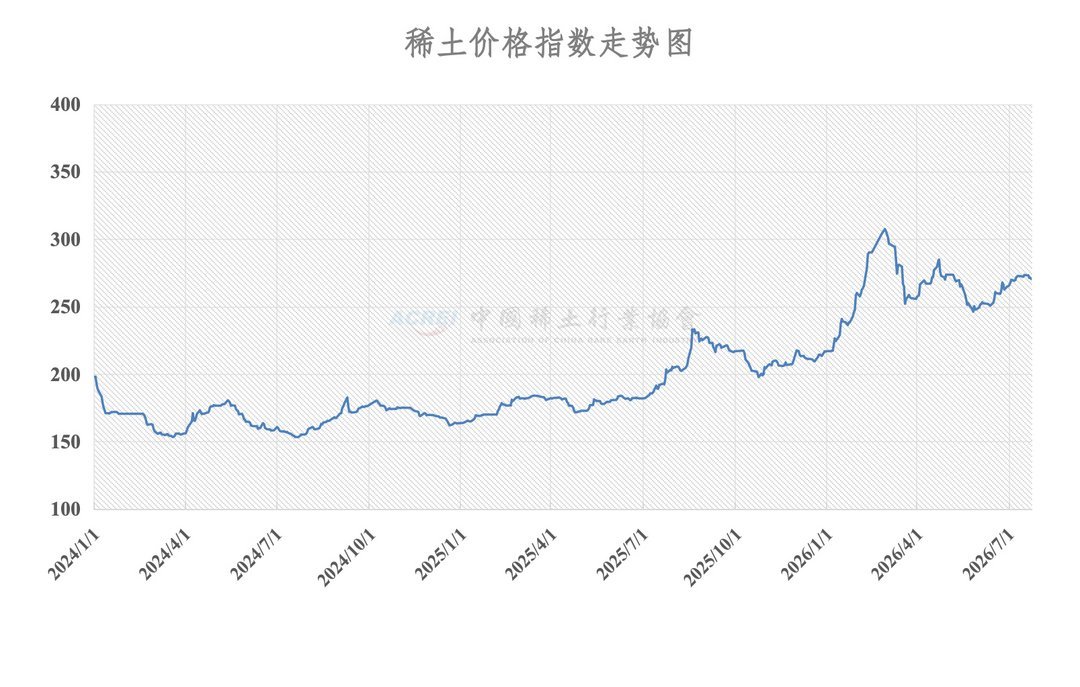
China's Rare Earth Price Index rose to 270.4 on July 23, 2026, according to the China Rare Earth Industry Association (CREIA). Most light rare earth prices were stable or slightly weaker, while heavy rare earths remained elevated despite modest declines. For investors, however, the more important story is not the reported prices but how those prices are formed. Neither China's domestic market nor today's emerging ex-China market resembles the transparent price discovery found in commodities such as gold or copper. Understanding those differences is essential for evaluating rare earth investments.
Heavy Rare Earths Remain the Strategic Story
CREIA reported a largely stable market, with dysprosium, terbium, and other heavy rare earth products maintaining historically elevated levels. Using an exchange rate of ¥6.67 = US$1.00 (¥0.15 = US$1), notable prices include:
| Product | China Price ((¥/kg) | Approx US$/kg Conversion | Trend |
|---|---|---|---|
| NdPr Oxide | ¥746–766 | US$112–115 | ↓ |
| Dysprosium Oxide | ¥1,390–1,430 | US$209–214 | Flat |
| Dysprosium Metal | ¥1,780–1,800 | US$267–270 | Flat |
| Terbium Oxide | ¥5,000–5,200 | US$750–780 | Flat |
| Holmium Oxide | ¥614–634 | US$92–95 | ↓ |
| Erbium Oxide | ¥623–643 | US$93–96 | ↑ |
| Yttrium Oxide | ¥15–17 | US$2.25–2.55 | Flat |
The official Rare Earth Price Index closed at 270.4, compared with a base value of 100 in 2010.
China's Prices Are Policy Prices
Investors should resist treating these figures as true market prices.
China's rare earth industry operates under state production quotas, export licensing, export controls, strategic stockpiling, industrial planning, and Communist Party policy directives. State-owned enterprises play dominant roles throughout the supply chain. The resulting prices are therefore policy-influenced reference prices, not transparent market-clearing prices.
For REEx readers, China's published quotations should be viewed as official industrial reference prices, not the equivalent of CME copper or LBMA gold.
Heavies Outside of China
Outside China, heavy rare earth pricing has diverged sharply from Chinese domestic reference prices following Beijing's export controls and tightening supply. While dysprosium oxide trades in China at roughly US$210/kg and terbium oxide around US$750–780/kg, reported ex-China transactions and market assessments have ranged from approximately five to ten times higher for dysprosium and three to six times higher for terbium, depending on delivery location, contract structure, product specification, and security-of-supply provisions. Unlike exchange-traded commodities, these are not transparent spot markets. Most ex-China sales are negotiated through confidential, bespoke bilateral contracts, meaning published price assessments represent only limited market snapshots rather than universally applicable transaction prices. In today's market, physical availability—not headline pricing—is increasingly the defining factor, with many manufacturers reporting difficulty sourcing dysprosium, terbium, and, at times, yttrium outside China regardless of published quotations. REEx therefore views heavy rare earths as an "availability market" rather than a conventional price market, where supply security often outweighs nominal price.
The Serra Verde–USA Rare Earth agreement established some of the first publicly disclosed long-term contractual price floors for strategic rare earth products outside China, providing investors with an important reference point for the economics needed to finance new Western supply chains. Under the 15-year offtake agreement, the floor prices are US$110/kg for NdPr, US$575/kg for dysprosium, and US$2,050/kg for terbium. These are not industry-wide market prices, but contract-specific floors supported through a U.S. government-capitalized financing structure designed to reduce investment risk while helping secure strategic supply. The agreement also allows Serra Verde to retain approximately 70% of any price upside above the floor levels. For investors, these pricing mechanisms reinforce REEx's long-held view that developing competitive heavy rare earth supply chains outside China will likely require prices substantially above Chinese domestic reference prices to justify the capital investment necessary for separation, metals, alloys, and magnet manufacturing.
Ex-China Pricing Isn't a Traditional Free Market Either
The opposite misconception is equally dangerous.
Although Western governments seek independent supply chains, approximately 90% of global rare earth separation still occurs inside China, leaving ex-China markets thin, fragmented, and highly specialized.
Most transactions outside China are confidential bilateral contracts, not exchange-traded spot markets. Pricing depends on numerous negotiated variables, including:
- Delivery location (Rotterdam, U.S. Gulf Coast, Japan, Korea, etc.)
- Incoterms (FOB, CIF, DDP and other delivery structures)
- Oxide, metal, alloy or magnet specification
- Purity and product qualification
- Volume commitments
- Contract duration
- Strategic supply security provisions
- Financing terms
- Export-control and geopolitical risk
- Customer qualification requirements
Two buyers purchasing nominally identical dysprosium oxide may legitimately pay materially different prices because each contract is bespoke. Pricing agencies provide valuable intelligence, but their assessments generally represent market snapshots compiled from traders, producers, and consumers—not comprehensive reporting of all transactions. Sample sizes remain limited, many industrial contracts are confidential, and participants may report selectively. Consequently, published ex-China assessments should be viewed as market indications rather than absolute transaction prices.
REEx Take
Today's CREIA report contains no major pricing breakthrough. The real takeaway is structural: Western supply chains remain critically short of heavy rare earth separation, metals, alloys, and magnet manufacturing. Until meaningful ex-China refining capacity emerges, physical access—not published prices—will remain the defining risk for manufacturers, defense contractors, and investors alike.
Disclaimer: This news originates from the China Rare Earth Industry Association, an industry organization operating within China's state-directed rare earth sector. The reported information should be independently verified. China's domestic rare earth market functions within a hybrid state-directed economic system shaped by industrial policy, production quotas, export controls, and national security priorities rather than conventional free-market price discovery.


0 Comments
No replies yet
Loading new replies...
Moderator
Join the full discussion at the Rare Earth Exchanges Forum →