
Highlights
- China and Vietnam agreed to expand standard-gauge railway connections, including Lao Cai–Hanoi–Haiphong and other key corridors, while enhancing customs clearance and cross-border freight capacity.
- The infrastructure push could integrate Vietnam's underdeveloped rare earth reserves into China-centered processing ecosystems, complicating Western efforts to build alternative supply chains.
- Framed as economic cooperation, the agreement extends China's logistical reach into a resource-rich neighbor, making Vietnam an increasingly contested player in the critical minerals landscape.
A newly released joint statement between China and Vietnam signals a renewed push to accelerate rail, road, and border infrastructure connectivity, with rail cooperation elevated as a “new strategic highlight.” The agreement aligns China’s Belt and Road Initiative with Vietnam’s “Two Corridors, One Circle” framework—linking trade more tightly to logistics networks, industrial zones, and cross-border economic corridors.
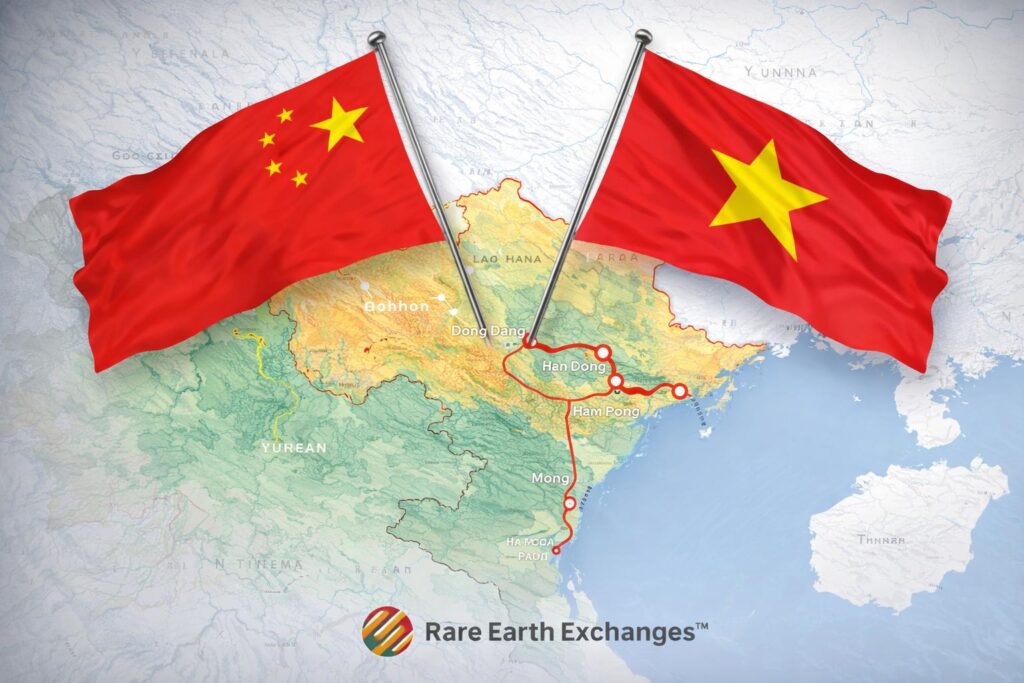
Translation: What Was Agreed
Both countries are committed to:
- Expanding standard-gauge railway planning and interconnection, including Lao Cai–Hanoi–Haiphong, Dong Dang–Hanoi, and Mong Cai–Ha Long–Haiphong corridors
- Increasing rail freight capacity and improving connectivity into China’s broader Eurasian rail network
- Building logistics hubs, cross-border economic zones, and multimodal transport systems
- Enhancing customs clearance, inspection coordination, and cross-border passenger and freight flows
- Supporting Chinese participation via financing, engineering, training, and industrial capacity cooperation
Note: The statement emphasizes planning, feasibility, and coordination—not confirmed full-scale construction timelines.
Rare Earth Exchanges™ Insight: Infrastructure Meets Resource Strategy
This is more than transport policy—it is supply chain architecture. Vietnam holds significant rare earth reserves, including heavy rare earth potential, though much remains underdeveloped and commercially constrained.
Improved rail connectivity to southern China (Guangxi, Yunnan) could:
- Lower friction for cross-border movement of minerals and intermediate materials
- Further integrate Vietnam into China-centered processing and manufacturing ecosystems
- Complicate Western efforts to build ex-China rare earth supply chains
Bottom Line: Strategic Convergence, Measured Execution Risk
While framed as economic cooperation, the agreement expands China’s logistical and industrial reach into a resource-rich neighbor. For the U.S. and its allies, Vietnam remains a critical—but increasingly contested—player in the rare-earth and critical minerals landscape.
Disclaimer: This summary is based on Chinese state-affiliated media reporting. Details should be independently verified before making investment or policy decisions.


0 Comments
Discuss this article