
Highlights
- A Baotou-linked research team has published a comprehensive review of NdFeB permanent magnet recycling, framing it as strategic industrial infrastructure rather than a green initiative.
- The review compares four recycling pathways—hydrometallurgy, pyrometallurgy, electrochemical recovery, and short-flow direct regeneration—finding no universal solution but identifying hydrogen-assisted magnet-to-magnet recycling as the most promising low-carbon route.
- The real bottleneck in magnet recycling is not rare earth recovery alone, but impurity control, coating removal, grain-boundary repair, and restoring full magnetic performance to OEM standards.
- China's integrated rare earth industrial base gives it a decisive deployment advantage over Western nations, which lack comparable collection systems, pilot facilities, and qualification programs.
- Western policymakers are urged to build mandatory magnet collection systems, design-for-recycling standards, and domestic metallization capacity before China's recycling ecosystem becomes another strategic moat.
A new Journal of Rare Earths review led by Jianfei Li of Inner Mongolia University of Science and Technology, with collaborators from Baotou Huashang Rare Earth Alloy Co., the State Key Laboratory of Baiyunobo Rare Earth Resource Researches, and the Baotou Research Institute of Rare Earths, lays out a detailed blueprint for closed-loop recycling of NdFeB permanent magnets—the high-performance magnets used in EVs, wind turbines, industrial motors, robotics, electronics, and defense supply chains. The paper is technically valuable but strategically revealing: it comes from Baotou, the heart of China’s northern rare earth complex, and treats recycling not as a green afterthought but as an industrial-control layer across collection, sorting, chemistry, metallurgy, magnet regeneration, and downstream qualification.
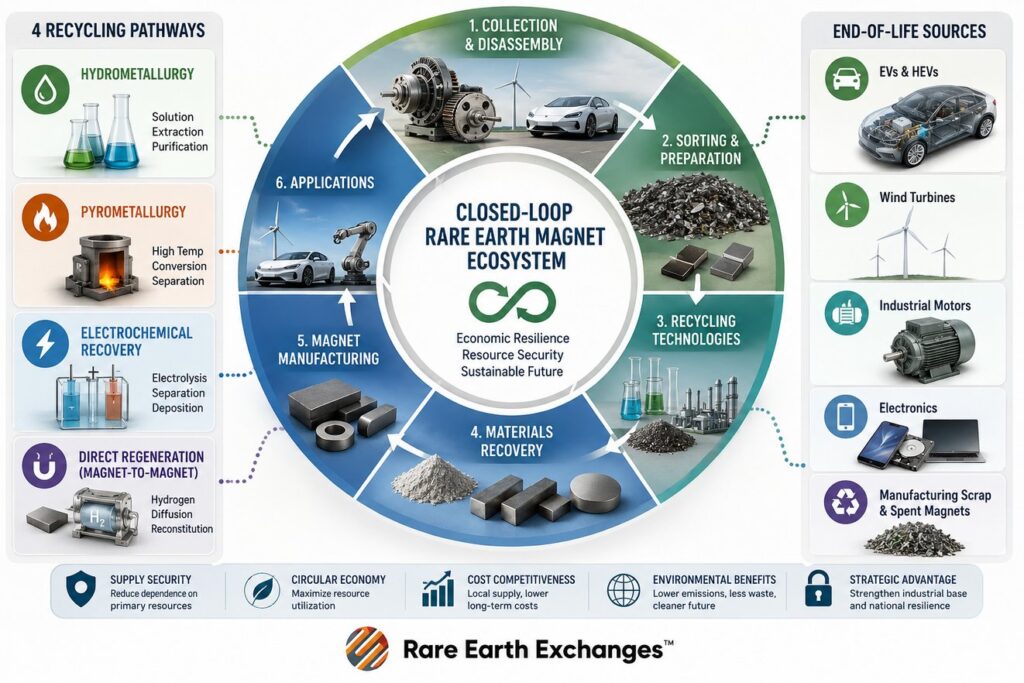
Primary Focus of the Study
The authors argue that NdFeB magnet waste is becoming a strategic secondary resource. Manufacturing already produces large volumes of scrap, sludge, and grinding residues, while future end-of-life EVs and wind turbines will create a growing “urban mine.” The paper states that NdFeB magnets dominate more than 90% of the rare earth permanent magnet market, that each wind turbine can contain roughly 1–2 tons of NdFeB magnets, and that EVs and hybrids require kilograms of magnet material per vehicle.
Rare Earth Exchanges™ suggests that the message is clear: future rare earth security will not come only from mines. It will come from closed-loop ecosystems.
What the Study Reviewed
The review compares four recycling pathways. Hydrometallurgy uses acids, precipitation, solvent extraction, ionic liquids, deep eutectic solvents, and adsorption systems to recover rare earths, often as oxides. It is mature and scalable but can consume large volumes of chemicals and generate waste streams.
Pyrometallurgy uses heat, chlorination, oxidation, sulfation, liquid metal extraction, or molten salt systems. It can handle dirty or oxidized scrap but often brings high energy use, corrosion, and equipment challenges.
Electrochemical recovery uses controlled electrical potential to dissolve, separate, or deposit rare earth elements with lower reagent use. It is promising but still technically demanding.
Short-flow direct regeneration—especially hydrogen-assisted “magnet-to-magnet” recycling—tries to preserve the original Nd2Fe14B magnetic phase and rebuild performance without fully reducing magnets back to oxides or metals. The authors identify this as the most attractive low-carbon route when waste magnets are clean, sorted, and standardized.
The Most Important Finding
No universal recycling route exists. Clean end-of-life magnets can potentially move through short-loop regeneration. Oxidized scrap, sludge, coatings, adhesives, binders, and mixed waste often require chemical or thermal processing. The real bottleneck is not simply rare earth recovery. It is impurity control, coating removal, grain-boundary repair, alloy chemistry, magnetic performance restoration, and OEM qualification.
That is the value-added insight for REEx readers: recycling is not merely “recovering rare earths.” It is rebuilding magnet performance.
The Strategic Reading
The paper is informative, but it is also industrial signaling. China’s rare earth system has long treated the supply chain as policy infrastructure. This review shows Baotou-linked institutions organizing the next layer of control: not just mining and separation, but circular magnet manufacturing. For Western policymakers and investors, the warning is direct. A country that controls primary separation, metals, alloys, magnets, and recycling standards can shape both virgin and secondary supply chains. Closed-loop recycling could become another moat.
Limitations
This is a review article, not a commercial demonstration. It does not prove project economics, Western scalability, collection feasibility, or customer qualification. It also underplays geopolitical asymmetry: China already has the integrated industrial base that makes these recycling pathways more deployable. The West does not.
What Should Follow
The West should not treat magnet recycling as a boutique ESG project. It should build mandatory magnet collection systems, design-for-recycling standards, pilot-scale HPMS and short-loop facilities, domestic metallization and alloying capacity, and qualification programs with automakers, defense contractors, wind OEMs, and robotics manufacturers.
The next rare earth contest will not be mine versus mine. It will be ecosystem versus ecosystem, as Rare Earth Exchanges continues to report. And when factoring in the Great Powers Era 2.0 thesis, there is little time to lose for the USA and allies. China’s Baotou complex appears to understand that. The West must catch up and figure out ways to technologically leapfrog the competition.
Citation: Jianfei Li et al., “Toward a closed-loop supply chain for Nd-Fe-B permanent magnets: Technologies, constraints and prospects (opens in a new tab),” Journal of Rare Earths, 2026.
The Study Team
| Author | Role | Institution |
|---|---|---|
| Jianfei Li | Lead/Corresponding Author | Inner Mongolia Univ. of Science & Technology; MOE rare earth lab; Inner Mongolia metallurgy lab |
| Yang Jiang | Co-author | School of Rare Earth Industry, IMUST |
| Yuefeng Wang | Co-author | School of Rare Earth Industry, IMUST |
| Linlong Li | Co-author | School of Rare Earth Industry, IMUST |
| Guangwen Jia | Industry co-author | Baotou Huashang Rare Earth Alloy Co., Ltd. |
| Tianyu Wang | Industry co-author | Baotou Huashang Rare Earth Alloy Co., Ltd. |
| Shaochun Hou | State lab/research institute co-author | State Key Lab of Baiyunobo RE Resources; Baotou Research Institute of Rare Earths |
| Shengfeng Ma | State lab/research institute co-author | State Key Lab of Baiyunobo RE Resources; Baotou Research Institute of Rare Earths |
| Jun Peng | Corresponding co-author | IMUST; MOE rare earth lab; Inner Mongolia metallurgy lab |
| Yifan Chai | Corresponding co-author | IMUST; MOE rare earth lab; Inner Mongolia metallurgy lab |


0 Comments
No replies yet
Loading new replies...
Moderator
Join the full discussion at the Rare Earth Exchanges Forum →