
Highlights
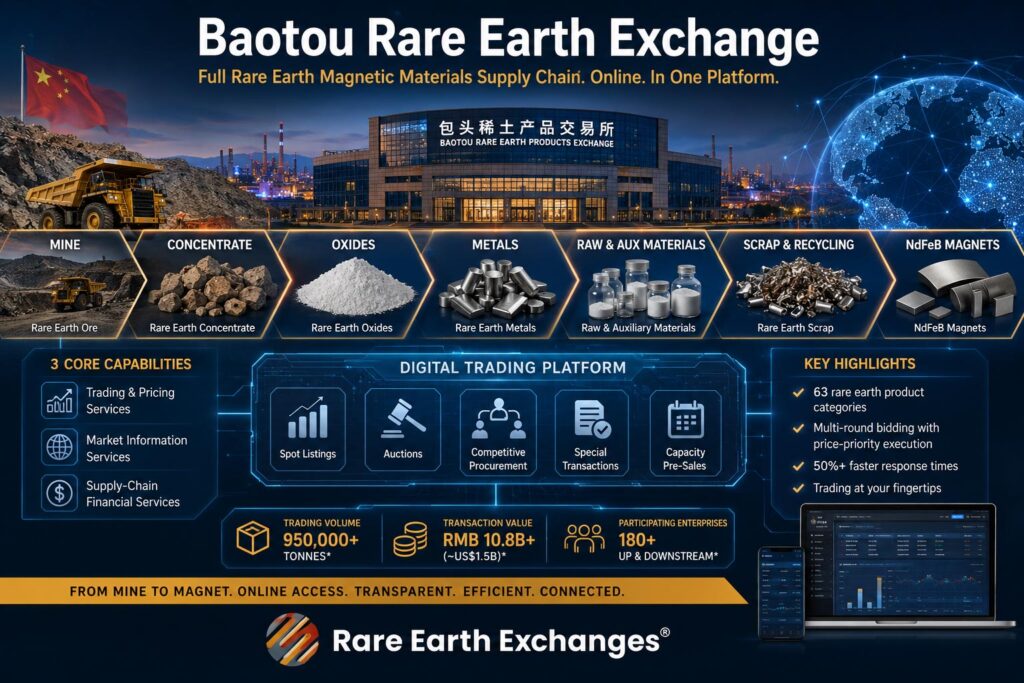
- Baotou Rare Earth Products Exchange completed online trading coverage across the entire rare earth magnetic materials value chain, from oxides to finished NdFeB magnets.
- The platform supports 63 rare earth product categories and integrates trading, pricing, market information, and supply-chain financial services.
- Through April, the exchange reported over 950,000 tonnes in trading volume and RMB 10.8 billion in transaction value, with 180-plus enterprises participating.
- While Western nations focus on rebuilding physical supply chains, China is simultaneously constructing the digital market architecture that could shape global rare earth pricing and procurement.
- Exchange-reported figures were not independently verified, and trading volume may not directly reflect physical delivery volumes.
China's Baotou Rare Earth Products Exchange announced completion of an online competitive procurement transaction for NdFeB (neodymium-iron-boron) magnets, a milestone the exchange says completes online trading coverage across the entire rare earth magnetic materials value chain—from raw materials to finished magnets. While this is not a technological breakthrough, it represents another step in China's long-term effort to build digital trading, pricing, procurement, and financial infrastructure around rare earths. For Western investors and policymakers, the development highlights a critical reality: China is not only dominant in rare earth production and processing, it is increasingly building the market architecture through which those materials are bought, sold, financed, and potentially priced.
From Oxides to Magnets
According to the announcement, the Baotou Rare Earth Products Exchange successfully completed an online competitive bidding procurement transaction involving NdFeB magnets.
The exchange now claims coverage across the full rare earth magnetic materials supply chain, including:
- Rare earth oxides
- Rare earth metals
- Rare earth scrap
- Raw and auxiliary materials
- NdFeB magnets
Management reports that the platform currently supports trading in 63 rare earth-related product categories, creating a digital marketplace that spans the industry from feedstock to finished magnetic materials.
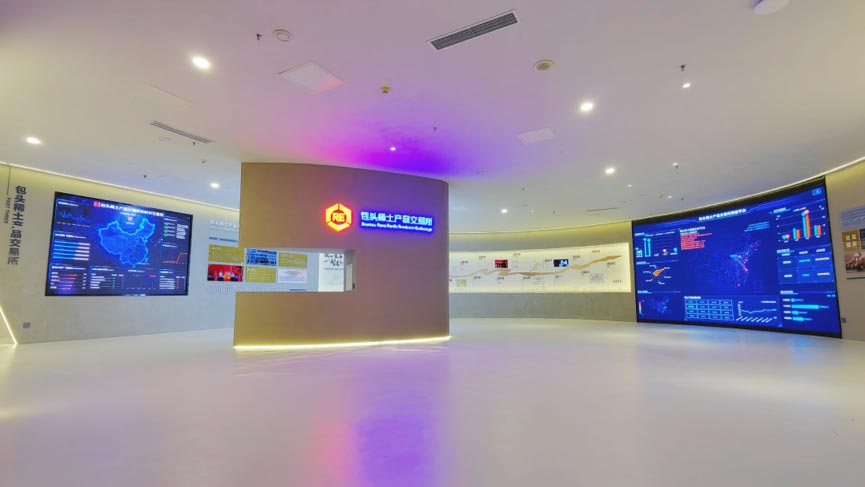
More Than a Trading Platform
The exchange describes its strategy as building three interconnected capabilities:
- Trading and pricing services
- Market information services
- Supply-chain financial services
Its proprietary trading system incorporates multiple transaction formats, including spot listings, auctions, competitive procurement, special transactions, and capacity pre-sales.
According to the company, the procurement platform uses multiple rounds of public bidding and price-priority execution to improve procurement efficiency and reduce information asymmetry. The exchange reports that transaction response times have improved by more than 50%, enabling what it describes as “rare earth trading at your fingertips.”
Why Investors Should Pay Attention
The most important development is not the magnet transaction itself. Rather, China continues to build institutional infrastructure around rare earth commerce that remains largely absent in the United States and Europe. While Western governments focus on mines, separation plants, metal facilities, and magnet factories, China is simultaneously developing trading venues, pricing systems, procurement networks, logistics coordination, and supply-chain finance platforms. If these efforts continue to expand, they could eventually influence how rare earth products are priced, traded, and sourced across China's industrial ecosystem.
The Numbers—and a Note of Caution
The exchange reports that through the end of April:
- Trading volume exceeded 950,000 tonnes
- Transaction value surpassed RMB 10.8 billion (approximately US$1.5 billion)
- More than 180 upstream and downstream enterprises participated
These figures were reported by the exchange and were not independently verified. Investors should also recognize that exchange trading volume does not necessarily equate to physical delivery volume and may include multiple transactions involving the same material streams.
The Bigger Strategic Question
The Baotou announcement underscores an often-overlooked aspect of rare earth competitiveness: markets require infrastructure.
A functioning rare earth ecosystem needs more than mines and processing plants. It also requires trusted pricing mechanisms, efficient procurement systems, market intelligence, financing tools, and ultimately transparent price discovery.
Whether the Baotou Rare Earth Products Exchange evolves into a meaningful benchmark-setting institution remains uncertain. However, China is clearly investing in the commercial architecture surrounding rare earths while much of the West is still focused on rebuilding physical supply chains.
For investors, that distinction may prove increasingly important in the years ahead.
Disclaimer: This report is based on information published by media affiliated with the Baotou Rare Earth High-Tech Zone and entities associated with China's rare earth industry. The claims, statistics, and operational descriptions presented should be independently verified before being relied upon for investment, commercial, or policy decisions.
Register today: REEx Marketplace™ (opens in a new tab)
Discover companies, projects, pricing intelligence, and opportunities across the global rare earth value chain at the REEx Marketplace: https://marketplace.rareearthexchanges.com/signup (opens in a new tab)


0 Comments
No replies yet
Loading new replies...
Moderator
Join the full discussion at the Rare Earth Exchanges Forum →