
Highlights
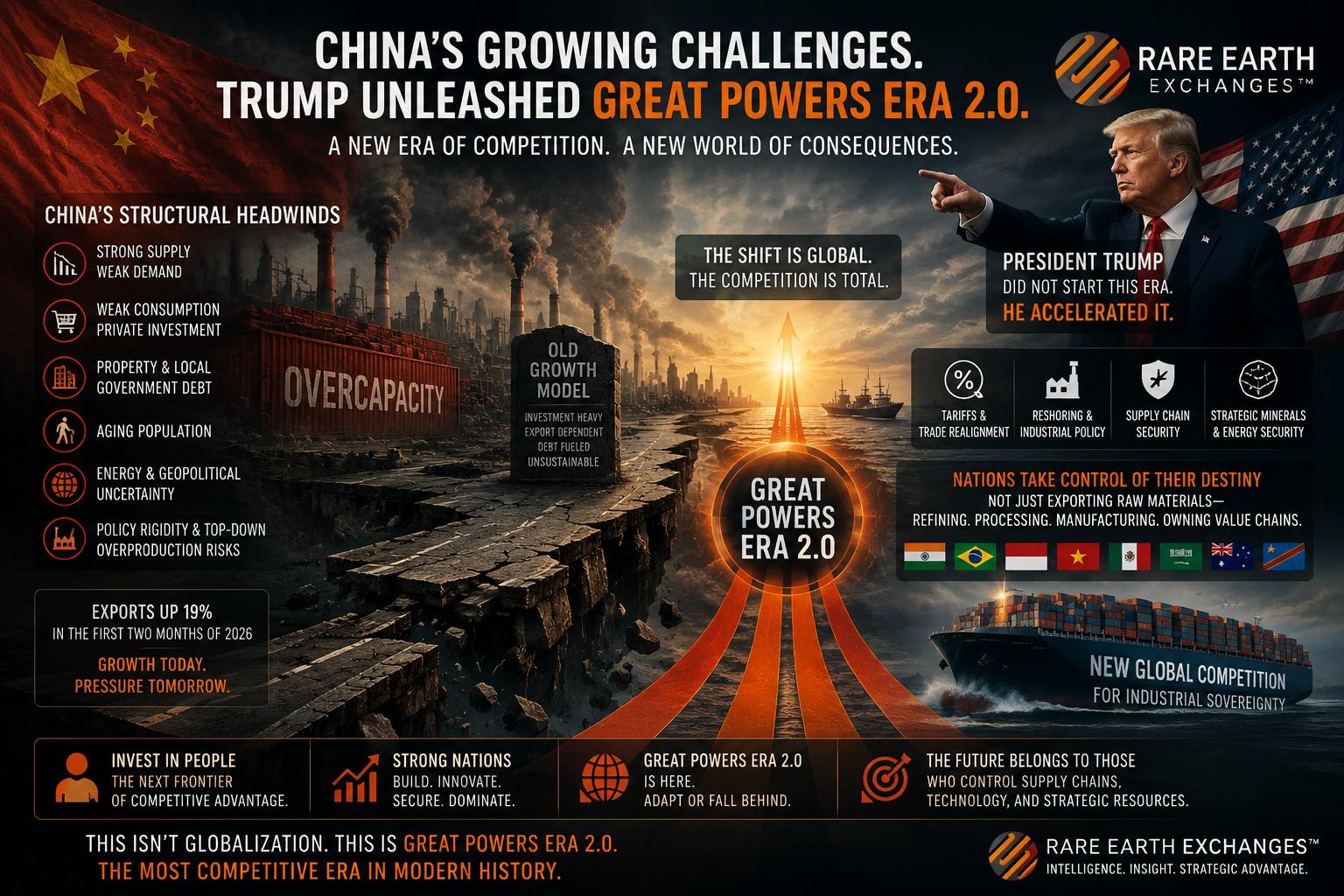
- China's economy shows surface-level stability with 4.5-5% GDP growth targets, but economist Huang Yiping warns of deeper structural vulnerabilities including weak consumption, negative private investment, and the core contradiction of “strong supply and weak demand.”
- China's 19% export surge reflects industrial overcapacity rather than strength, as Beijing's centralized development model produces far more than domestic markets absorb, triggering global concerns about subsidized excess reshaping entire industries.
- Great Powers Era 2.0 has arrived, with nations worldwide competing for industrial sovereignty, refining capacity, and supply chain control—moving beyond raw material exports to capture strategic economic leverage in a fragmenting global order.
China’s economy entered 2026 in better shape than many analysts expected. Industrial output improved. Infrastructure and high-technology investment strengthened. Exports surged. Prices even began recovering after a long period of weakness. But beneath the optimism emerging from Beijing lies something more consequential: a growing recognition among China’s economic establishment that the country’s old growth model is becoming increasingly difficult to sustain. That was the underlying message delivered by Huang Yiping in remarks published by Sina Finance and sourced to Peking University’s National School of Development.
Huang’s tone was not celebratory. It was cautionary.
A Stabilizing Economy Still Carries Structural Stress
Huang described China’s official 2026 GDP growth target of 4.5% to 5% as “pragmatic.” The choice of language matters. Beijing is no longer promising the explosive expansion that once defined the Chinese miracle. It is attempting to stabilize a far more mature, debt-laden, and politically complex economy.
While industrial production and state-backed investment remain resilient, Huang acknowledged deeper vulnerabilities that continue to pressure the system: weak household consumption, negative private-sector investment, real estate fragility, local government debt, demographic decline, and growing geopolitical uncertainty tied to energy markets and global trade.
Most importantly, Huang identified what may now be the defining contradiction of the Chinese economy: “strong supply and weak demand.”
China’s Export Machine Meets a More Hostile World
China continues producing far more than its domestic economy can comfortably absorb. Consumption recovery remains uneven, while private-sector confidence has not fully returned.
Historically, Beijing’s answer to weak domestic demand has been external demand. Huang noted that exports rose 19% during the first two months of the year. Inside China, that is interpreted as economic resilience. Outside China, many governments increasingly interpret it as industrial overcapacity spilling into global markets.
That distinction matters.
China’s highly centralized development model can mobilize enormous amounts of capital and industrial coordination at extraordinary speed. But increasingly, top-down economic management can also distort market signaling, suppress corrective feedback mechanisms, and encourage overproduction in sectors already experiencing global saturation.
For trading partners, this raises fears not simply of competition, but of structurally subsidized excess capacity reshaping entire industries.
Great Powers Era 2.0 Has Arrived
Rare Earth Exchanges™ has described this emerging environment as Great Powers Era 2.0: a geopolitical order in which supply chains, industrial capacity, refining infrastructure, energy systems, and strategic minerals increasingly function as instruments of national power.
Donald Trump did not create this transition. The forces driving it—China’s industrial rise, Western deindustrialization, supply-chain fragility, and geopolitical fragmentation—were already well underway.
But Trump accelerated the shift dramatically.
By forcing tariffs, reshoring, industrial policy, and supply-chain security into the center of American economic strategy, the Trump era helped formalize a global competition that many political leaders had previously preferred to avoid openly acknowledging.
The effects are now spreading far beyond Washington and Beijing.
Low- and middle-income countries increasingly no longer want to simply export raw materials into foreign-controlled value chains. Countries across Latin America, Africa, Southeast Asia, and parts of the Middle East increasingly want refining capacity, downstream processing, manufacturing ecosystems, and strategic control over industrial development.
The competition is no longer merely America versus China. It is becoming a worldwide contest for industrial sovereignty.
“Invest in People” Signals Beijing Understands the Risk
Perhaps the most revealing aspect of Huang’s remarks was his call to redirect more investment toward people rather than concentrating overwhelmingly on the supply side of the economy.
In practice, this likely means stronger support for domestic consumption, workforce development, social resilience, and household confidence alongside continued investment in advanced technologies and what Beijing calls “new quality productive forces.”
That may represent an implicit recognition inside China’s policy establishment that industrial expansion alone cannot indefinitely compensate for weak domestic demand.
Why This Matters
While there is no singular breakthrough in Huang’s comments. The significance lies in the admission itself.
One of China’s leading economists is publicly framing the country’s economic pressures as structural rather than merely cyclical. That distinction carries major implications for global trade, industrial policy, commodities, and supply-chain strategy.
For Western businesses and policymakers, the message is increasingly clear: China is not abandoning industrial policy. It is attempting to evolve it for a far more competitive and fragmented world.
And in Great Powers Era 2.0, nations everywhere are beginning to ask the same strategic question: why export the raw material if someone else captures the refinery, the factory, and the geopolitical leverage?


0 Comments
No replies yet
Loading new replies...
Moderator
Join the full discussion at the Rare Earth Exchanges Forum →