
Highlights
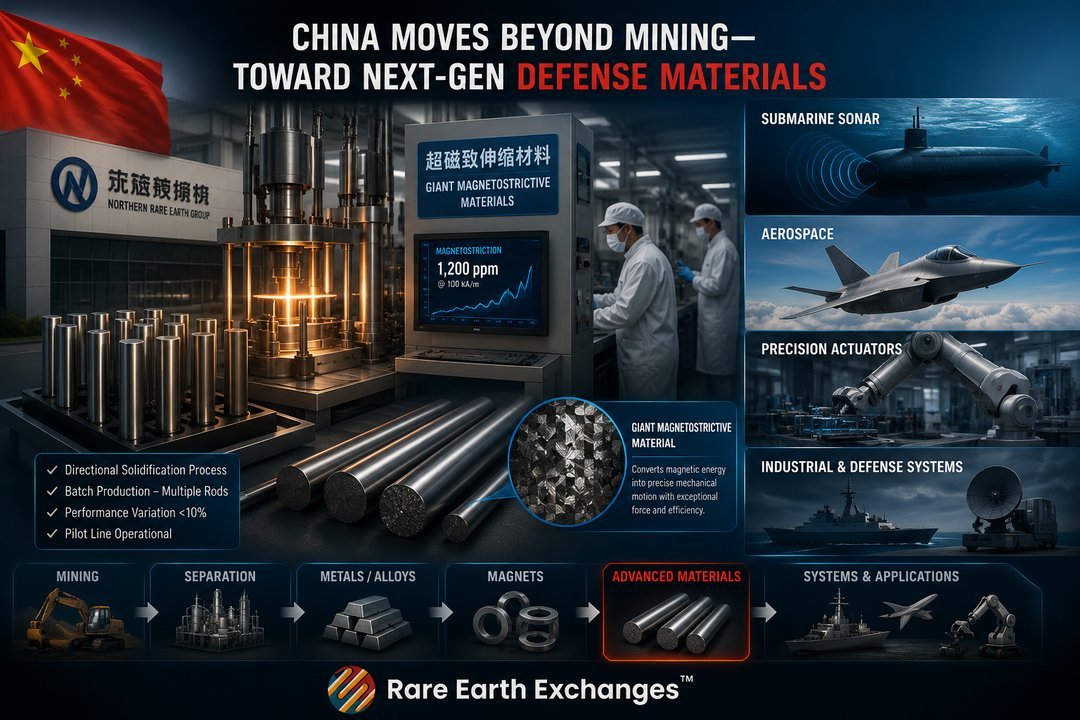
- Northern Rare Earth Group has commissioned a pilot-scale production line for giant magnetostrictive materials, claiming batch consistency within 10% performance variation.
- The materials achieve 1,200 ppm magnetostriction at 100 kA/m and are positioned to outperform piezoelectric ceramics in submarine sonar and deep-ocean detection systems.
- The project was developed with Beihang University and targets annual production of 1,000 kilograms by end of 2026, signaling a move toward commercial-scale output.
- China's push into engineered functional materials marks a strategic shift from rare earth mining dominance to high-value defense and aerospace component manufacturing.
- Western governments and investors are warned that the competition has moved beyond rare earth oxides to the advanced materials and systems that transform them into strategic assets.
China has taken another step beyond controlling rare earth mining and processing—and toward dominating the advanced materials that power next-generation defense and industrial systems. Northern Rare Earth Group announced the launch of a pilot-scale production line for giant magnetostrictive materials, claiming it has solved the long-standing challenge of manufacturing these high-performance smart materials consistently and at scale. If independently verified, the development could strengthen China's position in naval sonar, aerospace, precision actuators, and other strategic technologies. For Western governments and investors, the message becomes: the competition is no longer just about rare earth oxides—it is about who controls the technologies that transform them into high-value products.
A Strategic Leap Beyond Rare Earth Mining
China's Northern Rare Earth Group (China Northern Rare Earth Group High-Tech Co., Ltd.) announced it has completed and commissioned a pilot-scale demonstration production line for giant rare earth magnetostrictive materials, claiming to have overcome one of the industry's most difficult technical barriers: achieving consistent, batch production of these specialized smart materials.
According to the company, the new production line represents another step in China's strategy of moving beyond supplying rare earth raw materials into manufacturing advanced materials for aerospace, deep-sea exploration, precision actuation, and defense applications.
From Laboratory Success to Manufacturing Scale
The production line was jointly developed by the Rare Earth New Materials Technology Innovation Center, Beihang University (Beijing University of Aeronautics and Astronautics), and the Rare Earth Research Institute. Using a directional solidification process, the company says it can produce multiple magnetostrictive rods simultaneously while maintaining less than 10% performance variation across an entire production batch—a significant manufacturing challenge for these highly specialized materials.
Northern Rare Earth further claims its material achieves 1,200 ppm magnetostriction under a magnetic field of 100 kA/m, while product consistency has reached what it describes as a leading domestic standard.
Why Investors Should Pay Attention
Giant magnetostrictive materials are among the highest-performing smart materials known, converting magnetic energy into precise mechanical motion with exceptional force and efficiency. Their applications include sonar transducers, precision actuators, ultrasonic systems, vibration control, industrial sensors, and defense technologies.
Perhaps the announcement's most strategically significant claim concerns undersea warfare. Northern Rare Earth states that magnetostrictive transducers substantially outperform conventional piezoelectric ceramic transducers in energy conversion efficiency, response time, and long-range acoustic transmission, making them particularly attractive for submarine sonar and deep-ocean detection systems.
The company also frames the project as part of China's broader effort to overcome foreign technology restrictions while strengthening domestic high-end manufacturing.
The Next Objective
Northern Rare Earth says its next goal is producing larger-diameter (30 mm and above) magnetostrictive materials suitable for higher-power aerospace and military transducers. The demonstration line is expected to reach annual production of approximately 1,000 kilograms by the end of 2026, potentially marking the transition toward commercial-scale manufacturing.
REEx Perspective: The Value Chain Keeps Moving Upstream—and Downstream
This announcement reinforces a trend that many Western observers still underestimate. China is no longer satisfied with leading in rare earth mining, separation, metals, and magnets. It is increasingly investing in engineered functional materials that sit even farther downstream in the value chain, where intellectual property, manufacturing expertise, and defense applications generate the greatest strategic advantage.
Whether every technical performance claim ultimately withstands independent scrutiny remains to be seen. But the broader trajectory seems unmistakable. The next competitive frontier is shifting from rare earth oxides to advanced rare earth-enabled materials, components, and complete systems—where value creation, technological leadership, and geopolitical leverage increasingly converge.
Disclaimer: This report is based on information published by Chinese state-affiliated media and organizations associated with China's rare earth industry. The technical claims, production metrics, and performance data have not been independently verified and should be corroborated through independent technical, commercial, or government sources before being relied upon for investment, policy, or procurement decisions.


0 Comments
No replies yet
Loading new replies...
Moderator
Join the full discussion at the Rare Earth Exchanges Forum →