
Highlights
- China's Baotou Rare Earth Products Exchange has completed online trading coverage across the full rare earth magnetic materials supply chain, from oxides to NdFeB permanent magnets.
- The digital platform supports 24-hour trading across 63 product categories, with over 950,000 tonnes traded and RMB 10.8 billion in transactions serving 180+ enterprises.
- While Western rare earth markets remain fragmented, China is building an integrated industrial operating system that could enable centralized pricing influence and coordination across strategically critical materials essential for EVs, AI, defense, and renewable energy.
China’s state-backed rare earth ecosystem has taken another step toward deeper industrial coordination—and Western governments and manufacturers should pay close attention. As Rare Earth Exchanges™ has already chronicled, the Baotou Rare Earth Products Exchange says it has completed online trading coverage across the full rare earth magnetic materials supply chain, spanning upstream oxides and metals to downstream NdFeB permanent magnets. The development marks what the exchange describes as a completed “full industry-chain online trading loop.”
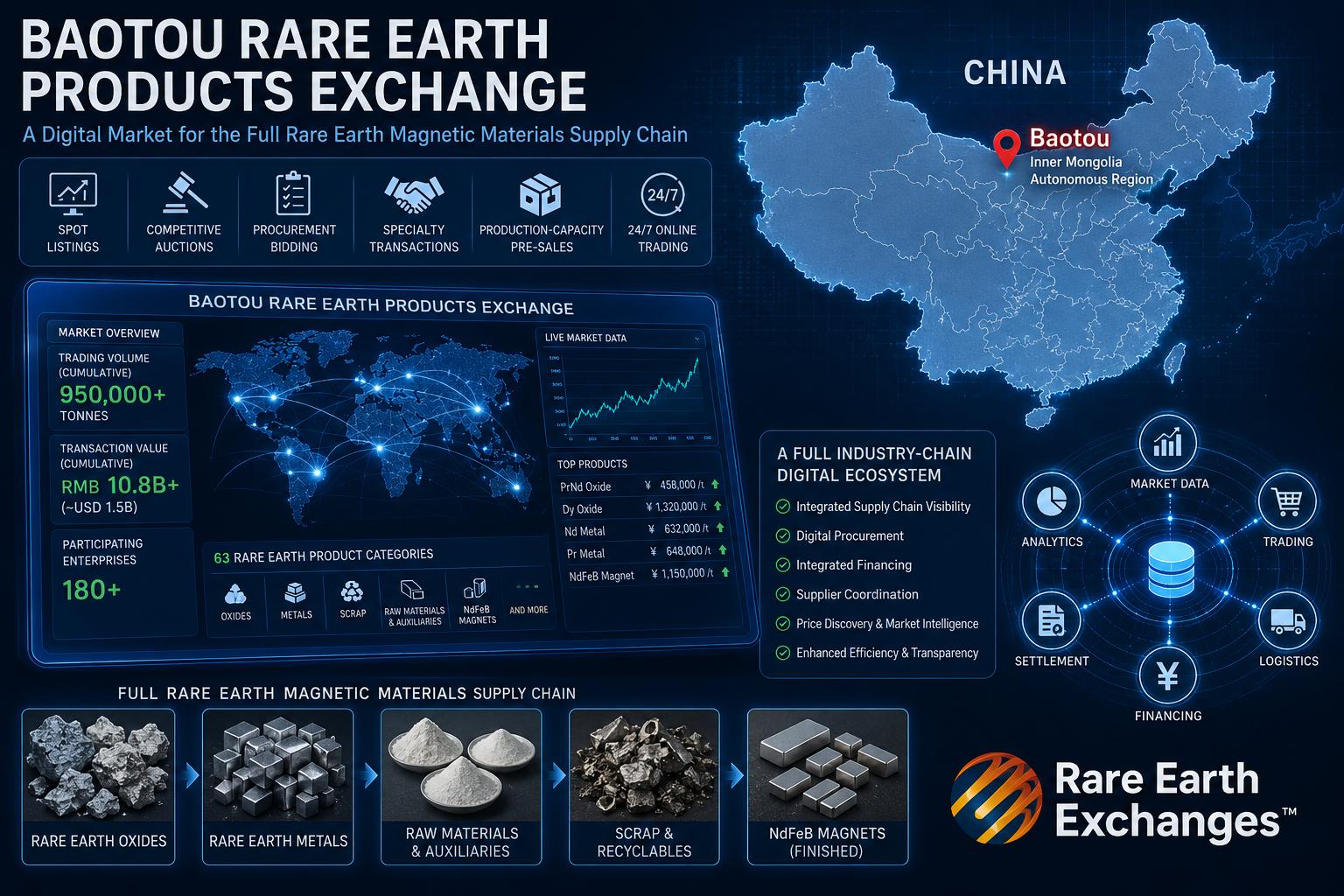
Beyond Mining: China Builds a Digital Rare Earth Ecosystem
At first glance, the announcement may appear technical. Strategically, it could be far more important.
NdFeB magnets are essential components in EV motors, drones, robotics, AI hardware, semiconductors, wind turbines, smartphones, and advanced defense systems. China already dominates much of the global rare earth processing and magnet manufacturing chain. Now it appears to be digitizing and integrating that ecosystem further.
According to the exchange, the upgraded platform supports:
- spot listings,
- competitive auctions,
- procurement bidding,
- specialty transactions,
- and production-capacity pre-sales.
The platform reportedly covers 63 rare earth-related product categories and supports 24-hour online trading.
Why This Matters to the West
The larger story is not simply digitization—it iscoordination.
As Rare Earth Exchanges noted in its analysis, China appears to be building an integrated industrial operating system around strategically critical materials. Outside China, rare earth markets remain fragmented, opaque, and heavily dependent on bilateral contracts. Western efforts to build large-scale separation, metallization, alloying, and magnet manufacturing capacity are still in early stages.
China, meanwhile, is moving toward centralized market visibility, digital procurement, integrated financing, supplier coordination, and potentially greater pricing influence across the supply chain. The exchange claims cumulative trading volume exceeded 950,000 tonnes and transaction value surpassed RMB 10.8 billion (approximately $1.5 billion USD), serving more than 180 enterprises. However, important details remain undisclosed, including how much activity reflects genuine market-based price discovery or physical delivery. Given the state ownership, ideologies and control factors involved, all of this information needs further validation from independent sources.
Still, the broader trend is becoming harder to ignore: China is not simply mining rare earths anymore. It is building the infrastructure to shape how the market itself functions.


0 Comments
No replies yet
Loading new replies...
Moderator
Join the full discussion at the Rare Earth Exchanges Forum →