
Highlights
- China's rare earth price index sits at 267.0 (2.67x the 2010 baseline) after surging above 300, signaling a structurally managed market shaped by quotas and state-aligned pricing rather than a transparent, globally cleared benchmark.
- Domestic Chinese PrNd oxide approached $120-125/kg in early 2026, while China Northern Rare Earth raised Q2 concentrate prices 44.6%, revealing upstream tightness and continued pricing power over global rare earth markets.
- Despite Western ambitions for mine-to-magnet independence, the global rare earth ecosystem remains fragmented and opaque, with prices constructed through confidential contracts and security premiums rather than transparent market discovery.
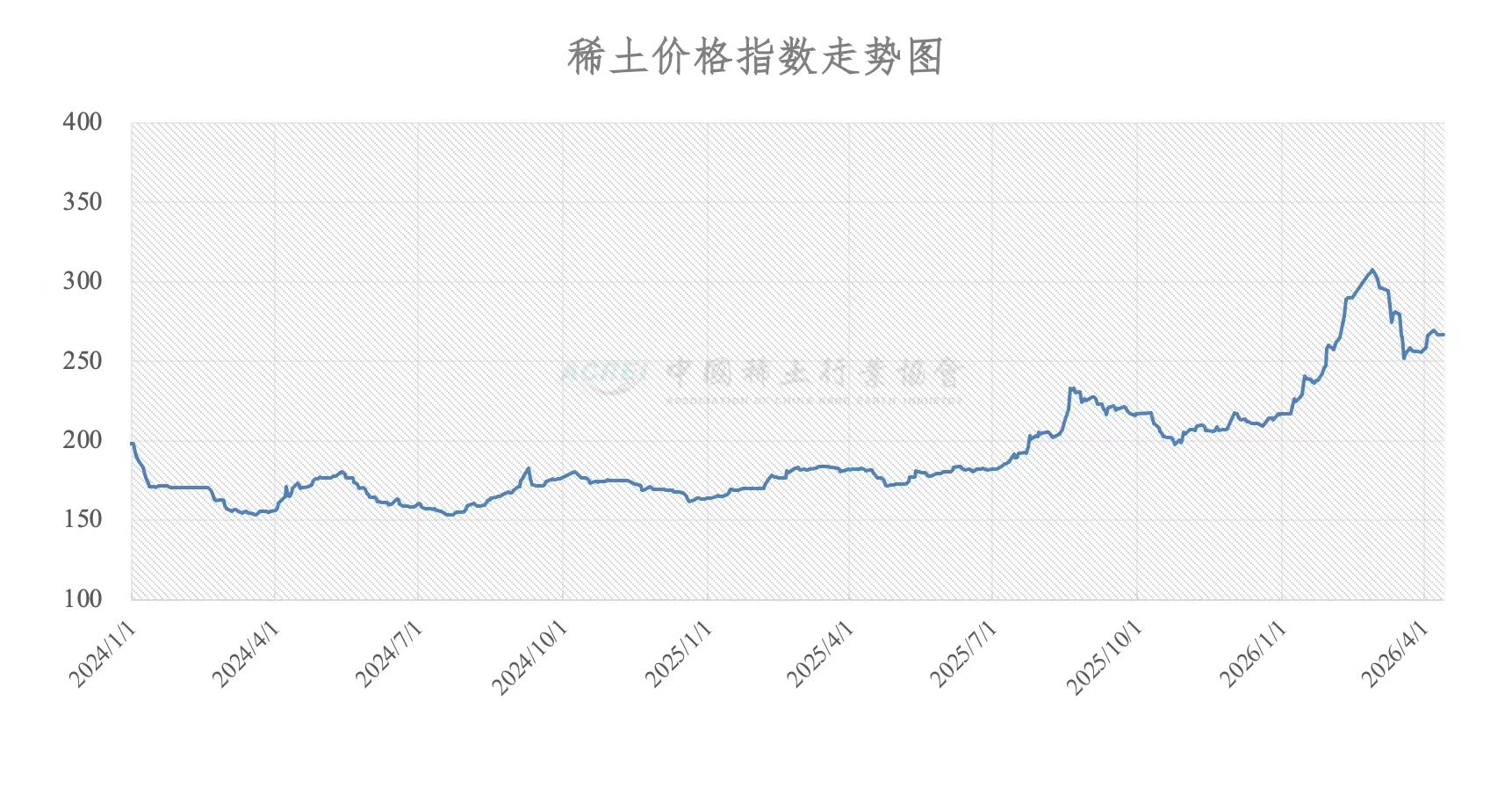
China’s rare earth price index printed 267.0 on April 13, 2026. That number checks out against the bulletin you supplied, and it matters. Not because it screams panic, but because it whispers something more consequential: after a violent run-up and a partial retreat, China’s domestic rare earth complex is still sitting at roughly 2.67 times its 2010 base level. That is not a collapse. It is a reminder that one of the most influential rare earth pricing signals comes from inside a system the West does not control.
What the Index Says — and What It Doesn’t
The China Rare Earth Industry Association describes the index as a model derived from 2010 full-year transaction data as the base period and the average daily transaction data reported by domestic rare earth enterprises during the reporting period, with the base index set at 100. That framing matters for an American business audience: this is not a transparent, globally cleared spot benchmark. It is a domestic reference index built from Chinese enterprise transaction data, useful, important, and informative — but not the same as an open-market price determined in a deep, liquid exchange.
Stable on the Surface, Tight Underneath
The more revealing story is not the index alone, but the texture beneath it. The table shows a market that is mostly flat on the day, with selective pressure in key heavy rare earths and related products rather than a broad-based washout. The chart tells the bigger story: prices surged above 300 in recent weeks, then pulled back into the high 260s. That is not stability in the classical sense. That is a structurally managed market shaped by quotas, consolidation, and state-aligned pricing behavior, digesting stress.
And the stress is real. Rare Earth Exchanges™ reported in February that domestic Chinese PrNd oxide had approached ~$120–125/kg in early 2026, the highest level since 2022, and noted that international buyers still tend to price against Chinese benchmarks because China dominates mining, separation, and magnet production. Then, on April 12, China Northern Rare Earth set its Q2 2026 rare earth concentrate transaction price at 38,804 yuan per tonne, a 44.6% increase over Q1, reinforcing the sense of tightness further upstream.
Why the West Should Read This Carefully
No breakthrough was announced here. No policy bombshell dropped. But that is precisely why this bulletin matters. It shows China still doing the quiet work of market power: publishing the reference points, shaping expectations, and normalizing a pricing regime the rest of the world is forced to watch.
The West keeps talking about mine-to-magnet independence. And several projects show potential over the next five years. Yet on days like this, the truth is harder and more humbling: In many respects, we are still reading China’s tape—and pricing off it.
Outside China, the rare earth “market” functions less like a transparent exchange and more like a patchwork of negotiated relationships. Prices are rarely discovered in real time; they are constructed—deal by deal—through confidential contracts, often intermediated by brokers and traders who provide trust, logistics, and risk absorption in a system lacking standardization. What emerges is a policy-tinged pricing layer, where material sourced and processed outside China frequently carries a security premium—reflecting geopolitical risk, compliance requirements, and supply assurance rather than pure supply-demand fundamentals. Governments, defense contractors, and strategic buyers are increasingly willing to pay for that premium, but without scale, liquidity, or uniform specifications, the ex-China ecosystem remains fragmented, opaque, and structurally thin as we have discussed in _Rare Earth Exchanges_—more network than market, and still very much in formation.
Disclaimer: This item is based in part on data published by the China Rare Earth Industry Association and mirrored by Chinese financial media. It originates from a state-influenced industrial information ecosystem and should be independently verified before being used for investment, procurement, or policy decisions.


0 Comments
No replies yet
Loading new replies...
Moderator
Join the full discussion at the Rare Earth Exchanges Forum →