
Highlights
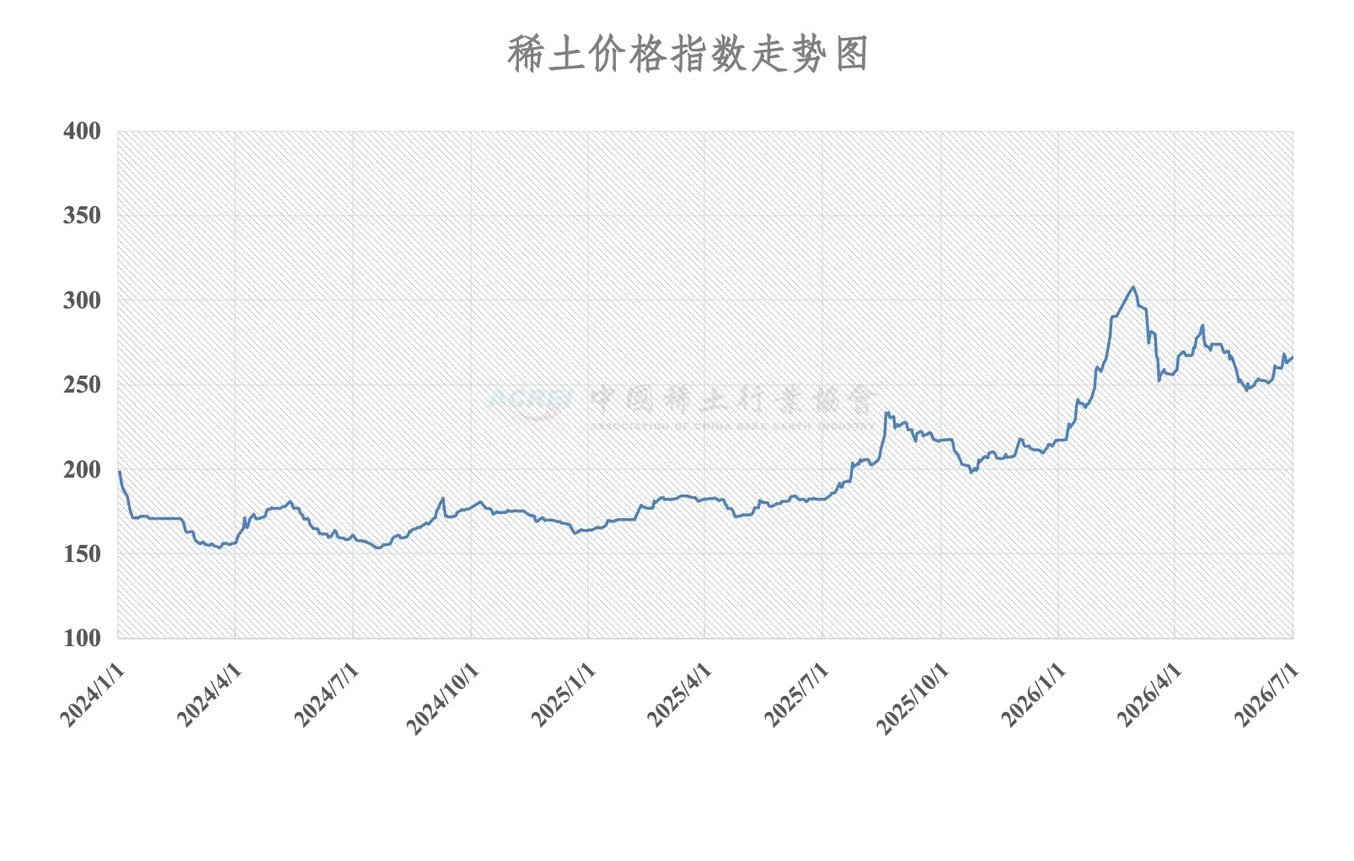
- China's Rare Earth Price Index reached 266.0 on July 1, 2026, with price stress concentrating in magnet and specialty inputs like NdPr, dysprosium, terbium, and samarium rather than broad inflation.
- Western rare earth price assessments from Argus, Platts, Fastmarkets, and Benchmark Mineral Intelligence face structural questions about how few transactions actually underpin each monthly price assessment.
- Outside China, heavy rare earths like dysprosium and terbium are not merely expensive—some buyers report difficulty sourcing qualified material at any price, making availability the dominant variable.
- Government-backed price floors, such as the US DoD's $110/kg NdPr minimum with MP Materials, are strategic contractual mechanisms and should not be mistaken for free-market equilibrium prices.
China Rare Earth Industry Association reported its Rare Earth Price Index at 266.0 on July 1, 2026, using 2010 as the base year of 100. The accompanying table, “Prices of Major Rare Earth Products,” shows most quoted materials flat, but several strategic inputs rising: samarium oxide, samarium metal, NdPr oxide, NdPr alloy, and medium-yttrium europium-rich ore.
That mix matters. The signal is not broad inflation. It is stress concentrating around magnet and specialty inputs.
The Numbers That Matter
At the requested conversion rate of ¥1 = US$0.15, China’s reported reference prices translate as follows:
- Dysprosium oxide: ¥1,390–1,430/kg, or US$208.50–214.50/kg.
- Terbium oxide: ¥6,435–6,495/kg, or US$965.25–974.25/kg.
- NdPr oxide: ¥733.9–753.9/kg, or US$110.09–113.09/kg.
- NdPr alloy: ¥896.5–916.5/kg, or US$134.48–137.48/kg.
- Yttrium oxide: ¥53.6–57.6/kg, or US$8.04–8.64/kg.
- Medium-yttrium europium-rich ore: ¥242–252/kg, or US$36.30–37.80/kg.
Why This Is News
No breakthrough is reported. The news value is the pressure pattern. China’s official index remains elevated while the West still lacks dependable access to heavy rare earth oxides and metals. For U.S. and allied buyers, dysprosium, terbium, yttrium, samarium, and heavy rare earth metals are not merely expensive. In some cases, they are scarce, delayed, restricted, or unavailable. That reaches directly into defense systems, drones, EV motors, wind turbines, sensors, precision electronics, and high-temperature magnets.
Buyer Beware: Neither China Nor the West Has a Perfect Price
China publishes domestic reference prices through the China Rare Earth Industry Association, but these should not be confused with free-market price discovery. China's rare earth industry operates under production quotas, export licensing, state-owned enterprises, industrial policy, and national security priorities. Prices emerge within a highly managed ecosystem rather than an open commodity exchange.
Ironically, the opposite problem exists outside China. The Western market is substantially freer—but far thinner.
Today, only a modest share of global rare earth separation occurs outside China, and even less heavy rare earth refining is available commercially. Transactions are nearly always negotiated privately between producers, traders, magnet manufacturers, OEMs, and governments. Nearly all contracts remain confidential, incorporate volume commitments, qualification requirements, freight, financing, strategic premiums, minimum-price provisions, and other bespoke commercial terms.
An ever growing number of companies across the supply chain become Rare Earth Exchanges® community members. Our mission—lower the friction to commence in these nascent early days of re-industrialization of these critical supply chains ex-China.
As a result, there is still no equivalent of an LME copper contract or CME gold future for rare earths. There is no deep, continuously traded market capable of establishing universally accepted spot prices.
Are Western Price Indices Measuring a Market—or Building One?
That raises important questions for every pricing agency—including Argus, S&P Global Commodity Insights (Platts), Fastmarkets, and Benchmark Mineral Intelligence—as each has recently expanded ex-China rare earth price assessments.
The questions are not about integrity. They are about market structure.
- How many physical transactions actually underpin each monthly assessment?
- What percentage represents producer sales versus trader indications?
- How many transactions involve strategic government-supported projects rather than purely commercial trades?
- Are prices based primarily on spot cargoes, term contracts, or negotiated indications?
- How are non-price commercial terms—credit, minimum volumes, financing, qualification costs, delivery obligations, and geopolitical risk—normalized into a single published number?
- When only a handful of transactions occur globally in a month, can any assessment truly represent "the market"?
These questions become even more important for heavy rare earths. Outside China, dysprosium, terbium, yttrium, holmium, and other heavy rare earth products may trade only sporadically. Some Western buyers report difficulty sourcing qualified material at any quoted price, suggesting that availability—not price alone—has become the dominant variable. Recent alternative-supply-chain assessments themselves reflect exceptionally large premiums for heavy rare earths outside China, underscoring how supply security has become embedded in pricing.
Price Floors Are Not Market Prices
Recent government-supported transactions illustrate another complication. The U.S. Department of Defense partnership with MP Materials established a US$110/kg minimum price for NdPr oxide within that specific commercial framework. Likewise, reported strategic agreements involving Serra Verde and downstream partners include heavy rare earth pricing floors that are substantially above Chinese domestic quotations.
These arrangements are economically important because they reduce investment risk and support financing. They should not, however, automatically be interpreted as industry-wide spot prices or equilibrium market values. They are negotiated contractual mechanisms designed to achieve strategic supply-chain objectives, not necessarily to reveal where a competitive global market would clear.
Disclaimer: This news item originates from the China Rare Earth Industry Association, part of China’s state-directed rare earth ecosystem. Figures should be independently verified before commercial reliance.


0 Comments
Discuss this article