
Highlights
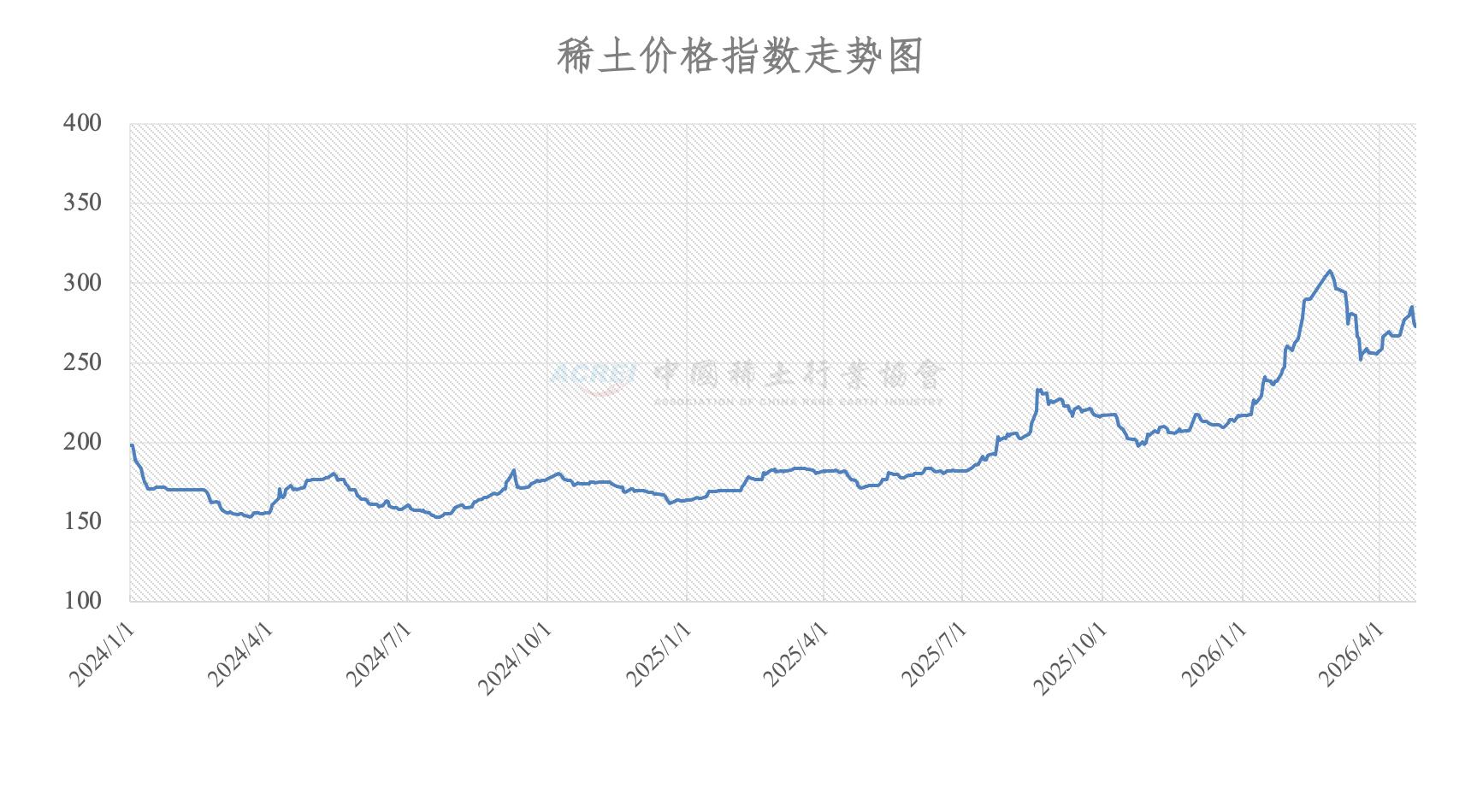
- China's rare earth price index stood at 272.8 on April 24, 2026—elevated from the 2010 base of 100 but down from early 2026 peaks above 300, reflecting a tight yet managed market rather than uniform breakout.
- Light rare earth products remained flat while critical magnet materials like neodymium, dysprosium, and terbium declined, signaling selective weakness within an otherwise elevated pricing system.
- China's pricing remains opaque and policy-driven through state controls, quotas, and export restrictions, while the ex-China market lacks mature price discovery due to insufficient Western processing capacity.
China’s rare earth price index stood at 272.8 on April 24, 2026, according to the China Rare Earth Industry Association. That is elevated by historical standards, using 2010 as the base year of 100, but it is not a straight-line surge. The chart shows the index climbing sharply into early 2026, peaking above 300, then pulling back before recovering into the high 270s. The correct read: China’s rare earth market remains tight and strategically important, but the latest data show a mixed, managed market—not a uniform price breakout.
The Daily Price Sheet: Strength at the Index Level, Weakness in Heavies
The product table shows many light rare earth products were flat, including lanthanum oxide, cerium oxide, PrNd carbonate, PrNd oxide, praseodymium oxide, and praseodymium metal. But several higher-value magnet and heavy rare-earth materials moved lower, including neodymium oxide, neodymium metal, dysprosium oxide, dysprosium metal, terbium oxide, terbium metal, gadolinium oxide, samarium products, erbium oxide, and mixed rare-earth concentrates.
That matters. The index is rising overall, but several critical inputs tied to magnets and high-performance applications were marked down on the day. This suggests selective softness within a still-elevated system.
Why China’s Prices Are Not “True Market Prices”
China’s pricing of rare earths is not a clear free-market signal. The sector is shaped by state-owned enterprises, production quotas, export controls, environmental inspections, strategic stockpiling, licensing rules, and periodic policy intervention. The index is built from domestic transaction data collected from Chinese rare-earth enterprises. It is useful—but it reflects a state-influenced domestic ecosystem rather than a transparent global exchange price.
Why the Ex-China Market Is Still Forming
Outside China, there is no mature, liquid, standardized rare earth price discovery system. Western buyers often rely on individually negotiated contracts, private offtake agreements, confidential pricing formulas, and China-referenced benchmarks. More importantly, the West still lacks sufficient control over separation, refining, and magnet-making capacity. Until ex-China processing scales, “Western pricing” will remain fragmented, bespoke, and dependent on China’s shadow.
Bottom Line: Track the Chain, Not Just the Ticker
The business signal is clear: rare earth pricing remains elevated, opaque, and policy-sensitive. The April 24 index does not show panic—but it does show that China still sits at the center of price formation.
Disclaimer
This item is based on data published by the China Rare Earth Industry Association, a state-affiliated industry body. The information should be independently verified before use for business or investment purposes.


0 Comments
No replies yet
Loading new replies...
Moderator
Join the full discussion at the Rare Earth Exchanges Forum →