
Highlights
- China's Rare Earth Price Index climbed to 271.9 on July 8, 2026, continuing a gradual recovery that began in late 2025.
- Heavy rare earths including dysprosium and terbium held at historically elevated prices, reflecting structural supply tightness rather than short-term volatility.
- Gadolinium, holmium, neodymium oxide, and praseodymium-neodymium products posted upward price movements on the day.
- Western manufacturers continue to face severe difficulty sourcing heavy rare earth oxides, metals, and alloys in commercial volumes with reliable delivery.
- Only an estimated 10% of global rare earth separation capacity exists outside China, leaving ex-China pricing dependent on confidential bilateral contracts.
China's Rare Earth Industry Association (CREIA) reported its Rare Earth Price Index increased to 271.9 on July 8, 2026, extending the gradual recovery that began in late 2025. Using CREIA's methodology—where the average transaction prices during 2010 equal an index value of 100—the index remains well above historical averages despite retreating from the sharp peak reached earlier this year.
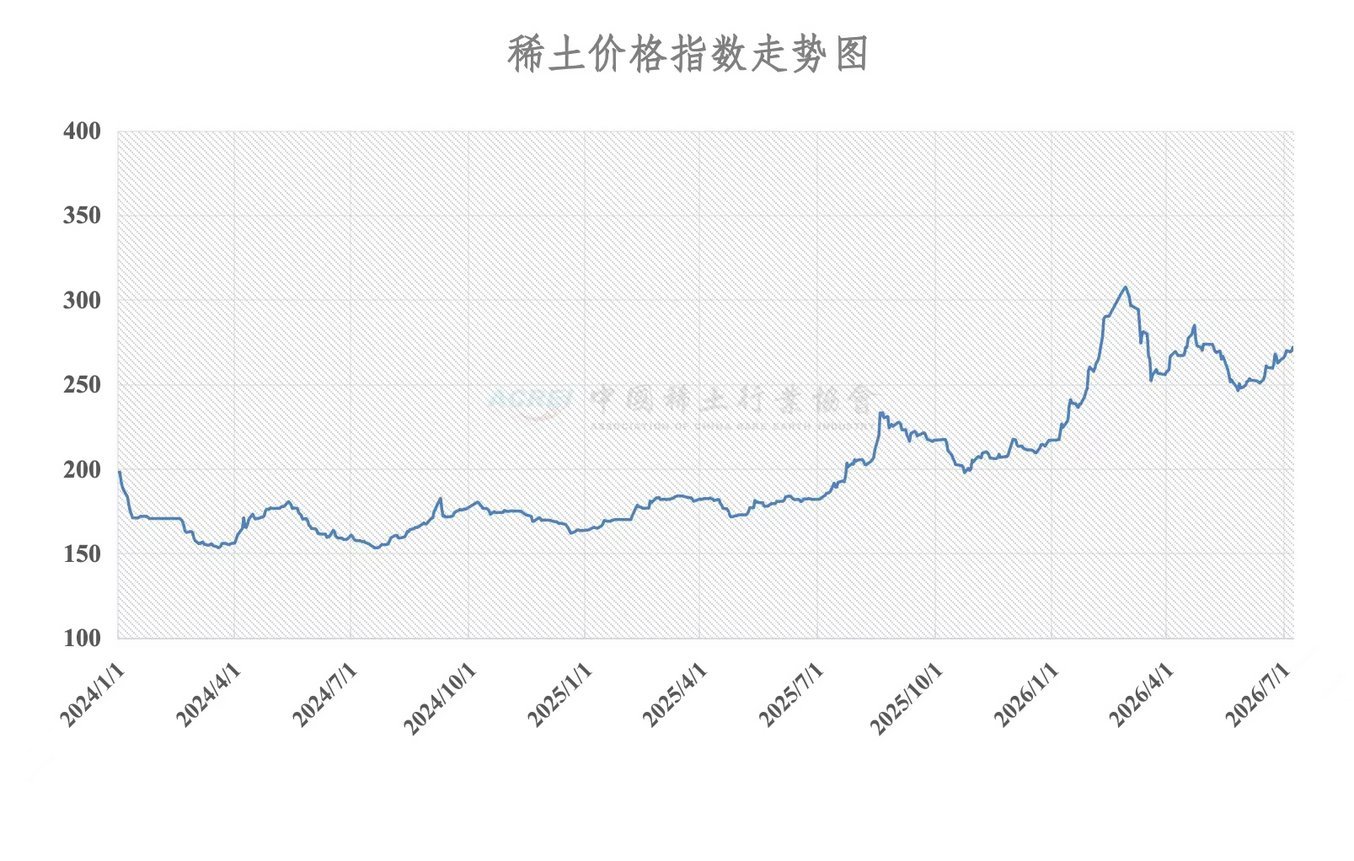
According to CREIA, the index is calculated using average daily transaction data reported by domestic Chinese rare earth enterprises. The association notes the prices are for reference only and should not be interpreted as investment advice.
Heavy Rare Earths Continue to Lead the Market
The July 8 pricing update shows continued strength in heavy rare earth products while most light rare earths were unchanged or modestly higher. Using the requested conversion rate of 1 Chinese yuan (RMB) = US$0.15, key domestic Chinese reference prices are:
| Product | China Price (RMB/kg) | Approx. US$/kg | Daily Trend |
|---|---|---|---|
| Dysprosium Oxide | 1,395–1,435 | $209.25–$215.25 | Flat |
| Dysprosium Metal | 1,765–1,785 | $264.75–$267.75 | Flat |
| Terbium Oxide | 5,000–5,200 | $750.00–$780.00 | Flat |
| Gadolinium Oxide | 213–233 | $31.95–$34.95 | ↑ |
| Holmium Oxide | 559.3–579.3 | $83.90–$86.90 | ↑ |
| Yttrium Oxide | 53.6–57.6 | $8.04–$8.64 | Flat |
| Neodymium Oxide | 475.3–495.3 | $71.30–$74.30 | ↑ |
| Praseodymium-Neodymium Oxide (75% Nd₂O₃) | 753.7–773.7 | $113.06–$116.06 | ↑ |
| Praseodymium-Neodymium Alloy | 919.5–939.5 | $137.93–$140.93 | ↑ |
Among the strongest performers were gadolinium, holmium, neodymium oxide, Pr-Nd oxide, Pr-Nd alloy, and several associated ferro-alloys. Meanwhile, dysprosium and terbium remained steady at historically elevated levels, reflecting continued structural tightness rather than short-term volatility.
The Real Story Is Availability, Not Just Price
For Western manufacturers, the headline is not simply today's prices—it is the continuing scarcity of heavy rare earth materials outside China.
Despite multiple government-backed initiatives in the United States, Europe, Australia, Japan, and elsewhere, commercial supplies of separated heavy rare earth oxides, metals, alloys, and permanent magnet feedstocks remain extremely limited. Buyers continue to report difficulty sourcing dysprosium, terbium, holmium, and at times even yttrium, particularly in commercial volumes with reliable delivery schedules.
The result is that supply security—not posted prices—remains the principal challenge confronting defense contractors, electric vehicle manufacturers, robotics companies, aerospace suppliers, and advanced manufacturers across the West.
China's Prices Are Policy Signals, Not Pure Market Discovery
Rare Earth Exchanges® continues to caution readers that China's published domestic prices should not be interpreted as equivalent to transparent commodity market pricing.
China's rare earth market functions within a hybrid socialist-capitalist system characterized by:
- State production quotas
- Export licensing and controls
- Strategic stockpiles
- National industrial policy
- Communist Party directives
- National security priorities
Consequently, Chinese domestic prices are better viewed as policy-influenced domestic reference prices than as prices established through unrestricted supply-and-demand dynamics.
The situation outside China is also far from a conventional free market. Only an estimated 10% of global rare earth separation capacity exists outside China, leaving ex-China pricing largely dependent on confidential bilateral contracts negotiated over-the-counter. Every agreement varies based on purity specifications, delivery timing, financing terms, processing requirements, strategic relationships, and volume commitments.
Rare Earth Exchanges has previously examined the limitations of so-called ex-China price reporting, noting that many pricing agencies rely on relatively small samples gathered from traders and intermediaries, creating the potential for significant bias. Corporate buyers should therefore exercise caution when treating published assessments as definitive market prices.
Likewise, benchmark transactions—including the U.S. Department of Defense-supported US$110/kg NdPr price floor associated with MP Materials and the approximately US$2,050/kg heavy rare earth price floor negotiated in Serra Verde financing—represent highly specific commercial arrangements rather than industry-wide pricing standards.
Bottom Line
CREIA's July 8 update reinforces an increasingly familiar reality: China's domestic rare earth market remains firm, heavy rare earth supply continues to tighten, and transparent price discovery outside China remains elusive. Until meaningful Western separation, metalmaking, alloy production, and permanent magnet manufacturing reach commercial scale, access to heavy rare earth materials—not simply published prices—will remain one of the defining strategic constraints facing Western industry.
Source Disclaimer: This market update originates from the China Rare Earth Industry Association (CREIA), an industry organization operating within China's state-directed rare earth sector. CREIA states that the published prices are provided for reference only and do not constitute investment advice. As with any information originating from state-affiliated Chinese institutions, the data should be independently verified and evaluated alongside broader commercial intelligence and market conditions.
Register today: REEx Marketplace™ (opens in a new tab)


0 Comments
No replies yet
Loading new replies...
Moderator
Join the full discussion at the Rare Earth Exchanges Forum →