
Highlights
- China's Rare Earth Price Index rose to 273.52 on July 20, continuing a year-long climb from roughly 200, with heavy rare earths showing the strongest structural tightness.
- China's published rare earth prices are reference values from a policy-managed system—not transparent exchange-traded benchmarks comparable to copper or gold.
- Outside China, roughly 90% of global rare earth separation remains in Chinese hands, leaving ex-China buyers reliant on confidential bilateral OTC contracts with no universal spot market.
- Physical availability—not posted prices—has become the primary constraint for buyers of dysprosium, terbium, holmium, lutetium, and other heavy rare earths outside China.
- Investors should focus on who controls separation capacity, metal production, alloy manufacturing, and magnet fabrication rather than daily price fluctuations.
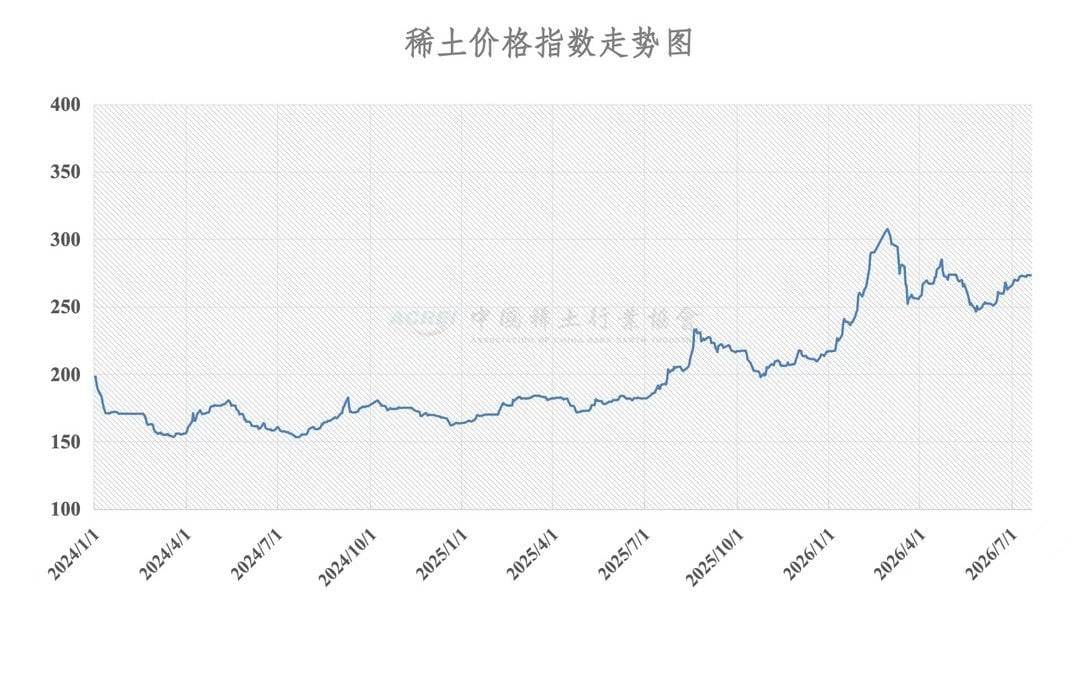
China's Rare Earth Price Index rose to 273.52 on July 20, continuing its gradual advance from roughly 200 one year ago. The index is calculated using transaction data submitted by Chinese rare earth enterprises, benchmarked against average trading activity during 2010. For investors, however, the index itself is only part of the story.
Heavy Rare Earths Continue to Defy Gravity
Most benchmark products were unchanged, but several heavy rare earth products continued to strengthen.
Among the notable prices:
- NdPr oxide: 754.8–774.8 yuan/kg (approximately US$114.40–117.40/kg) ▼
- NdPr alloy: 917.8–937.8 yuan/kg (approximately US$139.10–142.10/kg) ▼
- Dysprosium oxide: 1,405–1,445 yuan/kg (approximately US$212.90–219.00/kg) —
- Terbium oxide: 5,000–5,200 yuan/kg (approximately US$757.60–787.90/kg) —
- Holmium oxide: 621.7–641.7 yuan/kg (approximately US$94.20–97.20/kg) ▲
- Lutetium oxide: 593.1–613.1 yuan/kg (approximately US$89.90–92.90/kg) ▲
The day-to-day movements were modest, yet they reinforce a broader trend: heavy rare earths remain structurally tighter than light rare earths, reflecting persistent supply constraints and strategic demand.
China's Published Prices Are Reference Prices—Not a Fully Transparent Commodity Market
Investors should avoid treating China's published prices as equivalent to exchange-traded commodities such as copper or gold. China's rare earth industry operates within a policy-driven framework shaped by production quotas, mining controls, export licensing, state-owned enterprises, industrial planning, and broader national security priorities. The resulting prices provide an important domestic reference, but they are formed within a managed industrial system rather than through fully transparent global market competition.
Even the China Rare Earth Industry Association (CREIA) states that its published prices are collected from participating enterprises for reference purposes only and should not be interpreted as investment advice.
Outside China, Price Discovery Remains Immature
The situation outside China is different—but not necessarily more transparent.
China still performs roughly 90% of global rare earth separation, leaving only a limited volume of refined material available through ex-China supply chains. Most transactions occur through confidential bilateral contracts that include unique specifications for purity, delivery schedules, qualification status, logistics, and technical support.
As a result, there is no universally accepted spot market.
Price-reporting agencies typically construct assessments using surveys of traders and market participants. While valuable, those assessments represent sampled market observations rather than comprehensive transaction databases. Depending on the underlying respondents, reported prices may differ materially from actual commercial agreements.
Rare Earth Exchanges® has previously examined these dynamics through analyses of the U.S. Department of Defense's approximately US$110/kg NdPr floor price established in its MP Materials agreement, reported pricing mechanisms associated with Serra Verde's heavy rare earth production, and the inherent limitations of survey-based price reporting. Those agreements provide useful reference points but should not be interpreted as universal market benchmarks.
The REEx Investment View
The most important development is not today's price movement but the continued fragmentation of the global rare earth market. Outside China, buyers of dysprosium, terbium, yttrium, holmium, lutetium, and other heavy rare earths increasingly confront a market where physical availability—not posted prices—has become the primary constraint. In some cases, commercial quantities remain difficult to procure regardless of price. As we have covered, a network of traders and brokers supports this market.
Investors should understand that some price-reporting agencies may at times offer solid market intelligence—but they do not observe a deep, transparent exchange where every rare earth transaction occurs. Outside China, only a small fraction of global rare earth oxides, metals, and alloys are produced, and most transactions are negotiated privately through bespoke over-the-counter (OTC) contracts. Pricing often depends on product purity, qualification status, delivery schedules, volume commitments, payment terms, logistics, and strategic relationships. Because many commercial agreements remain confidential, pricing agencies must construct assessments from surveys, reported transactions, trader submissions, and market participants willing to share information. Those assessments may be useful reference points, but they should not be mistaken for universally accepted market-clearing prices like those found in exchange-traded commodities such as copper or gold. In today's ex-China rare earth market, every contract can be different, making supply security and qualification just as important as the quoted price.
As the Great Powers Era 2.0™ accelerates, investors should focus less on daily price fluctuations and more on who controls separation capacity, metal production, alloy manufacturing, magnet fabrication, and qualification. Those industrial bottlenecks—not today's published quotations—will increasingly determine pricing power, corporate competitiveness, and national strategic advantage.
Note: This report is based on pricing published by the China Rare Earth Industry Association (CREIA), a state-supervised Chinese industry association. The prices represent reference values from China's domestic rare earth market and should be independently verified. They should not be interpreted as transparent global market-clearing prices or as investment recommendations.


0 Comments
No replies yet
Loading new replies...
Moderator
Join the full discussion at the Rare Earth Exchanges Forum →