
Highlights
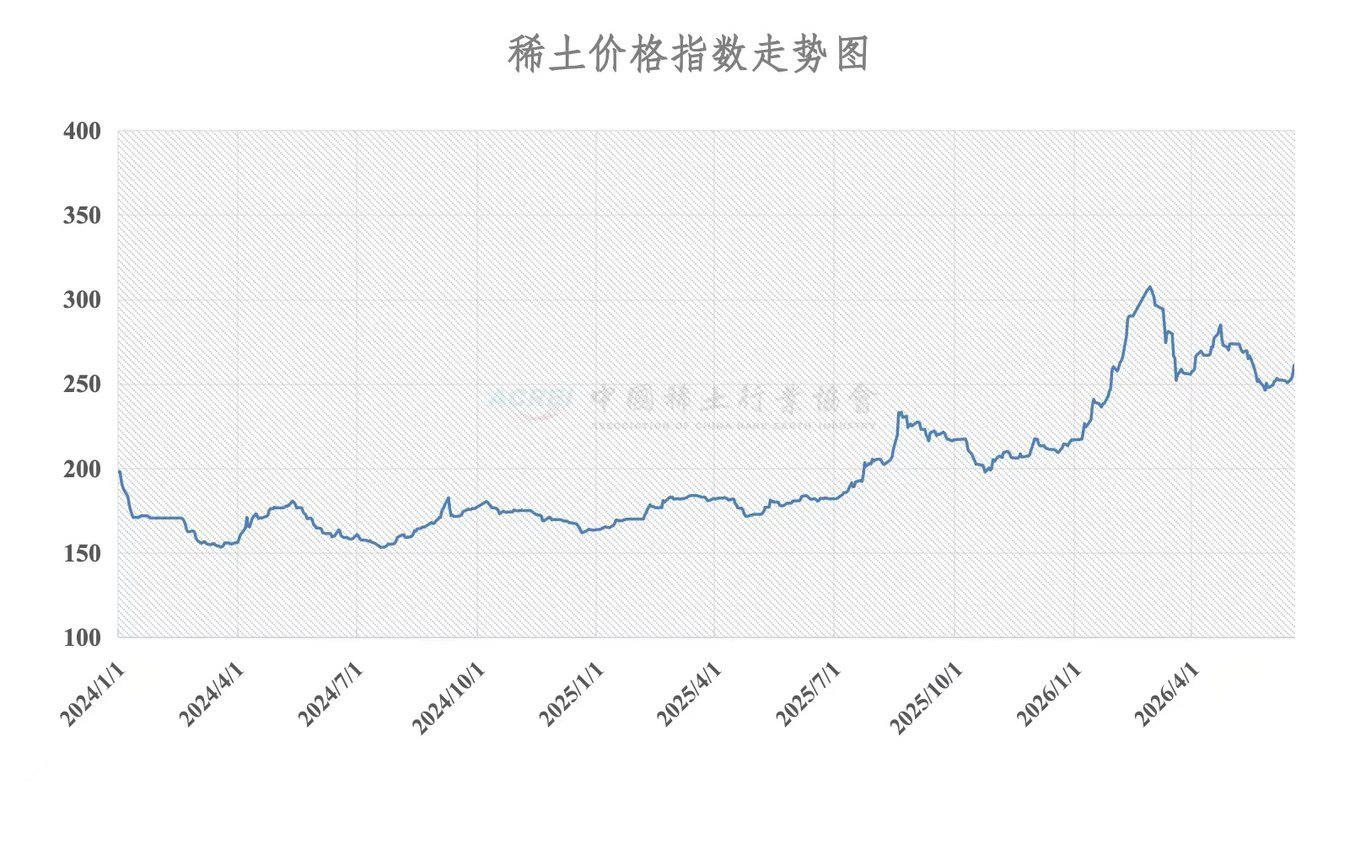
- China's Rare Earth Price Index reached 260.9, up roughly 65% from early-2024 lows, driven by demand for magnet materials used in EVs, defense, and humanoid robotics.
- Heavy rare earths like Terbium Oxide ($750–780/kg) and Lutetium Oxide ($960–969/kg) posted continued gains, reflecting strategic premium valuations.
- Outside China, no transparent global rare earth exchange exists—prices are negotiated through confidential bilateral deals, making true price discovery fragmented and unreliable.
- The U.S. government's $110/kg NdPr floor price agreement with MP Materials is emerging as a potential industry benchmark, though its broader adoption remains uncertain.
- China's control of 85–90% of global separation capacity gives Beijing the theoretical ability to suppress prices and undermine ex-China supply chain economics if it chooses.
China's Rare Earth Industry Association reported that its Rare Earth Price Index reached 260.9 on June 17, 2026, extending a powerful recovery that began in 2024. Using 2010 as a base year of 100, the index has risen roughly 65% from its early-2024 lows and remains near multi-year highs. The strongest gains continue to come from materials tied directly to high-performance magnets, defense applications, electric vehicles, data centers, and increasingly, humanoid robotics.
Magnet Materials Lead the Market
Among the most strategically important products:
- NdPr Oxide: ¥711.9–731.9/kg ($106.79–109.79/kg)
- NdPr Metal Alloy: ¥869.1–889.1/kg ($130.37–133.37/kg)
- Dysprosium Oxide: ¥1,400–1,440/kg ($210–216/kg)
- Terbium Oxide: ¥5,000–5,200/kg ($750–780/kg)
- Holmium Oxide: ¥549.2–569.2/kg ($82–85/kg)
- Lutetium Oxide: ¥6,400–6,460/kg ($960–969/kg)
Most heavy rare earth products posted gains on the day, reinforcing evidence of continued strength in strategically important magnet materials.
Understanding China's Price Signals
Investors should view Chinese rare earth prices as market-based reference prices operating within a heavily managed industrial system.
Production quotas, mining controls, export licensing requirements, state-owned enterprises, industrial policy objectives, and national security considerations all influence market outcomes. Consequently, Chinese prices reflect both commercial activity and strategic policy priorities.
The China Rare Earth Industry Association itself notes that its index is derived from transaction data collected from domestic enterprises and is intended as an industry reference rather than an investment benchmark.
The Ex-China Pricing Challenge
The situation outside China is arguably even more opaque. China still accounts for approximately 85–90% of global rare earth separation capacity and roughly 90% of rare earth magnet manufacturing. As a result, ex-China transactions remain relatively limited and are typically negotiated through confidential bilateral agreements with bespoke commercial terms.
Unlike copper, gold, or oil, there is no globally transparent rare earth exchange generating continuous spot-market price discovery. Published assessments often rely on limited transaction data, trader surveys, and voluntary market reporting. Buyer beware: two companies purchasing the same rare earth material may pay materially different prices depending on volume, specifications, logistics, financing arrangements, and strategic relationships.
The MP Materials Effect
A further complication emerged with the U.S. government's recent agreement with MP Materials, which established a $110/kg NdPr floor price for covered volumes under that specific arrangement. Many market participants view this as an emerging benchmark. Whether it becomes a broader industry reference point remains uncertain, but many in the industry seem to believe so.
Bottom Line
The June 17 data reinforce a clear trend: strategic magnet materials remain firm, with heavy rare earths continuing to attract premium valuations. Yet investors should resist the temptation to view either Chinese domestic prices or ex-China published assessments as definitive spot-market benchmarks.
Rare earths remain one of the world's least transparent critical mineral markets. China's prices reflect a hybrid system of commercial activity and state direction. Outside China, price discovery remains fragmented, confidential, and still in its formative stages. Understanding the market requires looking beyond the quoted price—and understanding the structure that produces it.
A Risk Few Want to Discuss
There is another risk investors should keep in mind. China's dominance in rare earth separation, refining, and magnet production gives Beijing substantial influence over market pricing should it choose to exercise it. In theory, a significant release of rare earth oxides, metals, or magnet materials into the domestic or export market could place considerable downward pressure on prices and severely challenge the economics of many emerging ex-China projects. Given that many Western rare earth ventures already operate with thin margins, depend on government support, or are still attempting to reach commercial scale, a prolonged price war could delay or derail portions of the industry's current resilience and diversification agenda. We believe such a strategy is unlikely in the near term, particularly as China increasingly views rare earths as strategic assets rather than commodities. Nonetheless, it would be negligent not to acknowledge the possibility. Investors evaluating ex-China supply chains must recognize that market fundamentals are influenced not only by geology, technology, and demand growth, but also by the actions of the one nation that still controls most of the world's rare earth processing capacity and magnet manufacturing infrastructure. Say if President Trump cuts a strategic deal with China that loosens up rare earths, this could have unintentional ripple effects.
Disclaimer: This report is based on pricing information published by the China Rare Earth Industry Association. The information reflects domestic Chinese market conditions and should be independently verified. It does not constitute investment advice.
Register for REEx Marketplace™: https://marketplace.rareearthexchanges.com (opens in a new tab)


0 Comments
No replies yet
Loading new replies...
Moderator
Join the full discussion at the Rare Earth Exchanges Forum →