
Highlights
- China's Rare Earth Price Index reached 253.3 on June 4, 2026, with heavy rare earths like dysprosium and terbium posting gains while NdPr products weakened.
- Dysprosium metal prices reached up to ¥7,590/kg (~$1,139/kg) in China, with ex-China prices potentially several times higher due to severe supply constraints.
- Only about 10% of global rare earth separation occurs outside China, leaving Western nations heavily dependent on Chinese supply for critical defense and EV magnet materials.
- A US government agreement with MP Materials established a $110/kg NdPr floor price, signaling growing policy intervention in rare earth market pricing.
- Chinese rare earth prices reflect state-influenced market conditions including production quotas, export licensing, and strategic stockpiling rather than free-market equilibrium.
China's Rare Earth Industry Association (CREIA) reported a Rare Earth Price Index reading of 253.3 on June 4, 2026, indicating that domestic Chinese rare earth prices remain substantially above the 2010 base period of 100. More important than the index itself, several strategically important heavy rare earth products—including dysprosium, terbium, holmium, and gadolinium-containing materials—posted gains, while benchmark neodymium-praseodymium (NdPr) products weakened modestly. The data suggest continued tightness in heavy rare earth supply despite softness in portions of the light rare earth market.
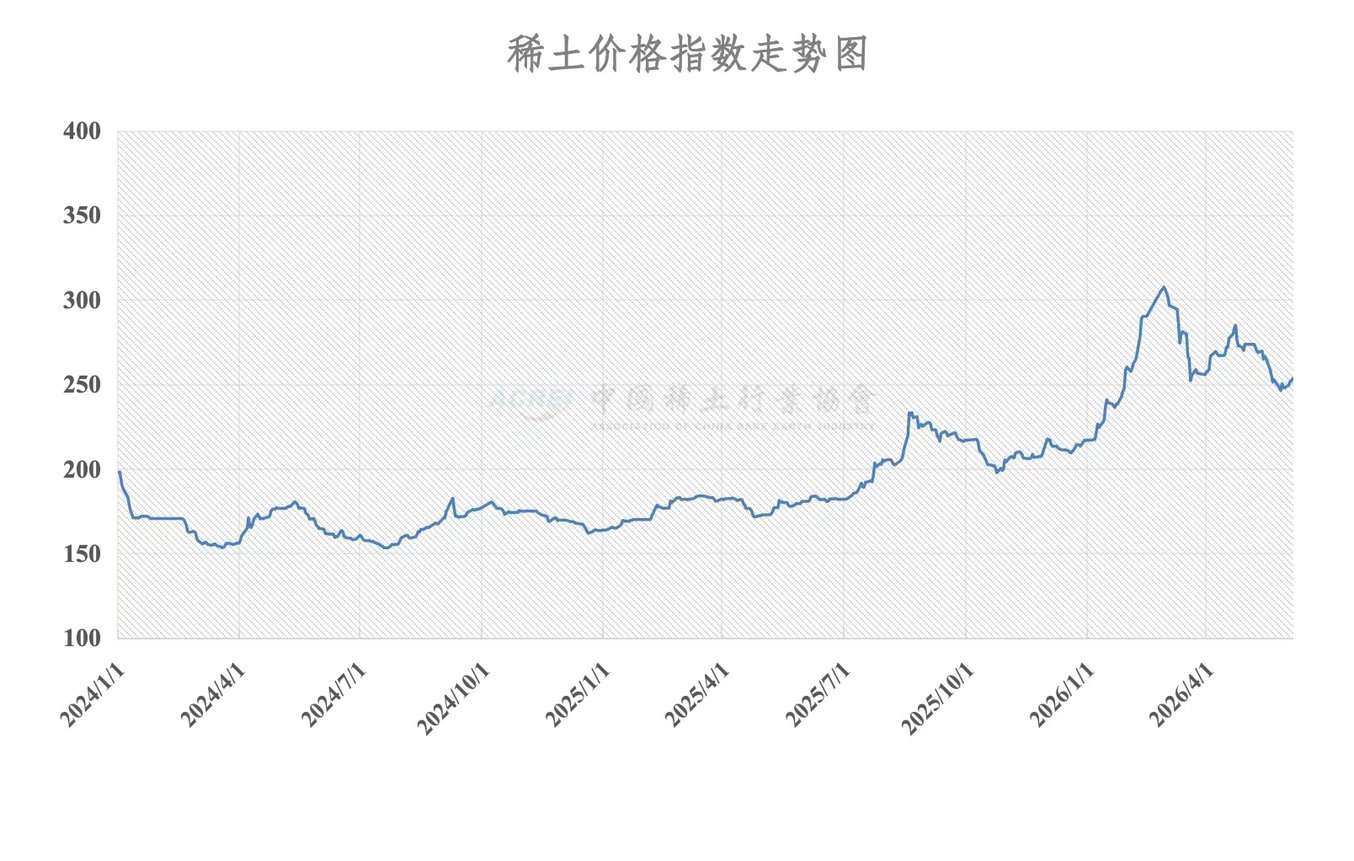
A Tale of Two Rare Earth Markets
The headline number—253.3—shows China's rare earth pricing remains elevated compared with historical norms. However, the composition of that pricing matters. The most important products for defense, aerospace, robotics, electric vehicles, and advanced electronics are not cerium or lanthanum. They are heavy rare earths such as dysprosium and terbium, which remain essential for manufacturing high-performance permanent magnets capable of operating at elevated temperatures.
According to CREIA's June 4 pricing data:
- Dysprosium Oxide: ¥6,095–6,155/kg (US$914–923/kg)
- Dysprosium Metal: ¥7,490–7,590/kg (US$1,124–1,139/kg)
- Terbium Oxide: ¥5,000–5,200/kg (US$750–780/kg)
- Holmium Oxide: ¥526.7–546.7/kg (US$79–82/kg)
All were reported as higher on the day.
Meanwhile, China's benchmark magnet feedstocks softened:
- NdPr Oxide: ¥688.9–708.9/kg (US$103–106/kg)
- NdPr Metal: ¥841.1–861.1/kg (US$126–129/kg)
Both were reported lower.
Why Western Investors Should Be Careful With These Prices
The Chinese prices should not be interpreted as pure market-discovery prices in the way investors think about copper, gold, or oil.
China's rare earth market operates within a system influenced by production quotas, state-owned enterprises, industrial policy objectives, export licensing controls, strategic stockpiling programs, environmental mandates, and national security considerations. As a result, published Chinese prices reflect actual domestic transactions but not necessarily a fully free-market equilibrium. And of course this market becomes more decoupled from the “ex-China” nascent market.
The situation outside China is not much clearer.
Only about 10% of global rare earth separation currently occurs outside China. Most non-Chinese transactions remain bilateral agreements with confidential pricing formulas, volume commitments, quality specifications, and strategic supply provisions. True spot-market liquidity remains extremely limited. Adding further complexity, the U.S. government's recent agreement with MP Materials established a US$110/kg floor price for NdPr, creating a policy-driven benchmark that some market participants believe could influence future negotiations. Whether that floor ultimately becomes an industry-wide reference point remains uncertain. Note that heavy rare earth element pricing can be several times that of the price in China in the West. In some cases, such as Samarium and Yttrium, the products become harder to come by outside of China. Now China policies make it harder for traders to access product.
The Real Story
The most important takeaway is not the daily index movement. It is the continued strength of heavy rare earth pricing.
Heavy rare earths remain the most difficult segment of the global supply chain for Western nations to replicate. While significant investments are flowing into mines, separation plants, metals facilities, and magnet manufacturing outside China, meaningful alternative supplies of dysprosium and terbium remain limited.
For investors, that reality—not the daily price index—is the signal worth watching.
Source Note: This information originates from the China Rare Earth Industry Association (CREIA), an industry body operating within China's rare earth sector. The association itself notes that the prices are collected from industry participants and are intended as reference information only, not investment advice. Investors should independently verify all market data and consider broader geopolitical, regulatory, and supply-chain factors when evaluating rare earth markets.


0 Comments
No replies yet
Loading new replies...
Moderator
Join the full discussion at the Rare Earth Exchanges Forum →