
Highlights
- China's Rare Earth Price Index reached 255.3 on May 19, 2026, reflecting a 155% increase from its 2010 baseline, though this pricing emerges from a state-managed industrial ecosystem rather than a conventional commodity market.
- Heavy rare earths remain historically elevated with Terbium Oxide at ~$906,750–$915,750/ton and Dysprosium Oxide at ~$189,750–$195,750/ton, while NdPr oxide trades around $105,165–$108,165/ton.
- China controls 85–90% of global rare earth separation and refining capacity, meaning Western markets still lack the independent industrial infrastructure needed for robust price discovery and strategic leverage.
China’s official rare earth pricing apparatus moved higher again on May 19, 2026, with the China Rare Earth Industry Association (CREIA) reporting a Rare Earth Price Index of 255.3, up dramatically from its 2010 baseline of 100.
The index is calculated using daily transaction data submitted by domestic Chinese rare earth enterprises and benchmarked against 2010 full-year trading activity. On paper, the message appears straightforward: rare earth pricing remains historically elevated. But for Western investors and policymakers, the more important story is what this index actually represents—and what it does not.
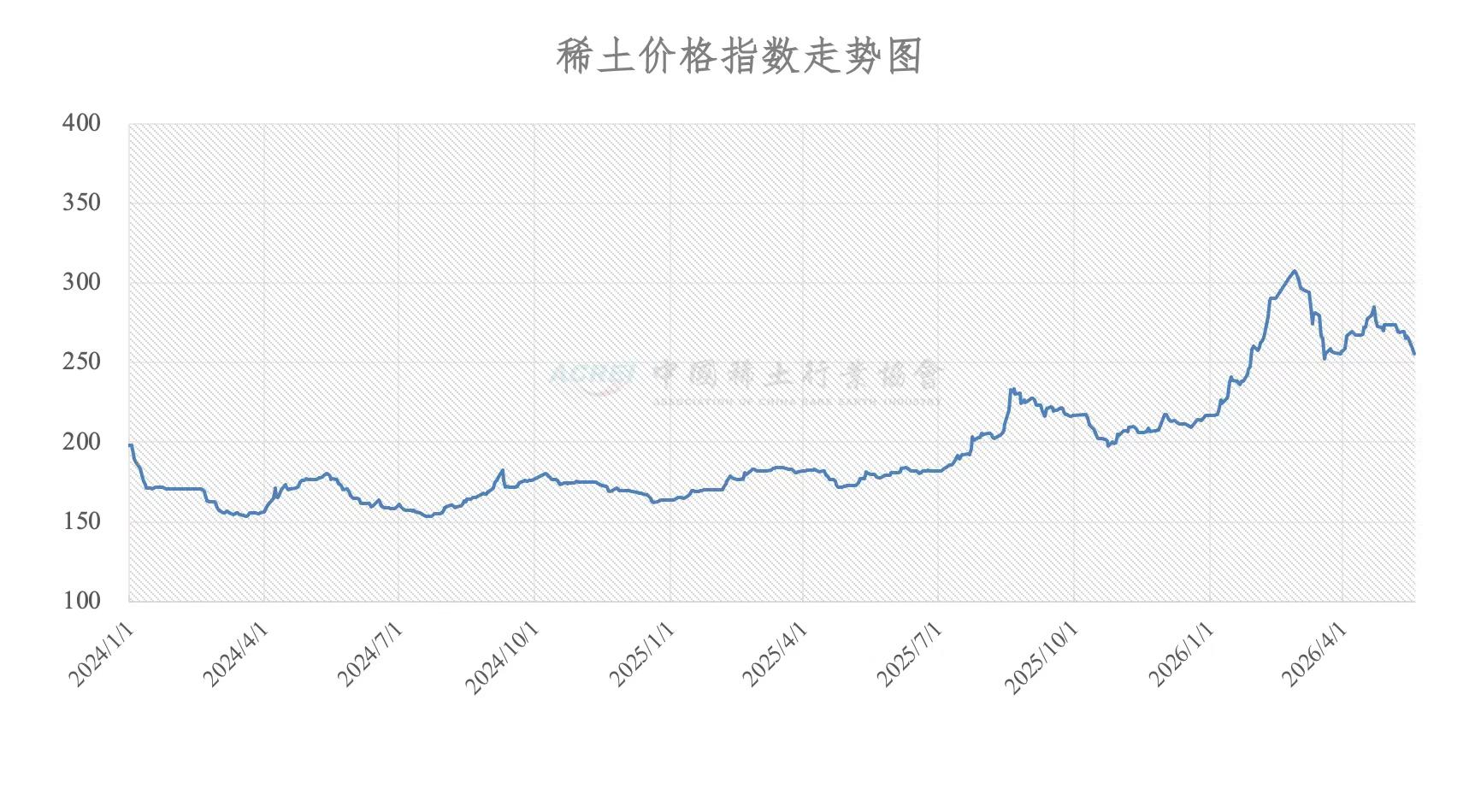
China’s Rare Earth “Market” Is Not a Conventional Commodity Market
Rare-earth pricing within China is deeply intertwined with state industrial policy, mining quotas, export licensing, environmental crackdowns, strategic stockpiling, and national security priorities. These prices emerge from a highly managed industrial ecosystem shaped by quotas, licensing controls, state-backed consolidation, environmental enforcement campaigns, and strategic national objectives—not from a fully liberalized commodity market.
China’s domestic pricing system often operates more like an industrial coordination mechanism within a vertically integrated national supply chain than a speculative Western spot market.
At the same time, the emerging “ex-China” market remains structurally immature. Roughly 85–90% of global rare earth separation and refining capacity still resides inside China, meaning only a thin layer of product trades outside Beijing’s industrial orbit.
Most ex-China transactions remain confidential bilateral agreements with bespoke terms involving purity specifications, delivery schedules, strategic partnerships, tolling arrangements, downstream qualification requirements, and geopolitical considerations. Pricing agencies, therefore, capture only partial snapshots of a fragmented and opaque market.
One widely discussed benchmark in Western markets remains the approximate $110/kg NdPr pricing floor associated with the U.S.-supported MP Materials arrangement. However, Rare Earth Exchanges™ continues to caution that many investors may incorrectly assume this reflects a universal Western market floor across all NdPr transactions.
That assumption remains far from proven.
Heavy Rare Earth Pricing Remains Historically Elevated
Several heavy rare earth categories softened modestly on the day, though pricing remains extraordinarily high by historical standards.
Key China domestic reference prices released on May 19 included:
- Dysprosium Oxide: ¥1.265–1.305 million/ton (~$189,750–$195,750 USD/ton) ↓
- Terbium Oxide: ¥6.045–6.105 million/ton (~$906,750–$915,750 USD/ton) ↓
- Praseodymium-Neodymium Oxide (NdPr): ¥701,100–721,100/ton (~$105,165–$108,165 USD/ton) ↓
- Praseodymium-Neodymium Metal: ¥868,500–888,500/ton (~$130,275–$133,275 USD/ton) ↓
- Gadolinium Oxide: ¥167,000–187,000/ton (~$25,050–$28,050 USD/ton) →
(USD conversions estimated using ¥1 = $0.15 USD.)
The Real Signal for America and Europe
The most important takeaway is not today’s incremental pricing movement. It is China’s continued dominance over the industrial architecture that determines global rare-earth pricing: separation, refining, metallization, alloying, and magnet manufacturing. The West still lacks sufficiently liquid, transparent downstream trade flows to establish robust independent price discovery mechanisms.
Until America and its allies solve that structural industrial problem, pricing power—and strategic leverage—will likely remain concentrated in Beijing, though nascent industrial policy will continue to foster an emerging ex-China market.
Disclaimer: This information originates from the Chinese Rare Earth Industry Association, an industry body operating within China’s state-directed industrial system. The reported pricing data should be independently verified. CREIA itself states the information is for industry reference purposes only and does not constitute investment advice.


0 Comments
No replies yet
Loading new replies...
Moderator
Join the full discussion at the Rare Earth Exchanges Forum →